Aristotle was born in 384 BCE in Stagira, a small town in northern Greece. His father, Nicomachus, was physician to the Macedonian king Amyntas III — a connection that would shape Aristotle’s life. Around the age of seventeen he went to Athens and joined Plato’s Academy, where he stayed for roughly twenty years, until Plato’s death around 347 BCE. He was by all accounts Plato’s most brilliant student, and eventually his most important critic.
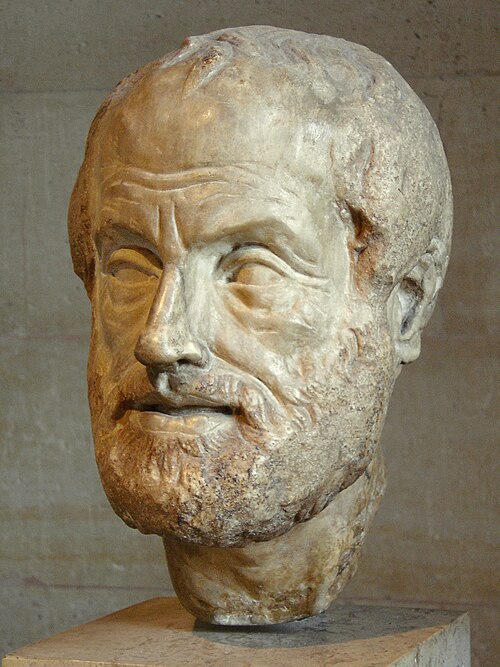 Eric Gaba, CC BY-SA 2.5
After leaving Athens, Aristotle spent several years in Asia Minor and on the island of Lesbos, where — with his student Theophrastus — he carried out detailed studies of marine animals that make him one of the founders of biology. Around 343 BCE King Philip II of Macedon invited him to tutor his teenage son, the future Alexander the Great. How much the pupil absorbed is debated; Alexander went on to conquer an empire, while Aristotle went back to building one of ideas.
In 335 BCE Aristotle returned to Athens and founded his own school, the Lyceum. His followers became known as “Peripatetics”, probably after the covered walkway (peripatos) where they met. The surviving works — mostly lecture notes rather than polished books — range across logic, physics, metaphysics, biology, ethics, politics, rhetoric and poetry. After Alexander died in 323 BCE, anti-Macedonian feeling in Athens put Aristotle in danger; an ancient anecdote has him leaving so that Athens would not “sin twice against philosophy”, a pointed reference to Socrates. He died the following year in Chalcis.
In the Nicomachean Ethics Aristotle argues that the goal of human life is eudaimonia — flourishing, or living well — and that we reach it through virtue. Each virtue is a mean between two extremes: courage sits between cowardice and recklessness, generosity between stinginess and extravagance. Virtue is built by habit, the way a musician is made by playing, and guided by phronesis, practical wisdom. In the Politics he adds that humans are by nature “political animals”, who can only flourish in community.
Where Plato placed the Forms in a separate realm, Aristotle insisted that form exists in things themselves, and that to understand anything you must ask four questions about it — what it is made of, what it is, what made it, and what it is for (his “four causes”). He invented formal logic with the syllogism, which dominated Western reasoning for two thousand years. Medieval scholars such as Ibn Rushd (Averroes) and Thomas Aquinas so revered him that he was known simply as “the Philosopher.”
“We are what we repeatedly do. Excellence, then, is not an act, but a habit.” This is Will Durant summarising Aristotle in The Story of Philosophy (1926) — faithful to his ethics, but not his words.
Explore more about Aristotle on Wikipedia.