Confucianism grew from the teaching of Confucius (551–479 BCE), a teacher and would-be government adviser from the small state of Lu in eastern China. In Chinese it is called Rujia, “the school of the scholars”: Confucius saw himself not as the founder of something new but as a transmitter of the wisdom of earlier sage-kings. For over two thousand years it shaped government, education and family life in China, Korea, Japan and Vietnam.
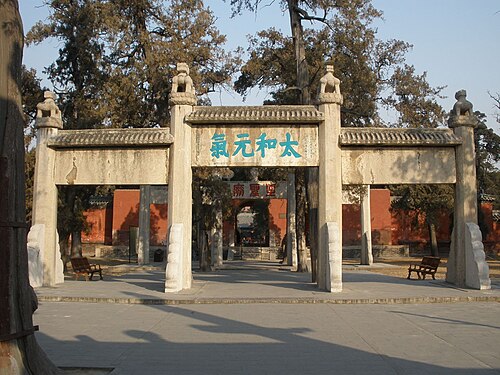 Acstar, CC BY-SA 3.0
“To master oneself and return to ritual propriety is humaneness.”Analects 12.1
“What you do not want done to yourself, do not do to others.”Analects 15.23
 Illustration: ritual, music and learning — the heart of Confucian education
Confucius’s two great successors disagreed about human nature. Mencius (c. 372–289 BCE) argued that people are naturally good: everyone has “sprouts” of compassion, shame, respect and moral sense that need only to be nourished. Xunzi (c. 310–235 BCE) answered that human nature is crooked, and goodness has to be shaped by teachers, ritual and law, as wood is straightened by steam. The argument has run through Chinese thought ever since.
Under the Han dynasty Confucianism became the official teaching of the state; an imperial academy for Confucian learning was founded in 124 BCE. Centuries later the scholar Zhu Xi (1130–1200) built a grand synthesis, Neo-Confucianism, and grouped the Analects, the Mencius, the Great Learning and the Doctrine of the Mean as the Four Books. From 1313 until 1905 his commentaries were the basis of the imperial civil-service examinations, so every official in China was steeped in them.
In the 20th century Confucianism came under fierce attack: reformers of the May Fourth Movement (1919) blamed it for rigid hierarchy and the subordination of women, and during the Cultural Revolution a mass campaign denounced Confucius by name. Since the 1980s interest has returned, both in East Asia and among philosophers worldwide, who find in it a rich ethics of relationships, education and self-cultivation.
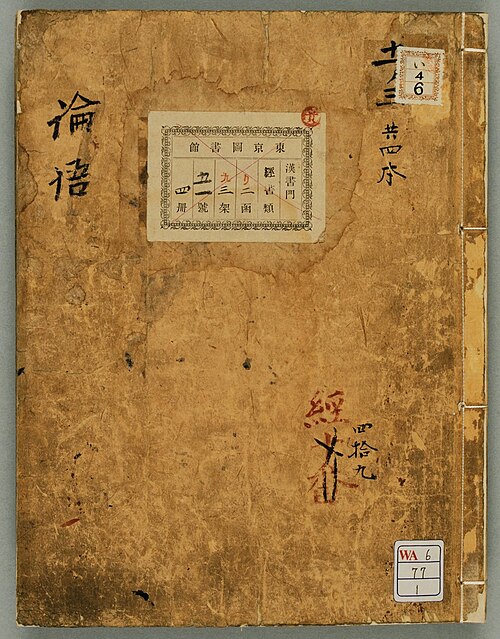 A historical printed commentary on the Analects — National Diet Library / World Digital Library, public domain
“The strength of a nation derives from the integrity of the home.” Widely quoted as Confucius, but not found in the Analects. The idea is closer to the Great Learning, which links an ordered state to ordered families.
Confucianism on Wikipedia · Stanford Encyclopedia: Confucius · The Analects · Confucius: quotes and lessons