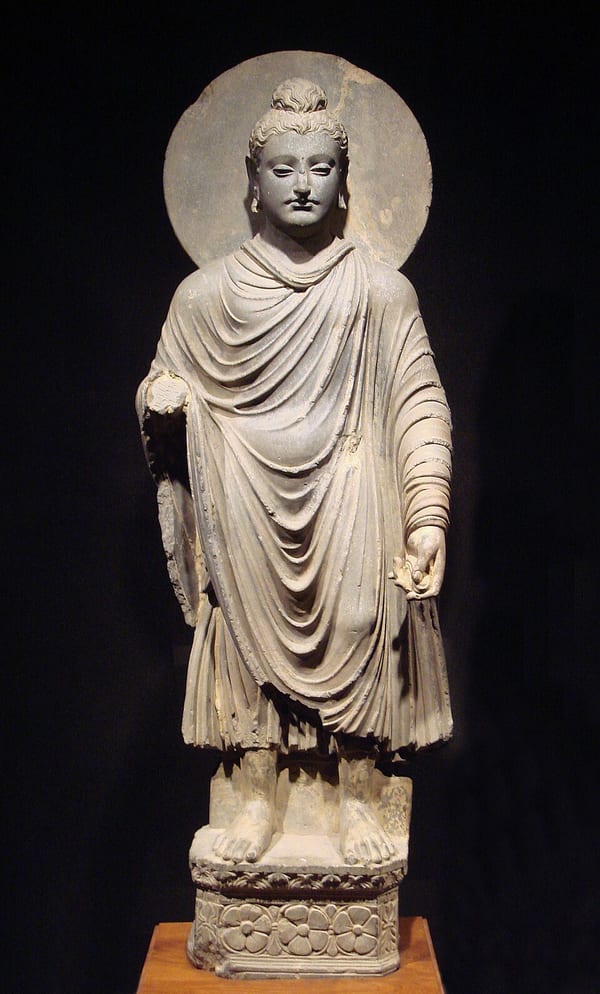
The Buddha wrote nothing himself. His teachings were passed down orally and first written in Pali, in Sri Lanka, around the 1st century BCE. That canon is enormous and few people read it, so almost any calm, wise-sounding sentence can be signed “Buddha” and nobody checks. Here are the most shared ones, what they really are, and what the early texts actually say.
Tags: Paraphrase a real teaching, reworded · Someone else written by a later author · No source found in no Buddhist text. More misattributed thinkers on Quotes They Never Said.
“Holding on to anger is like grasping a hot coal with the intent of throwing it at someone else; you are the one who gets burned.”
Someone else The image comes from Buddhaghosa, a commentator who wrote around 900 years after the Buddha. In his Path of Purification (Visuddhimagga IX), an angry person is like a man who picks up a burning ember, or excrement, to strike someone else, and soils or burns himself first. The smooth modern wording, put in the Buddha’s mouth, seems to come from Joan Borysenko’s 1987 book Minding the Body, Mending the Mind.
What the Buddha is recorded saying about hatred
“Hatred does not cease by hatred at any time: hatred ceases by love — this is an old rule.”Dhammapada 5 (tr. Max Müller)
“The mind is everything. What you think you become.”
Paraphrase Not found in any Buddhist text. It is often attached to a genuine line, “All that we are is the result of what we have thought”, which is how Max Müller’s Victorian translation opens the Dhammapada. The opening verses are about consequences: actions done with a corrupted mind bring suffering, and actions done with a clear mind bring happiness. “Think it and it will come true” is a much more modern idea.
The real verse
“All that we are is the result of what we have thought: it is founded on our thoughts, it is made up of our thoughts. If a man speaks or acts with an evil thought, pain follows him, as the wheel follows the foot of the ox that draws the carriage.”Dhammapada 1 (tr. Max Müller)
“You yourself, as much as anybody in the entire universe, deserve your love and affection.”
Someone else From the meditation teacher Sharon Salzberg’s book Lovingkindness (1995), as her own summary of a teaching. The early passage behind it actually points the other way: you love yourself, and that is exactly why you should not harm others.
The real passage
“Searching all directions with your awareness, you find no one dearer than yourself. In the same way, others are thickly dear to themselves. So you shouldn’t hurt others if you love yourself.”Udana 5.1 (tr. Thanissaro Bhikkhu)
“Do not dwell in the past, do not dream of the future, concentrate the mind on the present moment.”
Paraphrase A loose modern version of a real verse, but the original ends somewhere harder than calm: in urgency, because death may come tomorrow.
The real verse
“You shouldn’t chase after the past or place expectations on the future. What is past is left behind. The future is as yet unreached. … Ardently doing what should be done today, for — who knows? — tomorrow death.”Bhaddekaratta Sutta, Majjhima Nikaya 131 (tr. Thanissaro Bhikkhu)
“Three things cannot be long hidden: the sun, the moon, and the truth.”
Paraphrase Close to a real teaching, but reworded. In the original it is the Buddha’s own teaching, not truth in general, that shines like the sun and moon, and “long” is a later addition.
The real line
“Three things shine openly, not in secret: the moon, the sun, and the Dhamma.”Anguttara Nikaya 3.131
“Thousands of candles can be lighted from a single candle, and the life of the candle will not be shortened. Happiness never decreases by being shared.”
Paraphrase Heavily reworked from the Sutra of Forty-Two Sections, a Chinese Buddhist text of uncertain early date. There the image is a torch from which many people light their own, and the point is not sharing happiness but the merit of rejoicing when others follow the path.
“Peace comes from within. Do not seek it without.”
No source Not found in any Buddhist scripture. The sentiment is not un-Buddhist, but the sentence is a modern maxim. For a genuine line about the victory that matters most:
“If one man conquer in battle a thousand times thousand men, and if another conquer himself, he is the greatest of conquerors.”Dhammapada 103 (tr. Max Müller)
This page draws on the research of Bodhipaksa’s Fake Buddha Quotes and of Quote Investigator, checked against the translations cited. Spotted a mistake? Write to us.
The Dhammapada (Access to Insight) · SuttaCentral · Majjhima Nikaya 131 · The Buddha: life and ideas
