David Hume was born in Edinburgh in 1711. At twenty-eight he published A Treatise of Human Nature (1739–40), one of the great works of philosophy, which, as he put it in his short autobiography, “fell dead-born from the press”. His reputation as an unbeliever cost him university chairs at Edinburgh and Glasgow; fame came instead from his essays and his bestselling History of England. Witty and good-natured, he was among the best-loved people in Enlightenment Edinburgh and a close friend of Adam Smith. He died in 1776, calmly refusing to fear an afterlife he did not believe in.
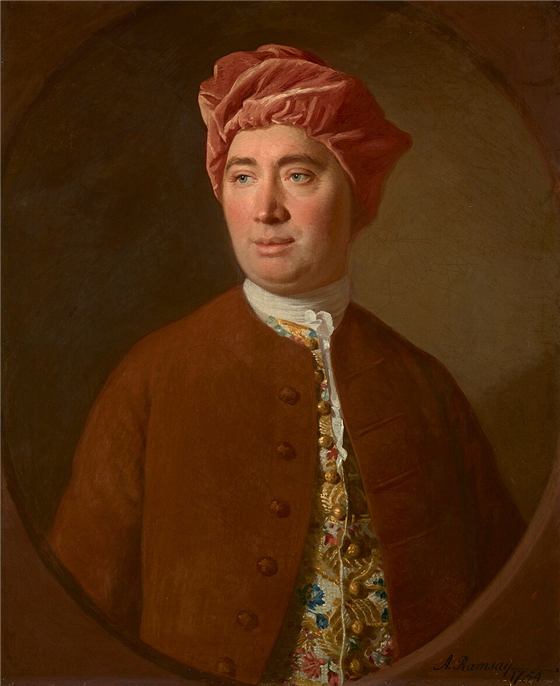 Allan Ramsay, 1754, public domain
Philosophers had long pictured reason as a charioteer controlling the horses of desire. Hume turned this upside down: reason can tell us how to get what we want, but it cannot tell us what to want.
“Reason is, and ought only to be the slave of the passions, and can never pretend to any other office than to serve and obey them.”A Treatise of Human Nature, Book II, Part III, Section 3
He also noticed that moral writers slide from describing how things are to declaring how they ought to be, without explaining the jump: the famous “is–ought” gap.
Why do we expect the sun to rise tomorrow? Because it always has. But that the future will resemble the past is not something logic can prove, and assuming it only begs the question. Our belief in cause and effect, Hume argued, rests on habit, not reason. Kant said that reading Hume woke him from his “dogmatic slumber”.
“A wise man, therefore, proportions his belief to the evidence.”An Enquiry Concerning Human Understanding, Section X
Looking inward for his “self”, Hume found only a stream of particular perceptions: heat, cold, love, hatred. The self, he concluded, is a bundle of perceptions in constant flux, a view strikingly close to the Buddhist teaching of non-self. He ended his Enquiry with a famous test for any book of abstract theology or metaphysics: does it contain reasoning about quantity, or about matters of fact based on experience? If not,
“Commit it then to the flames: for it can contain nothing but sophistry and illusion.”An Enquiry Concerning Human Understanding, Section XII
In Section X of the Enquiry, Hume asks when we should believe a report of a miracle. A miracle breaks a law of nature, and laws of nature are supported by the most uniform experience we have. So the testimony would have to be such that its falsehood would be even more miraculous than the event. Given how often people are mistaken, credulous or eager to believe, that standard is almost never met. Believers and sceptics still argue over this essay.
If reason cannot tell us what to want, where does morality come from? Hume’s answer is sympathy: our natural capacity to feel what others feel. We approve of traits that are useful or agreeable to their owner or to others, kindness, honesty, cheerfulness, and disapprove of the opposite. Adam Smith, his close friend, developed the idea in The Theory of Moral Sentiments. His Dialogues Concerning Natural Religion, published after his death in 1779, take apart the argument that the order of nature proves a designer.
Try it: pick a belief you hold strongly and give it a percentage. What evidence would move that number?
Three quick questions on David Hume. The wrong answers describe other thinkers on Darshniks.
Who was David Hume?
Which of these is David Hume's big idea?
What is David Hume best known for?
Hume on Wikipedia · A Treatise of Human Nature (Project Gutenberg) · Stanford Encyclopedia: Hume · Empiricism
