The I Ching (Yijing), the “Book of Changes”, is one of the oldest books in the world and among the most consulted. It began as a manual of divination in China’s Western Zhou dynasty, around 1000–750 BCE, and grew into a book of philosophy about how change works, studied for three thousand years by emperors, scholars, Taoists and Confucians alike.
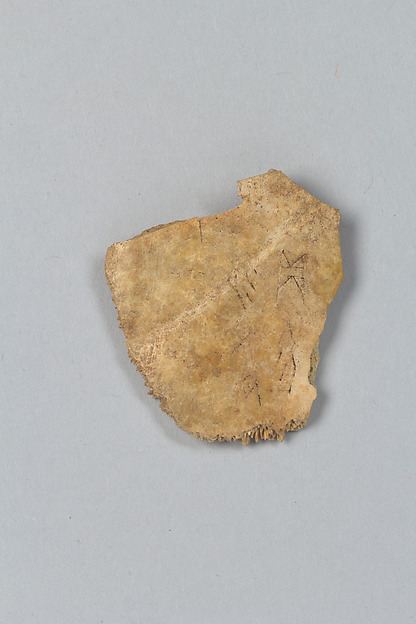 Oracle bone fragment, Shang dynasty, 13th–11th century BCE: divination in early China, from which the I Ching grew — The Metropolitan Museum of Art, public domain
The book is built from two kinds of line: a solid line (yang: firm, active, light) and a broken line (yin: yielding, receptive, dark). Stacked six at a time they make 64 hexagrams, each with a name, a short judgment and a comment on each of its six lines. Tradition credits King Wen with the judgments and his son, the Duke of Zhou, with the line texts. The first hexagram, six solid lines, is Qian, Heaven or the Creative:
“Khien (represents) what is great and originating, penetrating, advantageous, correct and firm.”Hexagram 1, Qian (tr. James Legge)
“Heaven in its motion (gives) the idea of strength. The superior man, in accordance with this, nerves himself to ceaseless activity.”Hexagram 1, the Image (tr. James Legge)
To consult it, a person asks a question and builds a hexagram by sorting yarrow stalks or tossing coins, then reads the text for the result. Lines that are “changing” turn into their opposites, giving a second hexagram: the situation and where it is heading.
Later commentaries, the “Ten Wings”, traditionally credited to Confucius, turned the book into philosophy. Their central idea is that reality is not a set of fixed things but a flow of alternating forces, each growing out of the other:
“The successive movement of the inactive and active operations constitutes what is called the course (of things).”The Great Appendix, Section I, chapter 5 (tr. James Legge)
Confucius himself is recorded as wishing for more time to study it:
“If some years were added to my life, I would give fifty to the study of the Yi, and then I might come to be without great faults.”Analects 7.16 (tr. James Legge)
Structure: 64 hexagrams of 6 lines each, with judgments, images, line texts and the Ten Wings commentaries
Influence: Taoism and Confucianism alike; in 1703 the German mathematician Leibniz saw his new binary arithmetic mirrored in the hexagrams, and in 1949 Carl Jung wrote a famous foreword to Richard Wilhelm’s translation
Related: Tao Te Ching, The Analects, Astrology & Divination
The traditional method uses fifty yarrow stalks, divided and counted in a slow ritual; a simpler method, used for many centuries, throws three coins six times. Each throw gives one line, built from the bottom up, and some lines come out as “changing”, turning into their opposites to give a second hexagram. The reader studies both: where the situation stands now, and where it is moving.
In 1703 the German philosopher Leibniz, who had invented binary arithmetic, was shown a diagram of the hexagrams by a Jesuit in China and saw in it the same pattern of 0s and 1s. In 1950 Carl Jung wrote the foreword to Richard Wilhelm’s English edition, using the book to illustrate his idea of synchronicity, and it became a Western bestseller.
Things people often get wrong: the I Ching was not originally a Confucian book; it began as a royal divination manual and was adopted by Confucians through the Ten Wings. As a fortune-telling device it has no evidence behind it, but as a prompt for thinking about change it has served readers for three thousand years.
I Ching on Wikipedia · Legge’s Yi King (Internet Archive) · Stanford Encyclopedia: Yijing · Tao Te Ching