Banner: Mirabai, painting by Raja Ravi Varma, before 1906 — an imagined likeness; no portrait from life survives.
Mirabai (Meera) was a 16th-century Rajput princess and poet-saint, devoted from childhood to Krishna. Most of her life story comes from devotional tradition rather than documents: she was born in the Rathore family of Merta in Rajasthan, perhaps around 1498, and married into the royal house of Mewar.
Widowed young, she refused to live as a royal widow was expected to. She sang and danced in temples with wandering holy men, and tradition tells of her in-laws trying to kill her — a cup of poison that turned to nectar, a snake that became a flower garland. She left for Vrindavan and later Dwarka, where, the legend says, she merged into the image of Krishna.
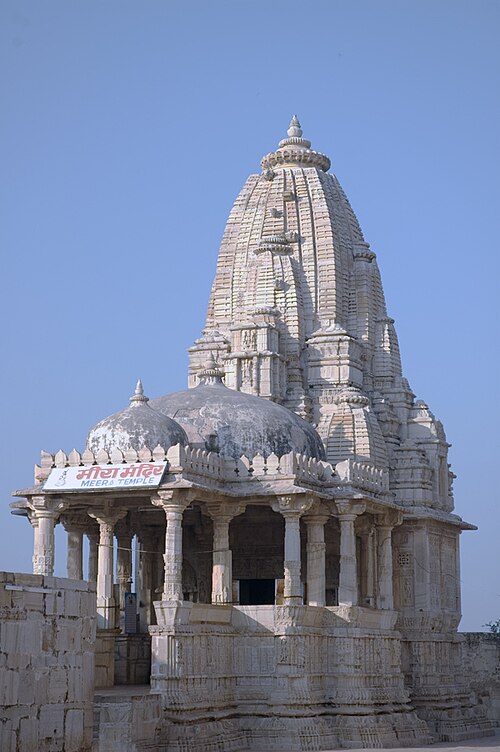 Koshy Koshy, CC BY 2.0
“For me there is Giridhar Gopal, and no other.”Opening line of one of Mira’s best-known songs (“Mere to Giridhar Gopal”)
Mira called Krishna Giridhar Gopal — the cowherd who lifted a mountain. She sang of him as her husband and beloved, and of herself as already married to him, so no earthly marriage could claim her.
Her songs (padas), in Rajasthani and Braj, are full of viraha — the ache of separation from the beloved — and of open defiance of family honour and public opinion. She chose devotion over rank, the company of saints over the palace. That is why her songs still feel bold: they put personal love of God above every social rule.
Thousands of songs are sung as Mira’s, but very few appear in early manuscripts, and scholars think most were composed later by singers in her tradition. That is how bhakti poetry lived: as a shared, sung tradition, not fixed texts.
Mira's songs are short and meant to be sung. Most are addressed to Krishna under names like Giridhar (“mountain-lifter”), Shyam (“the dark one”) or the Yogi who has gone away. She speaks as one of the gopis, the cowherd women of Krishna's youth: waiting through the rainy season for a beloved who does not come, dyeing her clothes the colour of devotion, dancing with ankle bells in front of the whole town.
 Illustration: the wandering singer’s one-stringed ektara
The feeling is personal rather than theological. There is little argument in Mira's poetry, and a great deal of longing, pride and defiance, which is why her songs travelled so easily from temples to village gatherings to film soundtracks.
Many of the songs sung as Mira's name Raidas (Ravidas) as her guru. Ravidas was a leatherworker from Varanasi, from a caste then treated as untouchable, and one of the most respected bhakti poets. Whether a Rajput princess really took him as her teacher is doubtful on grounds of dates and distance, but the tradition is telling: it puts a low-caste saint at the centre of a royal woman's devotion, an open challenge to the social order of the day.
The earliest written mention of Mira comes in Nabhadas's Bhaktamal (“Garland of Devotees”), compiled around 1600, which praises her fearlessness in a single short verse. A century later Priyadas's commentary on that book (1712) added the dramatic stories of poison and persecution that most people know today. Later still, plays, films and comic books shaped her into a national symbol.
 Illustration: the flute and peacock feather of Giridhar Gopal
Scholars have also traced a different Mira, remembered among poor and low-caste communities in Rajasthan and Gujarat. In Parita Mukta's study Upholding the Common Life (1994), she is less a princess-saint than a woman who walked out of a feudal household, and whose songs still give voice to people who defy those in power.
Mirabai is one of the best-loved figures of the bhakti movement. Mahatma Gandhi admired her as an example of nonviolent resistance, and the singer M. S. Subbulakshmi made her songs famous across India, starring as Meera in a 1945 film.