Nyaya (“method” or “rule”) is the darshana devoted to logic and the theory of knowledge. Its root text, the Nyaya Sutras, is attributed to the sage Gautama, also called Akshapada, and is usually dated somewhere between the 2nd century BCE and the 2nd century CE. A long line of commentators — Vatsyayana, Uddyotakara, Vachaspati Mishra and Udayana — built on it, and in the 14th century Gangesha’s Tattvacintamani launched Navya-Nyaya, the “new logic” whose precise technical language came to shape scholarly debate across India.
Its central question is one every school had to answer: how do we know anything at all?
“Perception, inference, comparison and testimony are the means of valid knowledge.”Nyaya Sutras 1.1.3
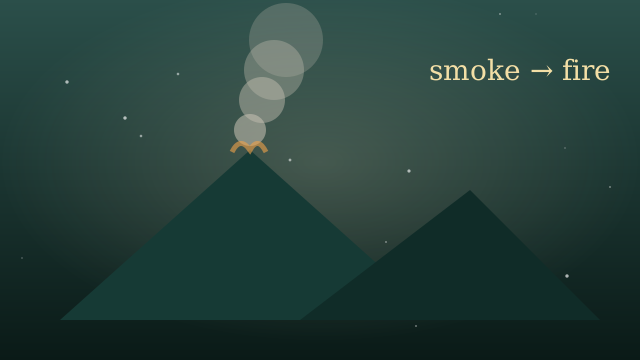 Illustration: smoke on the hill: we infer a fire we cannot see
Nyaya calls a reliable source of knowledge a pramana, and accepts four:
Much of the history of Indian philosophy is an argument about this list. The Carvakas accepted only perception; Buddhists and the Vaisheshikas accepted perception and inference; Mimamsa and Advaita Vedanta added more.
Nyaya’s model argument has five parts, and the classic example is a hill seen from a distance. The step that does the real work is the third: it states a general rule (fire always accompanies smoke) and anchors it in something everyone has seen. Nyaya called that invariable connection vyapti, and spent centuries cataloguing the ways an argument can fail — the “pseudo-reasons” (hetvabhasa) where the sign does not actually guarantee the conclusion.
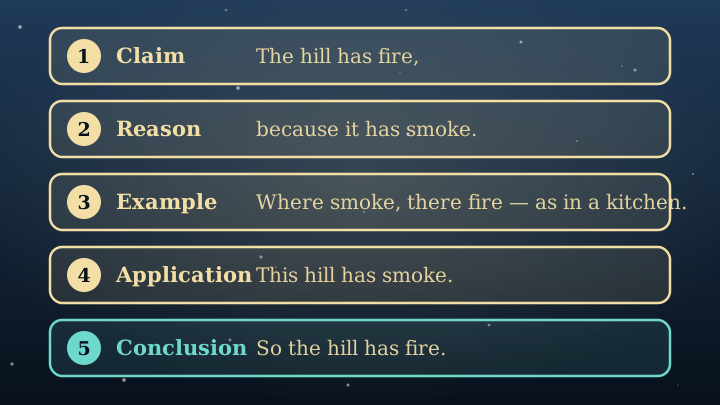 Illustration: the five-membered inference, with the stock example of smoke and fire
Nyaya was never logic for its own sake. The second sutra lays out a chain: false knowledge breeds faults like attachment and aversion; faults drive action; action leads to rebirth; rebirth brings suffering. Remove the first link and the rest fall away one by one. Clear thinking, in this view, is the way out of suffering, and the goal is apavarga — final release.
The self: Nyaya holds that there are many individual selves, each real and eternal. Consciousness is something a self has when joined to a body and mind, not its very nature — a position Vedanta sharply rejected.
God: Later Naiyayikas, above all Udayana in the 10th–11th century, developed some of India’s best-known arguments for a creator God (Ishvara), for example that the world is an effect and so needs an intelligent maker.
Nyaya eventually merged with its sister school, Vaisheshika, into a single system often called Nyaya-Vaisheshika: Vaisheshika supplied the picture of what exists, Nyaya the account of how we know it. Navya-Nyaya’s vocabulary became the shared toolkit of Indian scholastics, used even by grammarians and legal theorists who rejected its conclusions.
Nyaya on Wikipedia · The Nyaya Sutras on Wikipedia · Stanford Encyclopedia: Epistemology in Classical Indian Philosophy