Lucius Annaeus Seneca was born around 4 BCE in Corduba (modern Córdoba, Spain), the son of a wealthy rhetorician known as Seneca the Elder. Brought to Rome as a child, he trained in rhetoric and was drawn early to philosophy, studying with the Stoic teacher Attalus. He was sickly all his life — he wrote of bouts of breathlessness so severe he considered suicide, and stayed alive, he said, out of love for his father.
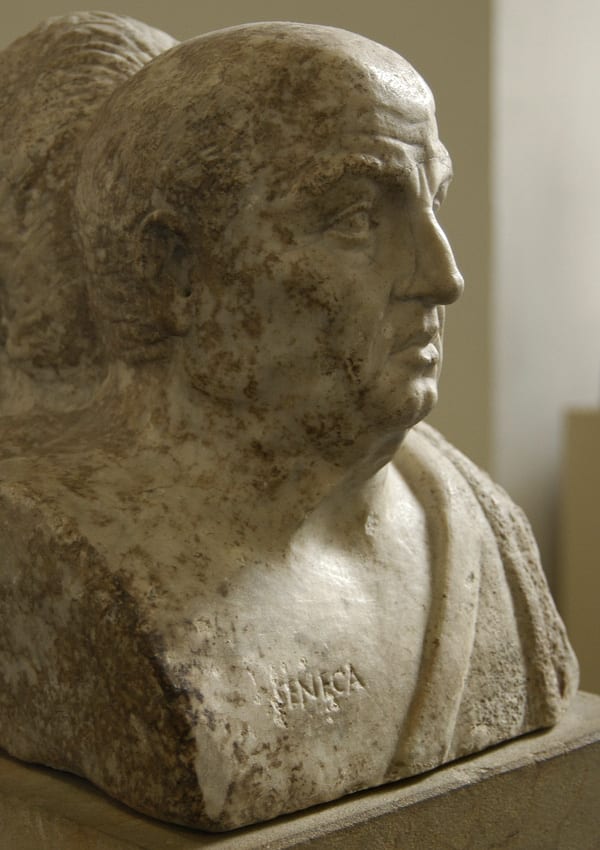 Roman double herm of Socrates and Seneca, Antikensammlung Berlin. Photo: Sergey Sosnovskiy, CC BY-SA 4.0 (source)
Seneca became a celebrated orator and senator, a success that made him enemies. In 41 CE the emperor Claudius exiled him to Corsica on a charge of adultery with the emperor’s niece Julia Livilla, an accusation most historians think was political. He spent eight years there. In 49 CE Claudius’ new wife, Agrippina, had him recalled to Rome for one purpose: to tutor her twelve-year-old son, Nero.
When Nero became emperor in 54 CE, Seneca and the prefect Burrus effectively steered the government, and Nero’s early reign was remembered as a good one. It also made Seneca one of the richest men in Rome — an uncomfortable fact for a philosopher who praised simple living, and one his critics never let him forget. As Nero grew more violent, Seneca was drawn into the regime’s crimes, including the cover-up after Nero had his own mother murdered in 59 CE. In 62 CE he withdrew from public life.
Seneca’s Stoicism is practical rather than technical: how to handle anger, grief, fear, money and time. His Letters to Lucilius, 124 letters written in retirement, are the most widely read; the essays include On the Shortness of Life, On Anger, On the Happy Life and On Tranquillity of Mind. He also wrote verse tragedies such as Medea and Thyestes. Again and again he returns to the same lessons: rehearse misfortune in advance so it cannot ambush you, examine yourself every evening, and stop living as if you had time to spare.
In 65 CE, after a failed plot to assassinate Nero, Seneca was accused of involvement — probably unjustly — and ordered to take his own life. The historian Tacitus describes the scene: he opened his veins, but being old and thin the blood flowed slowly, and death took a long and painful time, while he dictated to his secretaries and consoled his friends. His end became a model for how a Stoic should meet death, and his essays were read in the Middle Ages, the Renaissance and, once again, today.
Explore more about Seneca on Wikipedia.
