Stoicism began in Athens around 300 BCE, when Zeno of Citium started teaching in the Stoa Poikile, the “painted porch” on the edge of the marketplace — which is where the name comes from. It grew through three stages: the early Stoa of Zeno, Cleanthes and Chrysippus, whose many books are almost all lost; a middle period that carried it to Rome; and the Roman Stoics — Seneca, Epictetus and Marcus Aurelius — whose writings survive and are still read today.
Its promise is practical: a way to stay steady and good whatever life brings.
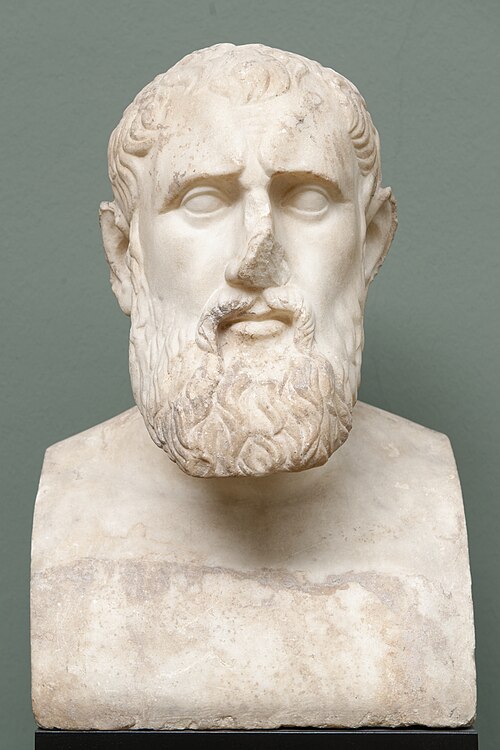 Marie-Lan Nguyen, CC BY 4.0
“Some things are up to us and some are not up to us.”Epictetus, Enchiridion 1
Everything in Stoicism starts here. Our judgments, intentions, desires and aversions are up to us. Our bodies, possessions, reputation and the actions of other people are not. Trouble comes from treating the second list as if it were the first — from staking our peace on things we cannot control.
“Men are disturbed not by things, but by the views which they take of things.”Epictetus, Enchiridion 5
An event arrives; then we add a judgment — “this is terrible” — and the judgment, not the event, is what upsets us. The good news is that judgments can be examined and changed.
For the Stoics, the only true good is virtue: excellence of character, usually described as four linked qualities — wisdom, courage, justice and moderation. Health, wealth and good reputation are “preferred indifferents”: sensible to pursue, but neither good nor bad in themselves, because they can be used well or badly. A happy life, eudaimonia, is simply a life lived in agreement with nature — which, for a human being, means in agreement with reason.
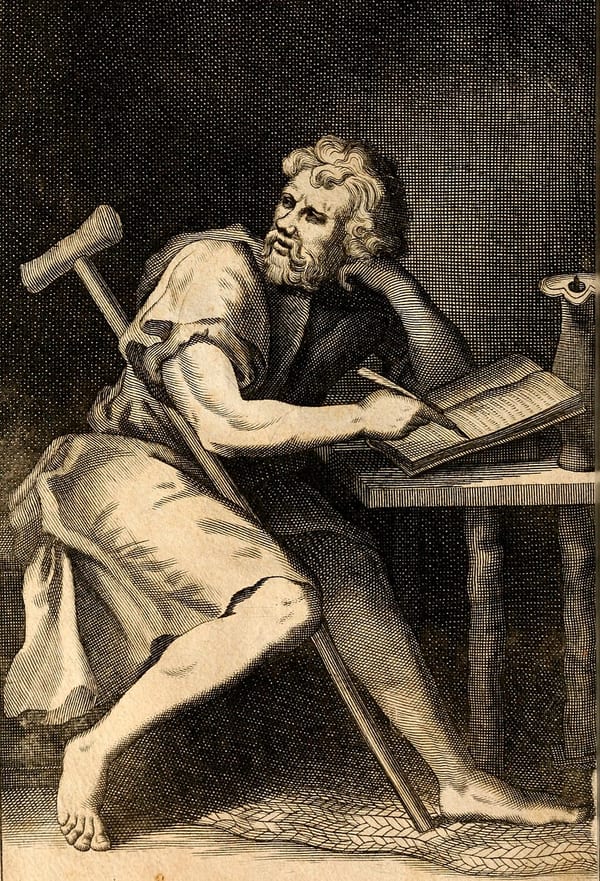 Epictetus, frontispiece to the Enchiridion (Oxford, 1715), public domain
The lowercase word “stoic” has come to mean unfeeling, but that is not what the philosophers taught. They aimed to be free of destructive passions — fear, distress, craving and wild elation — which they saw as the products of mistaken judgments. In their place they cultivated “good feelings”: joy, sensible caution and goodwill.
“If you are distressed by anything external, the pain is not due to the thing itself, but to your estimate of it; and this you have the power to revoke at any moment.”Marcus Aurelius, Meditations 8.47
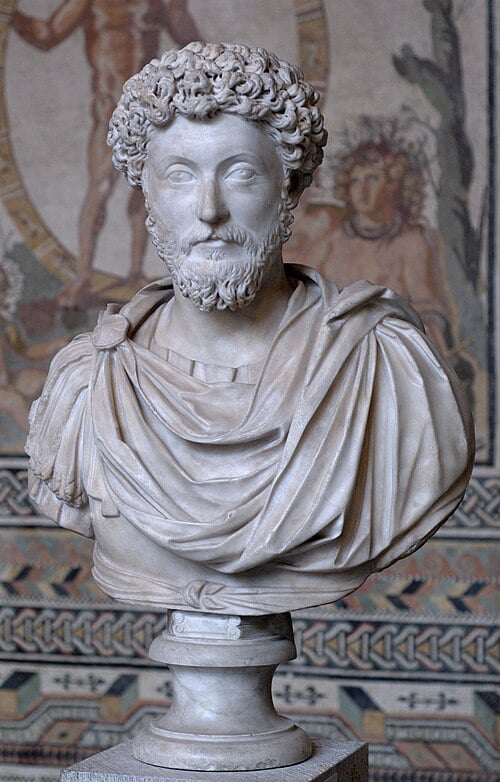 Marcus Aurelius, Roman marble bust, Glyptothek Munich — public domain
Seneca (c. 4 BCE–65 CE) was a statesman and adviser to Nero; his Letters to Lucilius are warm, practical and full of everyday examples. Epictetus (c. 50–135 CE) was born a slave; his pupil Arrian recorded his lectures as the Discourses and a short handbook, the Enchiridion. Marcus Aurelius (121–180 CE), emperor of Rome, wrote the Meditations as private notes to himself, never meant for publication.
“We suffer more often in imagination than in reality.”Seneca, Letters to Lucilius 13.4
When the psychologist Albert Ellis developed rational emotive behaviour therapy in the 1950s, he credited Epictetus; cognitive behavioural therapy shares the same core insight — that how we interpret events shapes how we feel about them. Stoicism has since seen a broad popular revival.
Two common misunderstandings: Stoicism is not about suppressing feeling, and it is not passive resignation. Seneca and Marcus Aurelius spent their lives in public office; the Stoics called themselves citizens of the whole world and argued for duties to all human beings.
“It's not what happens to you, but how you react to it that matters.” A modern paraphrase of Epictetus, not his words. The closest real line is Enchiridion 5, quoted above.
Stoicism on Wikipedia · Stanford Encyclopedia: Stoicism · Marcus Aurelius: quotes and lessons
