Vedanta means “the end of the Veda” — both its closing section, the Upanishads, and its culmination. As a school it rests on three foundations (the prasthana traya): the Upanishads, the Bhagavad Gita, and the Brahma Sutras of Badarayana, a terse summary of Upanishadic teaching whose date is uncertain. Every great Vedanta teacher proved himself by writing commentaries on these three.
“Now, therefore, the inquiry into Brahman.”Brahma Sutras 1.1.1
The opening deliberately echoes Mimamsa’s “inquiry into dharma”. Where Mimamsa asks what we must do, Vedanta asks what is: Brahman, the ultimate reality, and how it relates to the self (atman).
The Upanishads say both that the self is Brahman — tat tvam asi, “you are that” (Chandogya Upanishad 6.8.7) — and that Brahman is the inner ruler of a self that seems distinct from it. Vedanta’s schools differ in how they reconcile the two.
 Illustration: Shankara’s rope in the dusk, mistaken for a snake
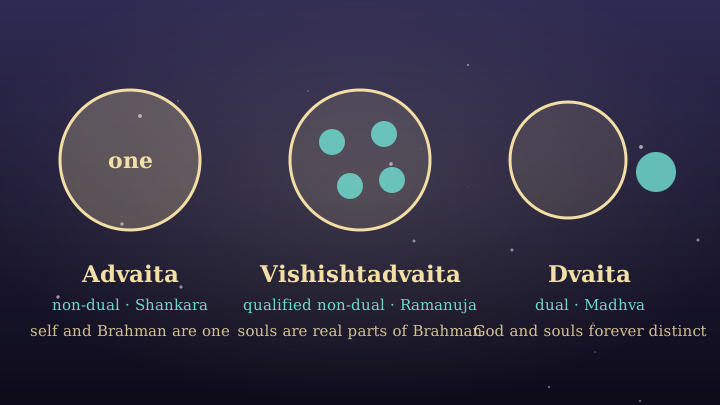 Illustration: three Vedanta answers to how the self relates to Brahman
Other schools followed, including the Shuddhadvaita of Vallabha and the Achintya Bhedabheda of the Chaitanya tradition, which holds that God and souls are inconceivably both one and different.
Vedanta became the dominant philosophy of Hinduism. In 1893 Swami Vivekananda presented it at the Parliament of the World’s Religions in Chicago, and for many Western readers since, “Hindu philosophy” has meant Advaita Vedanta — though it is only one voice in a long argument.
Knowledge in Advaita: Advaita adopted the six means of knowledge of Kumarila’s Mimamsa, but held that only scripture can reveal Brahman, since Brahman is not an object the senses or inference can reach.
Vedanta on Wikipedia · The Brahma Sutras on Wikipedia · Stanford Encyclopedia: Shankara
