The Vedas are the oldest scriptures of Hinduism and among the oldest religious texts still in continuous use anywhere in the world. Composed in archaic Vedic Sanskrit roughly between 1500 and 500 BCE, they were preserved for centuries through disciplined oral transmission before ever being committed to writing — a feat of memorization so precise that scholars can still reconstruct the exact intonation of verses composed three thousand years ago.
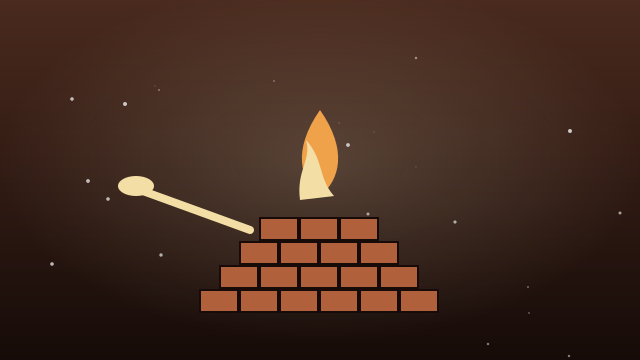 Illustration: a Vedic fire altar, the setting of the hymns and rituals
"Veda" refers not to a single book but to a collection of four distinct compilations:
Rigveda — the oldest and most important, a collection of over a thousand hymns of praise to deities such as Indra (king of the gods), Agni (fire), and Varuna (cosmic order)
Samaveda — largely verses drawn from the Rigveda, set to melodies for chanting during ritual
Yajurveda — prose formulas and instructions for performing sacrificial ritual
Atharvaveda — a more eclectic collection including spells, charms, healing incantations, and reflections on everyday concerns
Each of the four Vedas is itself traditionally divided into four layers of text, composed and added over a long span of time: the Samhitas (the core hymns and mantras), the Brahmanas (prose commentary explaining ritual procedure and meaning), the Aranyakas ("forest texts," transitional meditations composed for hermits and forest-dwellers), and finally the Upanishads — the philosophical culmination of the Vedic corpus, which shifted the tradition's center of gravity from external sacrifice toward inner realization.
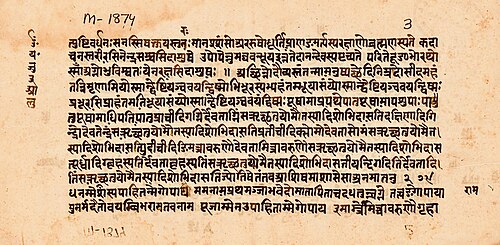
A manuscript page preserving Vedic Sanskrit text
What sets the Vedas apart from most ancient literature is the extraordinary system developed to preserve them without error across generations of purely oral transmission. Reciters (pandits) memorized not just the hymns but complex recitation patterns — word-by-word repetition, reversed sequences, and other techniques — specifically designed to catch and correct any drift in the text. UNESCO recognized this tradition of Vedic chanting as a Masterpiece of the Oral and Intangible Heritage of Humanity in 2003.
Beyond their religious centrality, the Vedas are a foundational source for the study of Sanskrit and, through 18th- and 19th-century Western scholarship on Sanskrit, played a key role in the discovery of the Indo-European language family connecting Sanskrit to Greek, Latin, and most European languages. They remain the ultimate scriptural authority underlying nearly all later Hindu philosophy, ritual, and law.
The Four Vedas: Rigveda, Samaveda, Yajurveda, Atharvaveda
Related Topics: The Upanishads, Vedic ritual, Sanskrit, Indo-European linguistics
