Zen is the Japanese name for Chan, a school of Mahayana Buddhism that grew in China from about the 6th century, mixing Indian Buddhism with Taoist simplicity. Its name means “meditation”. Zen distrusts words and theories: awakening, it says, is not something you learn about but something you see directly, here and now, in this ordinary moment.
Legend says the Indian monk Bodhidharma brought Chan to China and sat facing a cave wall for nine years. Later tradition summed up his teaching in four lines: a special transmission outside the scriptures, not founded on words, pointing directly at the mind, seeing one’s nature and becoming Buddha.
The Platform Sutra tells how Huineng (638–713), an illiterate firewood seller, became the Sixth Patriarch by showing that the mind is already pure: there is no mirror to polish and nowhere for dust to land. His school taught sudden awakening rather than gradual progress.
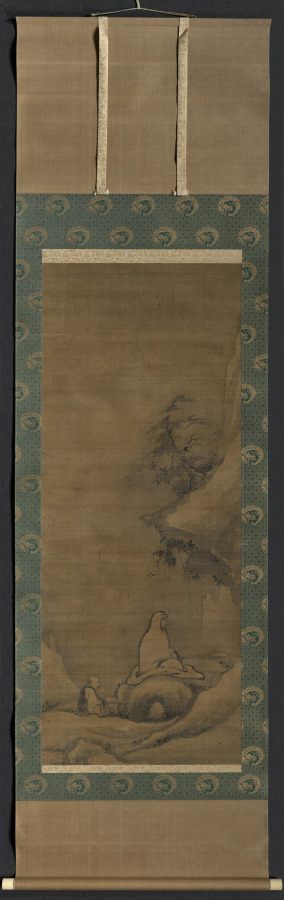 Bodhidharma Meditating Facing a Cliff, China, Song dynasty, late 1200s — Cleveland Museum of Art, CC0
Rinzai — brought to Japan by Eisai in 1191, along with tea. It uses koans, puzzling questions that cannot be solved by reasoning: does a dog have Buddha-nature? (“Mu!”, the first case of the 1228 collection The Gateless Gate), or Hakuin’s “What is the sound of one hand?”
Soto — brought to Japan by Dogen (1200–1253). It teaches shikantaza, “just sitting”: not sitting in order to become enlightened, but sitting as the expression of enlightenment itself.
Zen shaped Japanese culture far beyond the temple: the tea ceremony, ink painting, rock gardens such as Ryoan-ji, flower arranging, archery and the haiku of Basho. Each turns an ordinary act into a practice of complete attention. In the 20th century D. T. Suzuki’s books introduced Zen to the West, and Shunryu Suzuki’s Zen Mind, Beginner’s Mind (1970) taught a generation to approach each moment as if for the first time.
Core text: the Heart Sutra, chanted daily in Zen temples
Related: Meditation types compared, Zhuangzi, Tao Te Ching, The Buddha
A koan is not a riddle with a clever answer. It is designed to exhaust the thinking mind until something more direct breaks through.
A 12th-century Chinese master, Kuoan, drew ten pictures of a herdsman searching for a lost ox: finding its tracks, glimpsing it, catching it, taming it, riding it home, forgetting the ox, forgetting himself, returning to the source, and finally walking into the marketplace “with helping hands”. The last picture is the point: awakening ends not in a mountain cave but back in ordinary life.
Where to start reading: Shunryu Suzuki’s Zen Mind, Beginner’s Mind (1970), talks by the teacher who founded the San Francisco Zen Center: “in the beginner’s mind there are many possibilities”.
Zen on Wikipedia · The Gateless Gate · Dogen · Heart and Diamond Sutras