Every symbol below meant something specific once. Pick one to find out what.
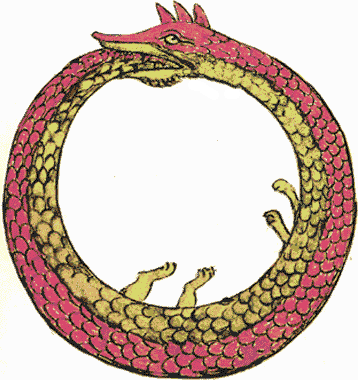
A serpent or dragon depicted eating its own tail, the ouroboros appears independently in ancient Egyptian funerary texts (the earliest known example is in the shrine of Tutankhamun, c. 1300 BCE), Greek alchemical manuscripts, and Norse mythology's world-serpent Jörmungandr, who encircles the entire earth in the sea. Across these unrelated traditions it consistently represents cyclicality — the eternal return of destruction and renewal, endings folding back into beginnings.
The Greek alchemists gave it a more technical reading: the image accompanied the phrase hen to pan ("the one, the all"), used as a visual shorthand for the idea that all matter is fundamentally unified and endlessly transforms into itself. Carl Jung later adopted the ouroboros as a psychological symbol for the process of individuation — the self consuming and remaking itself.
Origin: Independently in Egypt, Greece, and Norse mythology
Meaning: Eternal cycle, self-renewal, endings becoming beginnings
Notable appearance: Tutankhamun's shrine (c. 1300 BCE), one of the earliest known depictions
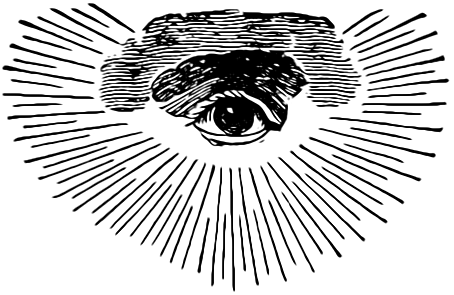
An eye enclosed within a triangle, radiating light, this image entered Christian art during the Renaissance as a symbol of divine watchfulness over humanity — the triangle representing the Trinity, the eye representing God's omniscience. It later appeared on the reverse of the Great Seal of the United States (adopted 1782, and printed on the one-dollar bill since 1935) and, separately, in some Masonic iconography of the same period as a similar emblem of divine oversight.
Its presence in both contexts is the seed of a great deal of popular conspiracy folklore linking Freemasonry to the founding of the United States government. Historians find no credible evidence connecting the two beyond the fact that both borrowed from a shared, much older visual tradition — the all-seeing eye of providence was already common in European religious art decades before either usage.
Origin: Renaissance-era Christian art
Meaning: Divine watchfulness and providence
Common myth: Often mistaken as proof of a hidden connection between Masonic and government symbolism
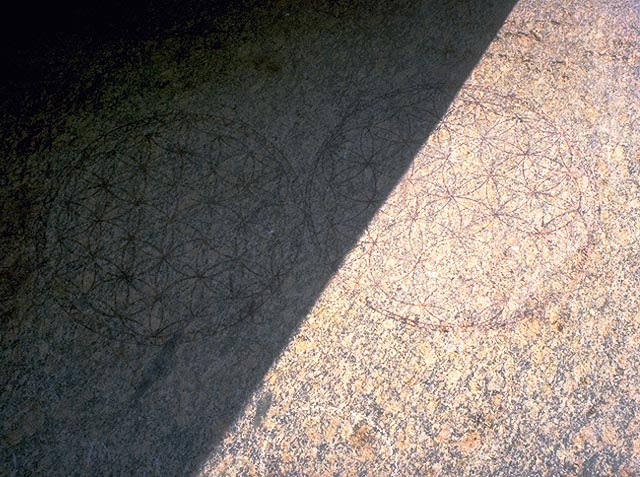
A pattern of evenly overlapping circles arranged in sixfold symmetry, the Flower of Life appears carved into stone at sites including the Osirian Temple at Abydos, Egypt — likely dating to the Ptolemaic or Roman period, later than often claimed — among other locations across several ancient cultures, from Assyrian palace reliefs to Gothic church windows.
It was popularized in the 20th century by the New Age sacred-geometry movement, particularly through the writings of Drunvalo Melchizedek, as a symbol of creation and universal interconnectedness said to encode the geometry of all life. That reading is a modern interpretive layer added on top of a genuinely ancient decorative and geometric motif; most historians treat the older carvings as ornamental compass-drawn patterns rather than deliberate mystical diagrams.
Origin: Found across many ancient cultures, notably Abydos, Egypt
Meaning: Creation, unity, interconnectedness (largely a modern reading)
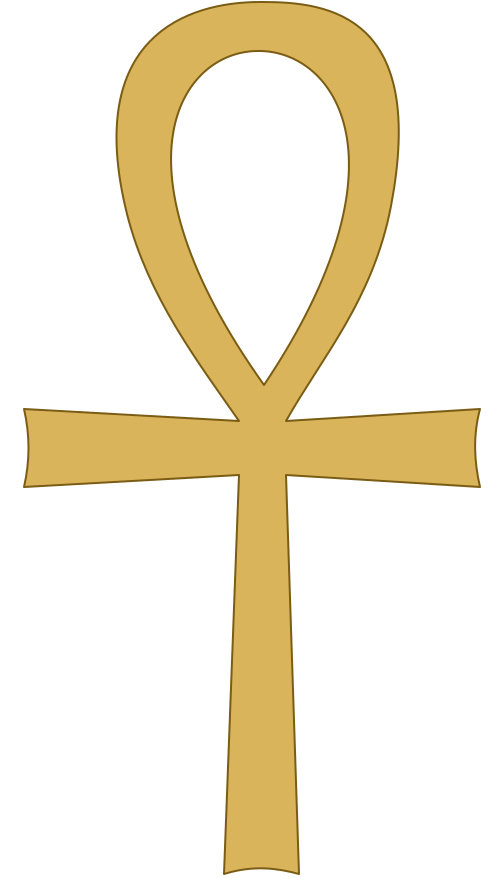
One of the most recognizable hieroglyphs of ancient Egypt, the ankh — a cross topped with a loop — represented the word and concept "life," and appears constantly in Egyptian art, held by gods and pharaohs alike as a symbol of the eternal life granted by the divine. Reliefs regularly show deities such as Isis or Osiris pressing an ankh to the nose of a king, a gesture understood as the "breath of life" being conferred directly.
Its exact origin is debated — theories range from a stylized sandal strap to a symbolic knot or the union of male and female principles — but its meaning was stable and explicit for over three thousand years of continuous use, making it one of the longest-lived symbols in this list. It was later adopted by Coptic Christians in Egypt as a form of the cross, and in the 20th century became a popular symbol in New Age and Kemetic revival spirituality.
Origin: Ancient Egypt
Meaning: Life, and eternal life granted by the gods
Later use: Adapted as a Christian cross form by Coptic Egyptians
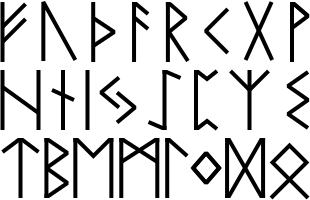
The Elder Futhark, the oldest form of the runic alphabets (named for its first six letters, F-U-Th-A-R-K), was used by Germanic peoples from around the 2nd century CE for practical writing — inscriptions on weapons, jewelry, memorial stones, and short messages. Its 24 angular characters were designed to be easily carved into wood or stone, which is why runic writing avoids curves almost entirely.
Later folklore, especially from the medieval Icelandic sagas and Eddas, layered on associations with divination and magic — the god Odin is said to have won knowledge of the runes by hanging from the world-tree Yggdrasil for nine days. But the runes' primary historical function, confirmed by the roughly 6,000 surviving inscriptions, was as an ordinary writing system for everyday and commemorative purposes, not a purely occult one.
Origin: Germanic peoples, c. 2nd century CE
Primary use: Everyday writing, not divination
Later evolution: Gave rise to the Younger Futhark (Viking Age) and Anglo-Saxon Futhorc
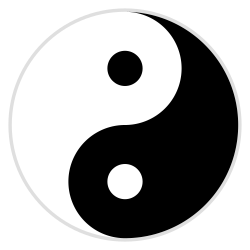
The black-and-white interlocking teardrop symbol, each half containing a seed of the other, represents one of the oldest ideas in Chinese philosophy: that apparent opposites — dark and light, passive and active, feminine and masculine, stillness and motion — are not enemies but complements, each defining and containing the other. The concept predates the symbol itself by centuries, rooted in Taoist cosmology and texts like the I Ching (Book of Changes), where yin and yang describe the balance underlying all change in the natural world.
The familiar circular diagram (called the taijitu, "diagram of the supreme ultimate") is a relatively late addition, generally dated to the Song dynasty (11th–12th century CE), used by Neo-Confucian scholars to illustrate the philosophical concept visually. The idea long predates the picture: early references to yin and yang as complementary cosmic forces appear in texts from the Zhou dynasty, over a thousand years earlier.
Origin: Chinese Taoist philosophy, notably the I Ching
Meaning: Complementary duality — opposites that define and sustain each other
The diagram itself: Formalized centuries after the concept, during the Song dynasty
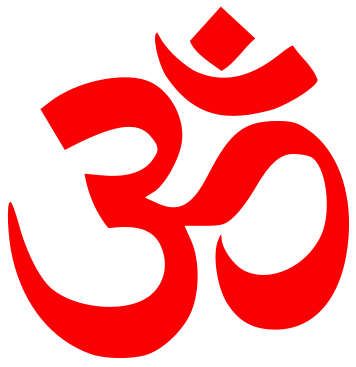
Written as a single curling glyph and chanted as a single sustained sound, Om is considered in Hindu, Buddhist, and Jain traditions to be the primordial sound of the universe itself — the vibration underlying all creation. The Mandukya Upanishad devotes its entire text to explaining the syllable, breaking it into three phonetic parts (A-U-M) that are said to correspond to the states of waking, dreaming, and deep sleep, with the silence after the sound representing a fourth, transcendent state.
Unlike most symbols on this page, Om is as much an auditory practice as a visual one — its meaning is inseparable from the act of chanting it, traditionally used to open and close prayers, mantras, and meditation sessions. The written glyph itself, now instantly recognizable worldwide, is a comparatively late development of the Devanagari script; the sound and its philosophical weight are considerably older, reaching back into the earliest Vedic literature (c. 1500–1000 BCE).
Origin: Vedic and Upanishadic India
Meaning: The primordial sound of creation; used in meditation and chant
Key text: The Mandukya Upanishad, devoted entirely to interpreting the syllable
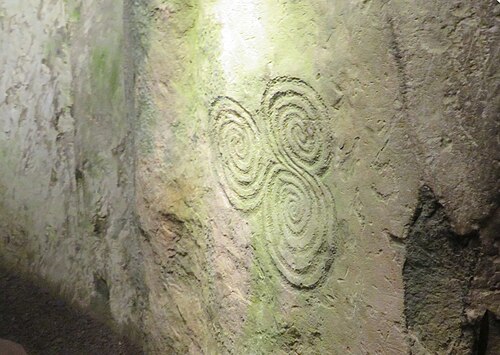
Three interlocked spirals radiating from a central point, the triskelion (or triple spiral) appears carved into Neolithic Irish monuments like Newgrange, dating back over 5,000 years — long before the Celtic culture it's now most associated with even arrived in Ireland. Its exact original meaning is genuinely unknown; no written explanation survives from the people who carved it, since the culture that built Newgrange left no decipherable texts.
Later Celtic and Christian traditions attached their own readings of threefold unity to it: land, sea, and sky; or the three realms of earth, water, and the heavens; and after Christianization, some artisans reused the same triple form to represent the Holy Trinity. This makes the triskelion one of the few symbols on this list where scholars are refreshingly honest that the true original meaning may be permanently unrecoverable — every interpretation offered today postdates the carving by thousands of years. The same three-legged motif appears independently, and much later, as the emblem of the Isle of Man and Sicily.
Origin: Neolithic Ireland, e.g. Newgrange (c. 3200 BCE)
Meaning: Unknown originally; later readings suggest threefold unity
Also seen in: The flags of the Isle of Man and Sicily, adopted independently much later
These symbols persist today in tattoos, jewelry, logos, and film — usually detached from their original religious or cultural framework and free to accumulate new meanings. Tracing a symbol back to its earliest documented use is often the only way to separate what it actually meant to the people who made it from what later centuries have projected onto it.
Ouroboros on Wikipedia · Eye of Providence on Wikipedia · Elder Futhark on Wikipedia