Immanuel Kant was born on 22 April 1724 in Königsberg, Prussia (today Kaliningrad, Russia), and famously never traveled more than about ten miles from the city in his entire life. He studied at the University of Königsberg and, after years working as a private tutor, eventually secured a professorship there in 1770. Kant was renowned for the rigid discipline of his daily routine — townspeople reportedly set their clocks by his afternoon walk — a life of quiet regularity that stood in sharp contrast to the scale of the intellectual revolution he was building.
Kant described his own work as a "Copernican revolution" in philosophy: rather than assuming the mind passively mirrors an external reality, he argued that the mind actively structures our experience of the world — space, time, and causality are not features we discover in things themselves, but frameworks the mind imposes to make experience possible at all. This let him argue that we can never know "things in themselves" (the noumenal world), only how they appear to us (the phenomenal world). In ethics, he proposed the categorical imperative — act only according to a principle you could will to become a universal law, and always treat humanity, in yourself and others, as an end in itself and never merely as a means.
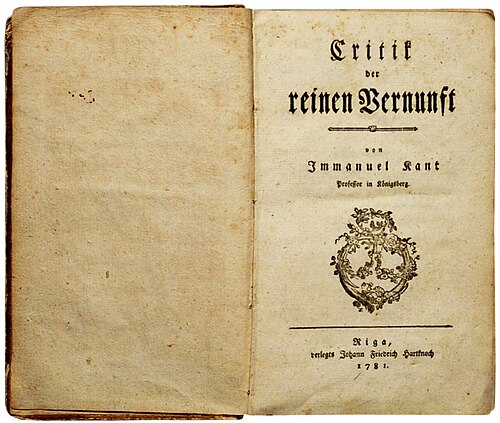 Foto Wikimedia H.-P.Haack, CC BY-SA 3.0
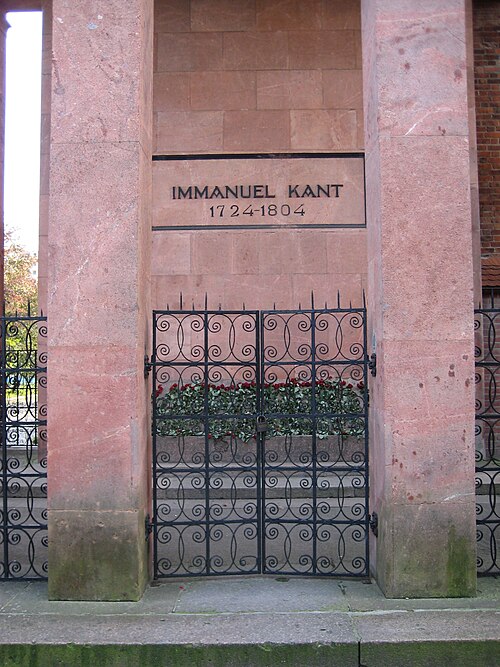 Photo by J110, public domain
Kant's synthesis of rationalism and empiricism reshaped nearly every subsequent field of philosophy. His successors in German Idealism — Fichte, Schelling, and Hegel, covered elsewhere on this site — built directly on his insight that the mind actively structures reality, even as they pushed far beyond where Kant himself was willing to go. His ethics remains one of the two or three dominant frameworks taught in moral philosophy today, and his vision of perpetual peace between constitutional republics is often cited as a philosophical ancestor of modern international law and human rights theory.
Explore more about Kant on Wikipedia.
Read Kant's Famous Quotes & Lessons →