Jean-Paul Sartre was born on 21 June 1905 in Paris; his father died when Sartre was only fifteen months old. He studied at the École Normale Supérieure, one of France's most elite institutions, where he met Simone de Beauvoir — the philosopher, writer, and lifelong intellectual partner with whom he maintained an open, unmarried relationship for over fifty years. After teaching philosophy, Sartre was drafted into the French army in 1939, captured by German forces in 1940, and spent nearly a year as a prisoner of war before his release, after which he became active in the French Resistance.
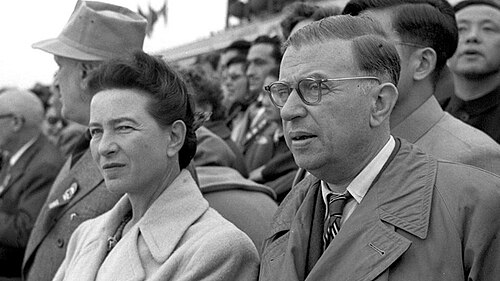 Liu Dong'ao / Xinhua News Agency, 1955, public domain in China
Sartre's central claim was that "existence precedes essence" — unlike a manufactured object, which is designed for a purpose before it's built, a human being simply exists first, with no predetermined nature, and only defines who they are through the choices they make. This makes freedom absolute and unavoidable: even refusing to choose is itself a choice, and Sartre argued we are, in his famous phrase, "condemned to be free." He described the temptation to deny this freedom — by hiding behind roles, social expectations, or the excuse of circumstance — as "bad faith." In his later work, he attempted to reconcile this radical individual freedom with Marxist ideas about class and historical structure, arguing that freedom is always exercised within, and constrained by, real material conditions.
 Celette, CC BY-SA 4.0
Sartre became the most publicly recognizable philosopher of the 20th century, using novels, plays, journalism, and political activism — including outspoken anti-colonial advocacy — to carry existentialist ideas far beyond the academy. In 1964 he was awarded the Nobel Prize in Literature and declined it, stating that a writer should not allow himself to be turned into an institution. His decades-long intellectual partnership with Simone de Beauvoir shaped both of their philosophies, and his work remains foundational to existentialism, phenomenology, and 20th-century political thought.
Explore more about Sartre on Wikipedia.
Read Sartre's Famous Quotes & Lessons →