Bhimrao Ramji Ambedkar was born on 14 April 1891 in Mhow, into the Mahar caste, then treated as “untouchable”. At school he had to sit apart on a sack and could not drink from the common tap. He became one of the most educated people of his generation anywhere: degrees from Bombay, a PhD from Columbia University in New York, and a doctorate from the London School of Economics, alongside training as a barrister.
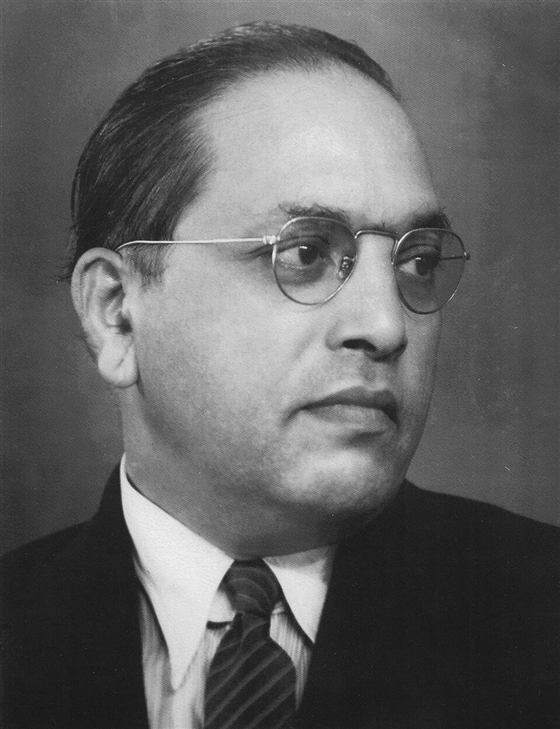 Photograph, public domain
At Columbia in 1916, aged twenty-five, he presented a paper, Castes in India, that asked how caste actually works. His answer: by marriage rules.
“… endogamy is the only characteristic that is peculiar to Caste.”Castes in India: Their Mechanism, Genesis and Development (1916)
In 1936 he wrote Annihilation of Caste as a speech for a reform society in Lahore; the organisers cancelled it when they read it, and he published it himself. It argued that caste could not be reformed from inside, because it was sanctioned by scripture, and that the scriptures themselves had to lose their authority.
In 1927 he led thousands of Dalits to drink from the public Chavdar tank at Mahad, and that December publicly burned the Manusmriti, the law code that justified untouchability. In 1932 he clashed with Gandhi over separate electorates for the “Depressed Classes”; Gandhi fasted against them, and Ambedkar, under enormous pressure, signed the Poona Pact, which gave reserved seats instead. In 1935 he announced that although he had been born a Hindu, he would not die one. His watchwords to his followers were educate, agitate, organise.
After independence Ambedkar became India’s first Law Minister and chaired the committee that drafted the Constitution, with its guarantees of equality, its abolition of untouchability and its reservations for disadvantaged groups. In his final speech to the Constituent Assembly, on 25 November 1949, he warned of two dangers. One was mass protest once constitutional means existed:
“These methods are nothing but the Grammar of Anarchy and the sooner they are abandoned, the better for us.”Speech to the Constituent Assembly, 25 November 1949
The other was worship of leaders:
“Bhakti in religion may be a road to the salvation of the soul. But in politics, Bhakti or hero-worship is a sure road to degradation and to eventual dictatorship.”Speech to the Constituent Assembly, 25 November 1949
On 14 October 1956 at Nagpur, Ambedkar and hundreds of thousands of followers converted to Buddhism, taking twenty-two vows that rejected caste and Hindu ritual. He read the Buddha as a rational, social reformer, and set this out in The Buddha and His Dhamma, published after his death. He died less than two months later, on 6 December 1956. Today his birthday is celebrated across India, his statue stands in countless villages, and he is honoured as the voice of those caste tried to silence.
Read Ambedkar in his own words: Ambedkar quotes with sources.
In 1936 a Hindu reform society in Lahore, the Jat-Pat Todak Mandal, invited Ambedkar to give its presidential address. When the organisers read his text, which called for the destruction of the religious authority behind caste, they asked him to change it; he refused, the conference was cancelled, and he printed the speech himself as Annihilation of Caste. Gandhi replied in his paper Harijan, and Ambedkar answered him in turn.
Where to start: Annihilation of Caste, then his short memoir, Waiting for a Visa.
Three quick questions on B. R. Ambedkar. The wrong answers describe other thinkers on Darshniks.
Who was B. R. Ambedkar?
Which of these is B. R. Ambedkar's big idea?
What is B. R. Ambedkar best known for?
Ambedkar on Wikipedia · Castes in India (Project Gutenberg) · Annihilation of Caste · Social Justice
