Mohandas Karamchand Gandhi was born on 2 October 1869 in Porbandar, Gujarat. He trained as a lawyer in London, and in 1893 took a job in South Africa, where he was thrown off a first-class train compartment at Pietermaritzburg because he was Indian. He stayed for over twenty years, organising the Indian community against discriminatory laws, and there he developed the method he called satyagraha, “holding firmly to truth”.
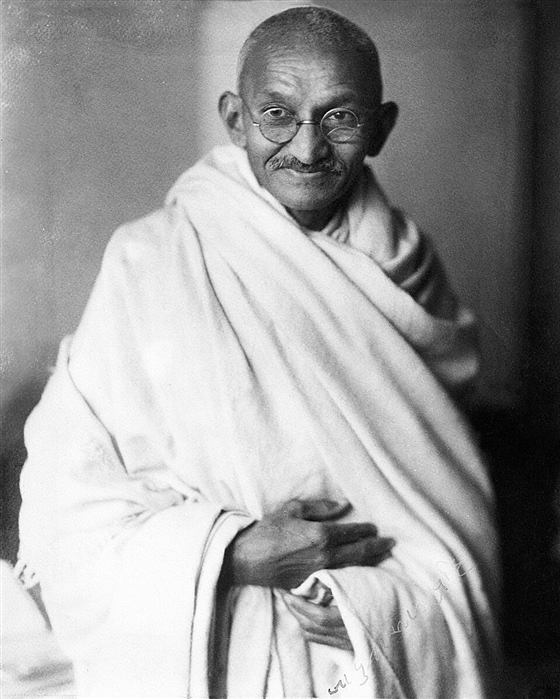 Elliott & Fry, London, 1931, public domain
Satyagraha is resistance without violence: refusing to cooperate with injustice and accepting the punishment, so that the suffering of the resister moves the conscience of the opponent. Its root is ahimsa, non-harm, which Gandhi took from Hindu and Jain tradition and stretched into politics. In Hind Swaraj (1909), written on a ship from London to South Africa, he defined it:
“Passive resistance is a method of securing rights by personal suffering; it is the reverse of resistance by arms.”Hind Swaraj (Indian Home Rule), ch. 17
For Gandhi the way you fight decides what you win. A free India won by violence would be a violent India.
“The means may be likened to a seed, the end to a tree; and there is just the same inviolable connection between the means and the end as there is between the seed and the tree.”Hind Swaraj, ch. 16
Gandhi first read the Bhagavad Gita as a student in London, in Edwin Arnold’s English, and it became his daily guide: action without attachment to results. Tolstoy’s The Kingdom of God Is Within You convinced him of non-resistance, and the two corresponded; he named a South African community Tolstoy Farm. John Ruskin’s Unto This Last, read on an overnight train, changed his life in a night: he set up a farm community and later translated the book into Gujarati as Sarvodaya, “the welfare of all”. The Jain ideals of his Gujarat childhood ran through all of it.
Back in India from 1915, he turned the independence movement into a mass movement of ordinary people: the spinning wheel, homespun cloth, boycotts and marches. In 1930 he walked some 240 miles to the sea at Dandi to make salt in defiance of the British salt tax, and tens of thousands followed him into prison. In 1942 he launched the Quit India movement. India became independent in August 1947, divided and in bloodshed that Gandhi tried to stop with fasts. On 30 January 1948 he was shot dead in Delhi by Nathuram Godse, a Hindu nationalist.
Gandhi inspired Martin Luther King Jr., Nelson Mandela and nonviolent movements across the world, and he was nominated for the Nobel Peace Prize five times without winning. He is also criticised, not only by opponents of nonviolence. In South Africa he wrote disparagingly of Black Africans. B. R. Ambedkar fought him bitterly over how to end caste and how Dalits should be represented, and his experiments in celibacy late in life trouble many readers. Taking him seriously means holding both.
“Be the change you wish to see in the world.” The closest Gandhi came is a 1913 passage that begins “We but mirror the world”; the snappy version first appears decades after his death.
“An eye for an eye leaves the whole world blind.” No record of Gandhi saying it has been found.
These and more, with their real origins: Fake Gandhi Quotes
Read Gandhi in his own words: Gandhi quotes with sources.
Near the end of his life he left a short test for moments of doubt, in substance: recall the face of the poorest and weakest person you have ever seen, and ask whether the step you are considering will be of any use to them. If it will, your doubts will melt away.
Hind Swaraj, a short dialogue, free on Project Gutenberg as Indian Home Rule. Then his autobiography, The Story of My Experiments with Truth, which is unusually honest about his failures.
Three quick questions on Mahatma Gandhi. The wrong answers describe other thinkers on Darshniks.
Who was Mahatma Gandhi?
Which of these is Mahatma Gandhi's big idea?
What is Mahatma Gandhi best known for?
Gandhi on Wikipedia · Hind Swaraj (Project Gutenberg) · Gandhi Heritage Portal · Fake Gandhi Quotes