Augustine was born in 354 in Thagaste, in what is now Algeria, to a pagan father and a devout Christian mother, Monica. A brilliant student of rhetoric, he spent his youth chasing success, love and philosophy; he lived for years with a partner and their son, and followed the Manichaeans for nine years. He became a professor of rhetoric in Milan, where the sermons of Bishop Ambrose began to change his mind.
Sandro Botticelli, Saint Augustine in His Study, 1480, public domain
The Confessions
Written around 397–400, the Confessions is often called the first autobiography: a long prayer telling the story of his inner life. It opens with its most famous line:
“Thou madest us for Thyself, and our heart is restless, until it repose in Thee.”Confessions I.1 (tr. E. B. Pusey)
He is honest about his own divided will. As a young man, he admits, he prayed:
“Give me chastity and continency, only not yet.”Confessions VIII.7
In a garden in Milan in 386, in tears, he heard a child’s voice chanting “Take up and read; take up and read.” He opened Paul’s letters at random, read a passage on putting away the old life, and was converted (Confessions VIII.12).
Time and the Mind
Book XI of the Confessions contains one of philosophy’s great puzzles about time: “If no one asks me, I know: if I wish to explain it to one that asketh, I know not.” His answer, that past and future exist only in the mind as memory and expectation, still shapes debates today. Read more on What Is Time?
The City of God
Augustine became bishop of Hippo, on the North African coast, in 396. When Rome was sacked by the Goths in 410 and pagans blamed the Christians, he wrote The City of God, contrasting the earthly city, built on love of self, with the city of God, built on love of God. He died in 430 as the Vandals besieged Hippo. His ideas on grace, sin, the will and just war shaped Western Christianity, Catholic and Protestant alike, for fifteen centuries.
Often misattributed
“The world is a book, and those who do not travel read only one page.” Endlessly credited to Augustine, but it has never been found in his writings.
Augustine’s most quoted line outside the Confessions comes from a sermon on the First Letter of John: “Love, and do what you will” (Homilies on 1 John, 7.8, in substance). It is often read as permission to do anything. He meant the opposite: if love truly governs you, what you will to do will be good; a father who disciplines and a kidnapper who flatters may do similar things, but only love tells them apart.
Key Ideas
Memory and the inner self. Book X of the Confessions explores memory as a vast hall within us. God, he wrote earlier in the book, is “more inward than my inmost self” (III.6): found within, not outside.
Grace. Against the monk Pelagius, who taught that people can choose goodness by their own effort, Augustine argued that the will is too divided to heal itself without God’s grace. The debate shaped Christian thought for a millennium.
Just war. He set down early conditions for when war could be justified, rightful authority, a just cause and right intention, the starting point for later just war theory.
Evil as absence. Evil, he argued, has no being of its own; it is a lack or corruption of good, as blindness is a lack of sight.
Things People Often Get Wrong
“The Confessions is just an autobiography.” Only the first nine books tell his story; the last four are philosophy, on memory, time and creation.
“He invented the idea that sex is sinful.” His views on sexuality were severe and influential, but he defended marriage as good against those who condemned it.
Where to start: Confessions, Books I–IX, free in E. B. Pusey’s translation.
Check Yourself
Three quick questions on Augustine of Hippo. The wrong answers describe other thinkers on Darshniks.
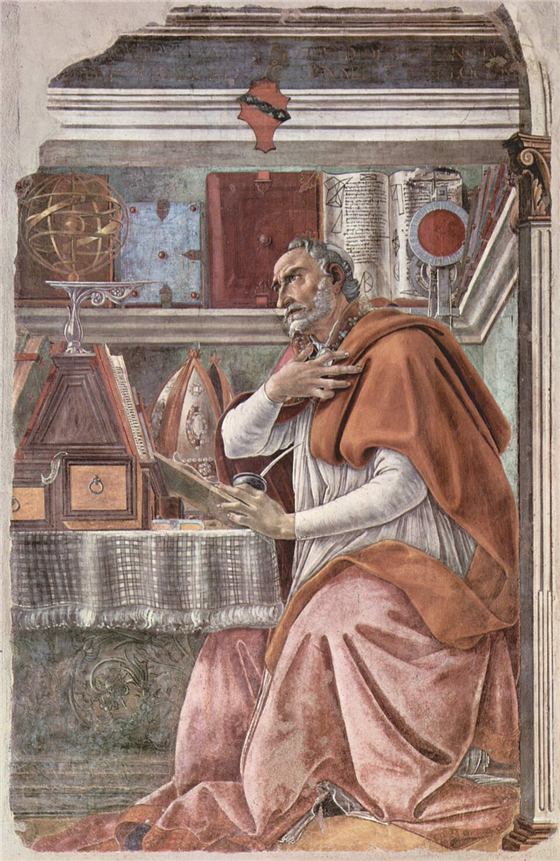 Sandro Botticelli, Saint Augustine in His Study, 1480, public domain
