We measure it, waste it, run out of it. But what is it? Philosophers have found time one of the hardest things to explain, and physics has only made it stranger: it can stretch, it seems to have a direction, and it may not flow at all.
“What then is time? If no one asks me, I know: if I wish to explain it to one that asketh, I know not.”Augustine, Confessions XI.14 (tr. E. B. Pusey)
Augustine noticed the puzzle: the past no longer exists, the future does not yet exist, and the present has no width at all. So where is time? His answer was that it lives in the mind, as memory, attention and expectation.
Heraclitus, as Plato reports him, said you cannot step into the same river twice (Cratylus 402a). Six centuries later the emperor used the same image.
“Time is like a river made up of the events which happen, and a violent stream; for as soon as a thing has been seen, it is carried away, and another comes in its place.”Marcus Aurelius, Meditations 4.43 (tr. George Long)
For Aristotle, time is not a thing on its own but the measure of change: “the number of motion in respect of before and after”. If nothing ever changed, there would be no time to speak of (Physics IV.11).
Hindu cosmology sees time as cyclic and immense. Four ages, the yugas, repeat endlessly; our own Kali Yuga is reckoned at 432,000 years, and a single day of Brahma, a kalpa, at 4.32 billion years. The astronomer Carl Sagan remarked that these were the only ancient timescales to match those of modern cosmology, by coincidence. Buddhist philosophers went the other way, into the very small: the Abhidharma schools taught that experience is a stream of momentary events, each arising and vanishing in an instant.
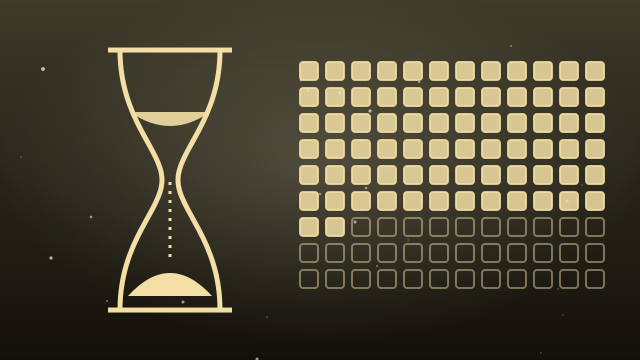 Illustration: the flow we feel, and the physics that questions it
Relativity showed that time is not the same for everyone. Clocks run slower when they move fast or sit deep in gravity. This is not theory alone: the clocks on GPS satellites tick at a different rate from clocks on the ground, by about 38 millionths of a second a day, and the system has to correct for it or your map would drift by kilometres.
Relativity also unsettles “now”: two events that are simultaneous for one observer need not be for another. When his old friend Michele Besso died in 1955, Einstein wrote to Besso’s family that for physicists the distinction between past, present and future is only a stubborn illusion.
Most laws of physics work equally well forwards and backwards. Yet eggs break and never unbreak. In 1927 the astronomer Arthur Eddington called this one-way direction the “arrow of time”, and tied it to entropy: disorder tends to increase. Why the universe began in such an orderly, low-entropy state, so that the arrow points the way it does, is still an open question.
Continue: Memento Mori, the Wisdom Timeline, or Are We Alone?
In 1908 the Cambridge philosopher J. M. E. McTaggart published a paper called The Unreality of Time. He distinguished two descriptions. In one, events move from future to present to past, and “now” is special. In the other, events are simply earlier or later than each other, like points on a line, with no moving “now” at all. Many physicists lean toward the second picture, a “block universe” in which past, present and future all equally exist. Yet our whole experience is of the first. The quarrel between them is still unsettled.
Augustine, Confessions Book XI (Project Gutenberg) · Stanford Encyclopedia: Time · Arrow of time · Hindu units of time