Abu Ali al-Husayn ibn Sina, known in Europe as Avicenna, was born around 980 near Bukhara, in today’s Uzbekistan. In his short autobiography he says he knew the Quran by heart by the age of ten, mastered medicine in his teens, and read Aristotle’s Metaphysics forty times without understanding it, until a cheap commentary by al-Farabi bought in a bookseller’s market made it suddenly clear. At about eighteen he cured the ruler of Bukhara and won access to the royal library.
Avicenna as imagined in a 15th-century European manuscript painting, public domain. No portrait from his lifetime survives.
The Canon of Medicine
His Canon of Medicine gathered Greek, Persian, Indian and Arabic medicine into one vast system, with remarkable observations on contagion, clinical trials of drugs and the importance of quarantine. Translated into Latin in the 12th century, it was a standard medical textbook in European universities until the 1600s.
The Floating Man
Avicenna’s most famous thought experiment asks you to imagine a person created in mid-air, fully grown, blindfolded, limbs spread so they touch nothing, with no memory of any sensation. Would they know they exist? Avicenna says yes: they would be aware of their own self, without any body or sense experience. So the self, he concluded, is something other than the body. It anticipates Descartes’s “I think, therefore I am” by six centuries.
Necessary Existence
In his great philosophical encyclopedia, The Book of Healing, he drew a sharp line between what a thing is (its essence) and the fact that it exists. Everything in the world could have not existed; it depends on something else. The chain must end in a being that exists necessarily, of itself: the Necessary Existent, God. Thomas Aquinas and the Latin scholastics built on these arguments, while in the Islamic world al-Ghazali attacked them in The Incoherence of the Philosophers. Avicenna died in Hamadan, Iran, in 1037.
A Life on the Move
Avicenna did not write in a quiet library. After Bukhara fell he served a series of rulers across Iran as physician and, twice, as vizier; he was imprisoned, went into hiding, and once escaped disguised as a dervish. According to his student al-Juzjani, much of The Book of Healing was written at night after a day of government work, with students reading drafts aloud. He died in 1037 while travelling with the ruler of Isfahan on campaign.
Key Ideas
The soul is not the body. From the Floating Man he argued that the self knows itself directly, needs no body to exist, and so survives death.
Knowledge comes from above as well as below. The senses give us particular things; grasping universal truths, he held, is an illumination from the “Active Intellect”, a cosmic intelligence our minds connect with when properly prepared.
Medicine as a science. The Canon set out rules for testing a drug: try it on a simple, uncomplicated disease, watch its effect over time, and check that the effect is consistent. It is one of the earliest descriptions of what we would call a controlled trial.
Things People Often Get Wrong
“An Arab scientist.” He was Persian, wrote mostly in Arabic (the scholarly language of his world) and also wrote the first philosophical encyclopedia in Persian, the Danishnama.
“A secular rationalist.” His whole system rises to God as the Necessary Existent; he saw no conflict between rigorous philosophy and faith, though al-Ghazali did.
To meet him in his own voice, start with his short autobiography, completed by al-Juzjani, and then his Compendium on the Soul, free online.
Check Yourself
Three quick questions on Avicenna. The wrong answers describe other thinkers on Darshniks.
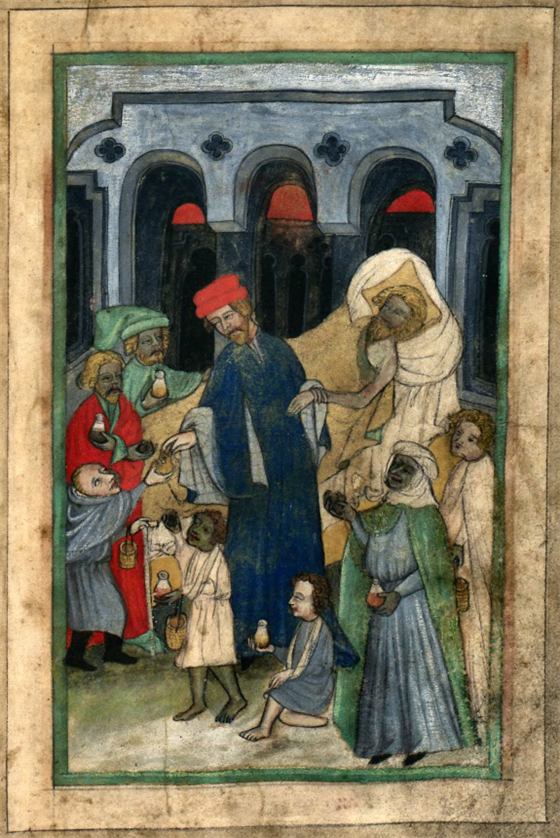 Avicenna as imagined in a 15th-century European manuscript painting, public domain. No portrait from his lifetime survives.