René Descartes was born in 1596 in La Haye, France, a town now named Descartes after him. He was educated by the Jesuits, served briefly as a volunteer soldier, and on a winter night in 1619, shut in a stove-heated room in Germany, had the dreams that set him on his life’s project: to rebuild knowledge from the ground up. He spent most of his working life in the Netherlands.
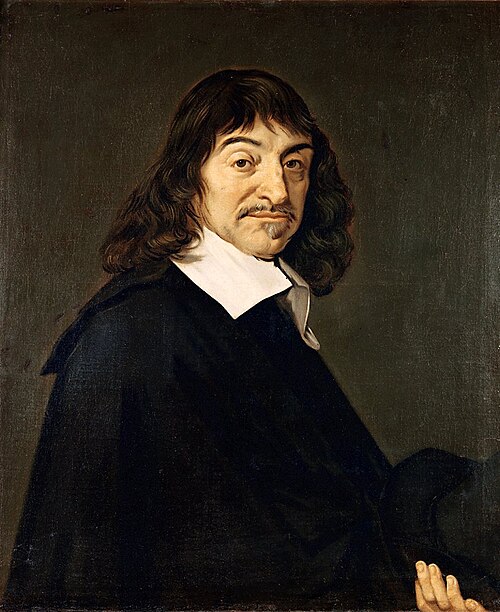 After Frans Hals, 17th century, public domain
Descartes’s method was to doubt everything that could possibly be doubted. The senses deceive us; we may be dreaming; perhaps, he imagined in his Meditations (1641), a powerful evil demon is fooling us about everything. What survives? The doubting itself. Even if I am deceived, I must exist to be deceived.
“I think, therefore I am (COGITO ERGO SUM).”Discourse on Method (1637), Part IV (tr. John Veitch)
From this one certainty he tried to rebuild the rest: God, the world and the reliability of clear and distinct ideas. He wrote it first in French, for ordinary readers, rather than in Latin, opening with a gentle joke:
“Good sense is, of all things among men, the most equally distributed; for every one thinks himself so abundantly provided with it.”Discourse on Method, Part I (tr. John Veitch)
Descartes divided reality into two kinds of thing: thinking mind and extended matter. The body is a machine; the mind is not. But how can they affect each other? He proposed that they meet in the brain’s pineal gland. Princess Elisabeth of Bohemia pressed him in letters on exactly this point, and he never fully answered her. The “mind–body problem” is still with us, and is at the heart of debates about artificial intelligence.
He also invented the coordinate system of x and y axes that every student learns, joining algebra to geometry. In 1649 Queen Christina of Sweden invited him to Stockholm to teach her, at five in the morning, and he died there of pneumonia in February 1650. Rationalists after him, from Spinoza to Leibniz, began from his questions, and empiricists began by attacking his answers. Read more on Rationalism.
In Part II of the Discourse, Descartes reduces his method to four rules, still useful for any hard problem:
Doubting everything is dangerous if you still have to live. So in Part III he adopts a “provisional morality” while his search goes on. Obey the laws and customs of your country. Once you have decided, act firmly, like travellers lost in a forest who should walk straight in one direction rather than wander in circles: they may not reach exactly where they hoped, but they will get out. And try to master yourself rather than fortune, changing your desires rather than the order of the world. It is one of the most practical passages in modern philosophy.
Three quick questions on René Descartes. The wrong answers describe other thinkers on Darshniks.
Who was René Descartes?
Which of these is René Descartes's big idea?
What is René Descartes best known for?
Descartes on Wikipedia · Discourse on Method (Project Gutenberg) · Stanford Encyclopedia: Descartes · Rationalism