India’s two great epics, the Ramayana and the Mahabharata, have shaped more lives than any philosophy book. Generations learned right and wrong from them through grandparents’ stories, temple carvings, village plays and, in 1987–90, television series that emptied Indian streets on Sunday mornings. They are adventure stories, but above all they are long arguments about dharma: what is the right thing to do when every choice costs something?
Attributed to the poet-sage Valmiki, the Sanskrit Ramayana runs to about 24,000 verses in seven books (kandas). Prince Rama accepts fourteen years of exile so that his father can keep a rash promise. His wife Sita and brother Lakshmana follow him into the forest. Sita is abducted by Ravana, king of Lanka, and Rama wins her back with the help of Hanuman and an army of monkeys and bears.
Rama is the ideal of duty, but the epic does not make him easy to admire. After the war he asks Sita to prove her purity by fire, and in the final book, which many scholars think was added later, he banishes her anyway because of gossip in the city. Readers have argued about those choices for two thousand years.
There is no single Ramayana. Kamban’s Tamil Ramavataram (12th century), Tulsidas’s Awadhi Ramcharitmanas (16th century, the version most of north India knows), the Thai Ramakien and Indonesian shadow-puppet plays all tell it differently. The scholar A. K. Ramanujan called his famous essay on this “Three Hundred Ramayanas”.
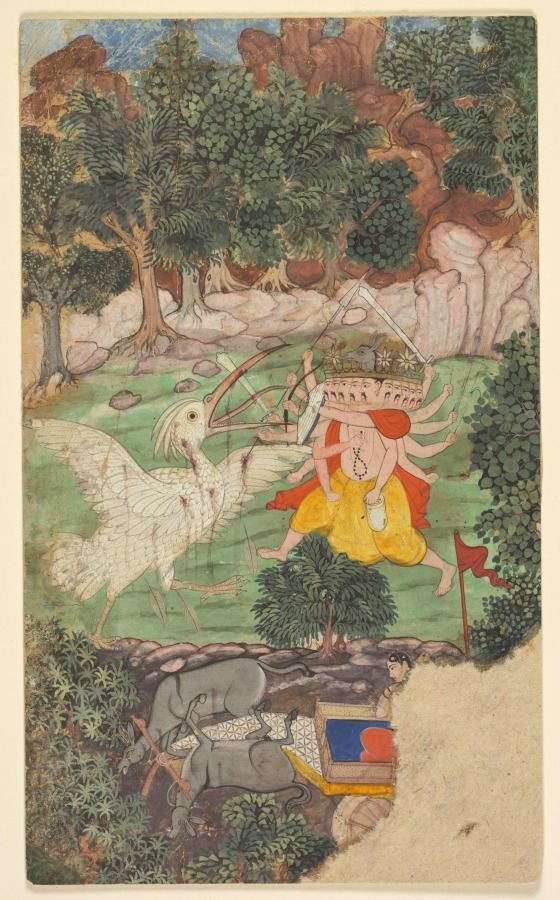 The Battle of Ravana and Jatayu, from the “Burnt” Ramayana, Datia, c. 1605 — Cleveland Museum of Art, CC0
Traditionally composed by Vyasa, the Mahabharata is among the longest poems ever written: about 100,000 couplets in eighteen books, built up over centuries (scholars often suggest roughly 400 BCE to 400 CE). At its centre is a family war between the five Pandava brothers and their hundred cousins, the Kauravas, ending at Kurukshetra in a battle that destroys almost everyone.
The Bhagavad Gita is a small part of it, eighteen chapters in the sixth book, spoken by Krishna to Arjuna just before the fighting begins.
It also holds stories that stand on their own. Savitri follows Yama, the god of death, and argues so well that he returns her husband’s life. And in the “Yaksha’s questions”, a spirit at a lake quizzes Yudhishthira; asked what is most wonderful, he answers that every day creatures die all around us, yet those who remain live as if they never will.
The dice game — Yudhishthira, the most righteous brother, gambles away his kingdom, his brothers, himself and finally his wife Draupadi. Dragged into the hall, she asks a question no one can answer: had he the right to stake her after he had already lost himself?
Karna — the abandoned eldest brother of the Pandavas, who learns the truth too late and stays loyal to the friend who raised him up, fighting against his own brothers.
The half-truth — to break the enemy commander, Yudhishthira says “Ashwatthama is dead”, meaning an elephant of that name, and lets him believe it was his son. Tradition says his chariot, which had always floated above the ground, sank to earth.
Bhishma’s vow — a lifelong promise of celibacy, made out of love for his father, that binds him to the wrong side of the war.
The Mahabharata says of itself that what is found in it may be found elsewhere, and what is not in it is nowhere. Its heroes lie, its villains are sometimes noble, and victory leaves the winners grieving. That is why it is still argued over rather than simply admired.
Ramayana: about 24,000 verses in 7 kandas, attributed to Valmiki
Mahabharata: about 100,000 couplets in 18 parvas, attributed to Vyasa
Related: Bhagavad Gita, Moral Dilemmas, Sri Aurobindo’s Savitri
In the forest book of the Mahabharata, the Pandava brothers drink from a lake guarded by a spirit, a yaksha, and fall dead. Only Yudhishthira stops to answer its riddles. What is heavier than the earth? A mother. What is the greatest wonder? That every day people die, yet the living act as if they will live forever. Pleased, the yaksha lets him bring back one brother; he chooses not his strongest brother but a son of his stepmother, so that both mothers have a son alive. The episode, the Yaksha Prashna, is the epic’s philosophy in miniature.
Ramayana on Wikipedia · Mahabharata on Wikipedia · Ganguli’s full Mahabharata translation (Project Gutenberg) · Moral Dilemmas
