Karl Heinrich Marx was born on 5 May 1818 in Trier, in the Kingdom of Prussia, to a family of Jewish descent that had converted to Lutheranism a few years before his birth, largely to allow his father to continue practicing law under Prussian restrictions on Jewish professionals. Marx studied law at the University of Bonn before transferring to the University of Berlin, where he fell under the spell of Hegelian philosophy and joined a circle of radical thinkers known as the Young Hegelians, who applied Hegel's ideas about historical change toward increasingly pointed criticism of religion, politics, and the Prussian state. He completed a doctorate in philosophy in 1841, but his radical associations closed off an academic career, pushing him instead toward journalism and political activism.
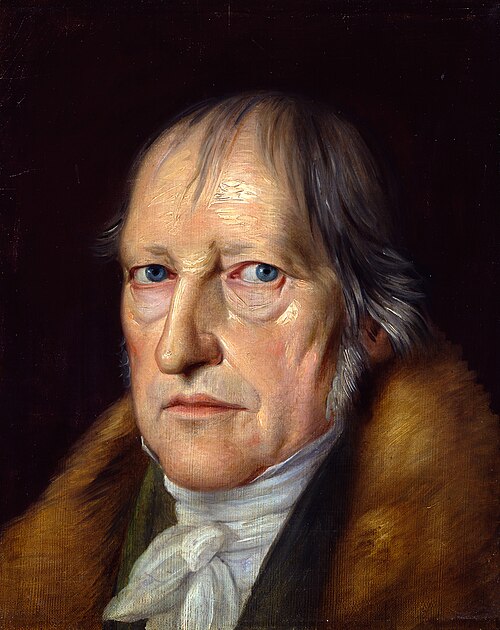 Hegel, whose philosophy the young Marx studied in Berlin and later “turned on its head” — Jakob Schlesinger, 1831, Alte Nationalgalerie, public domain
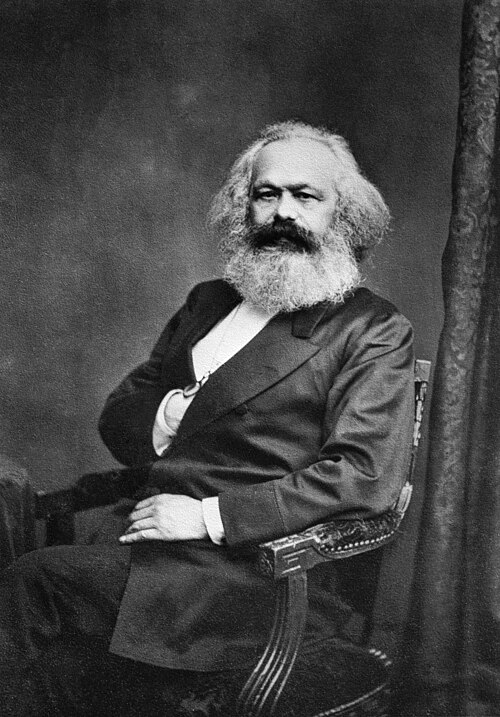
Marx's political writing repeatedly got him expelled from one European country after another — Prussia, France, Belgium — as governments grew wary of his revolutionary journalism. In Paris he formed a close, lifelong intellectual partnership with Friedrich Engels, the son of a wealthy German industrialist whose own observations of factory conditions in Manchester profoundly shaped their shared thinking. In 1848, amid a wave of revolutions sweeping Europe, the two published The Communist Manifesto, a short, urgent pamphlet arguing that all human history could be understood as a history of class struggle, and predicting that industrial capitalism would eventually be overthrown by the very working class (the proletariat) it depended on and exploited.
Underlying Marx's political conclusions was a broader theory of history he called historical materialism: the idea that a society's economic structure — how it organizes production and property — forms the real foundation on which its politics, law, religion, and culture (the "superstructure") are built and justified. Rather than ideas driving history, Marx argued that material and economic conditions drive the development of ideas, and that history progresses through a sequence of conflicts between classes with opposing economic interests — a dynamic he believed would inevitably push feudalism toward capitalism, and capitalism, in turn, toward socialism.
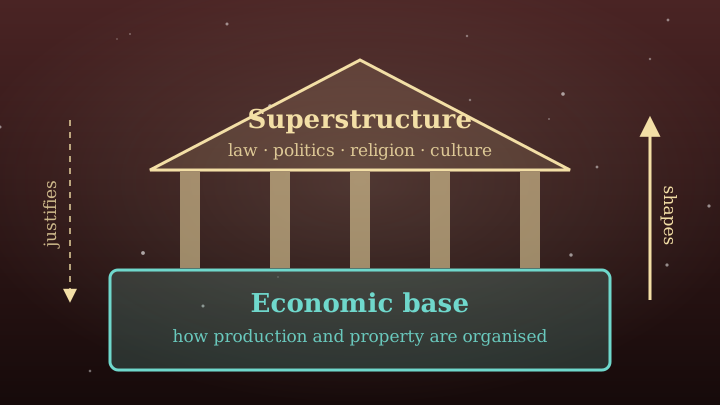 Illustration: historical materialism — the economic base shapes the superstructure, which in turn justifies the base
After settling permanently in London in 1849 following further expulsions, Marx spent much of the rest of his life in relative poverty, sustained financially by Engels, while conducting exhaustive economic research — much of it in the reading room of the British Museum. This research produced his major, unfinished life's work, Das Kapital (Capital: A Critique of Political Economy), the first volume of which appeared in 1867. In it, Marx developed a detailed critique of capitalism centered on the idea of surplus value: that capitalist profit derives from paying workers less than the value their labor actually creates, with the difference captured by the owners of capital. Only the first volume was published in his lifetime; Engels edited and published two further volumes from Marx's notes after his death.
Key Concepts: historical materialism, class struggle, surplus value, alienation, the proletariat
Related Topics: German idealism, socialism, 19th-century political economy
Marx died in London in 1881, largely outside the political mainstream of his own time, but his ideas would go on to shape much of the 20th century in ways he could not have anticipated — inspiring revolutions, states, and political parties across the globe, from the Soviet Union to China to Cuba, under interpretations of "Marxism" that varied enormously from his own writings and from each other. Independent of any political movement built in his name, Marx's analytical tools — class analysis, the critique of ideology, attention to the economic base of social life — remain deeply embedded in academic sociology, economics, and history, making him one of the most influential and most contested thinkers of the modern era.
Explore more about Karl Marx on Wikipedia.
