Søren Kierkegaard was born in Copenhagen in 1813, the youngest child of a wealthy, devout and melancholy father, whose sense of guilt overshadowed the family. In 1840 he became engaged to Regine Olsen, then broke it off a year later, believing he could not make her happy or share his inner life with her. He never married, and the broken engagement echoes through his books.
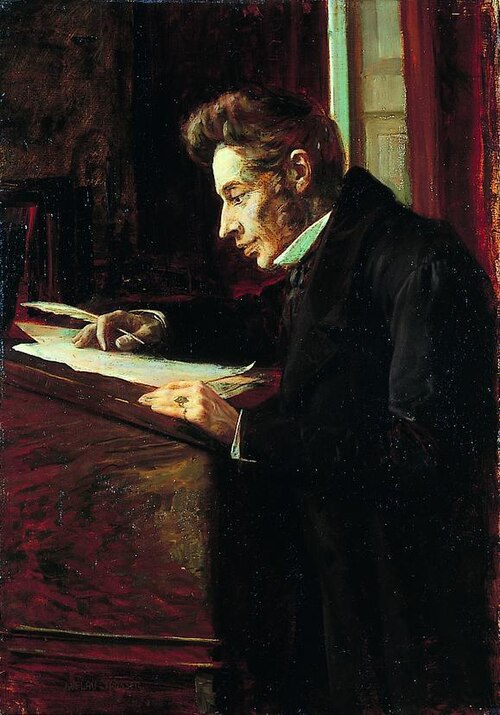 Sketch by his cousin N. C. Kierkegaard, c. 1840, public domain
Between 1843 and 1846 he poured out books under pseudonyms such as Johannes de Silentio and Victor Eremita, each voicing a different way of life, so that readers would have to decide for themselves. Either/Or (1843) sets the life of pleasure against the life of duty. Fear and Trembling (1843) dwells on Abraham, told to sacrifice his son, and asks what faith could possibly mean if it is that terrifying.
The single individual — truth that matters is not abstract but lived; each person must choose and stand alone before it. “The crowd”, he wrote, is untruth.
Anxiety — in The Concept of Anxiety (1844) he called anxiety the dizziness of freedom: the vertigo of standing before possibilities you alone must choose among.
Three stages of life — the aesthetic (living for experience), the ethical (living by duty and commitment) and the religious (a personal relation to God beyond what reason can justify).
Purity of heart — the title of an 1847 discourse: “to will one thing”.
In an 1843 journal entry he noted the puzzle at the heart of every life: we can only understand it looking backwards, but we have to live it forwards.
Kierkegaard spent his last years attacking the Danish state church for turning Christianity into a comfortable social habit. He collapsed in the street in 1855 and died weeks later, aged 42. Largely ignored in his lifetime outside Denmark, he was rediscovered in the 20th century as the forerunner of existentialism, influencing thinkers from Heidegger and Sartre to Camus.
“Leap of faith.” The phrase most associated with Kierkegaard does not appear even once in his published works; scholars who searched the complete Danish text confirmed it. He wrote about a “leap”, the qualitative jump into commitment, but “leap of faith” is a later summary.
More famous misquotes: Quotes They Never Said
In a short 1846 essay, The Present Age, Kierkegaard described a society that reflects endlessly but rarely acts, levels every distinction, and hands judgement to an anonymous “public” created by the press: a crowd that exists everywhere and nowhere and takes responsibility for nothing. Written after a satirical paper, The Corsair, had made him a figure of public mockery, it reads now like a description of online life.
In Works of Love (1847), published under his own name, he argues that Christian love is a duty, not a feeling: “you shall love your neighbour”, and the neighbour is everyone, especially the one we would not choose. Because it is commanded, he says, such love is protected from the changes of mood that make ordinary affection fragile.
Where to start: The Present Age, then Fear and Trembling. A free selection of his writings in English is on Project Gutenberg.
Three quick questions on Søren Kierkegaard. The wrong answers describe other thinkers on Darshniks.
Who was Søren Kierkegaard?
Which of these is Søren Kierkegaard's big idea?
What is Søren Kierkegaard best known for?
Kierkegaard on Wikipedia · Stanford Encyclopedia: Kierkegaard · Existentialism · Fear of Failure