Friedrich Nietzsche was born on 15 October 1844 in Röcken, a small village in Prussian Saxony, the son of a Lutheran pastor who died when Nietzsche was only four. A brilliant classicist, he was appointed professor of classical philology at the University of Basel at just 24 — remarkably, before he had even finished his doctorate. Chronic illness, including violent migraines and near-blindness, forced him to resign the post a decade later, and he spent most of the rest of his life as an independent writer, moving between boarding houses in Switzerland, France, and Italy in search of a climate that eased his suffering. In January 1889, he suffered a complete mental collapse in Turin; he lived another eleven years, cared for by his mother and then his sister, without ever writing again.
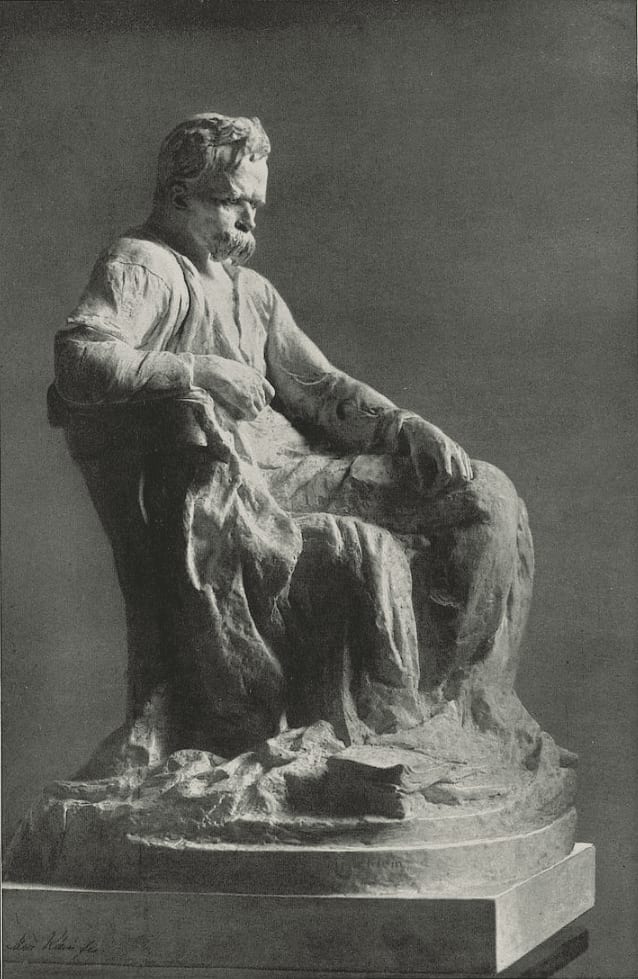 Max Klein (d. 1908), public domain
Nietzsche challenged the foundations of traditional Christian and rationalist morality, arguing that inherited values were not eternal truths but historical inventions serving particular interests — most famously the shift he described from an ancient "master morality" of strength and nobility to a "slave morality" of humility and guilt. His declaration that "God is dead" was not a triumphant statement of atheism but a diagnosis: without a divine foundation, all inherited values were now groundless, and humanity faced the difficult task of creating new ones. He proposed the Übermensch ("overman") as a figure who creates their own values rather than inheriting them, driven by what Nietzsche called the will to power — the fundamental drive to grow, express strength, and overcome resistance, in oneself as much as over others.
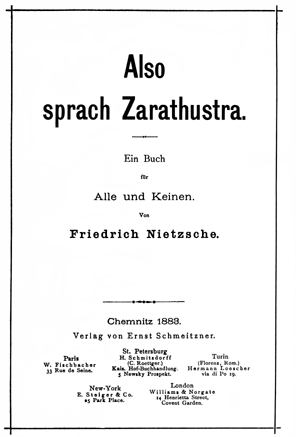 First edition cover, 1883, public domain
His writings deeply influenced existentialism (Sartre and Camus both engaged closely with his work), postmodern philosophy (Foucault and Derrida drew heavily on his critique of fixed truth), and psychology (Freud acknowledged him as a forerunner). His legacy was badly distorted after his death: his sister Elisabeth, a nationalist and antisemitic sympathizer, edited and published his unfinished notebooks in ways that suited her own politics, and the Nazi regime later appropriated his name and the term "Übermensch" for propaganda — despite Nietzsche himself writing explicit, scathing criticism of antisemitism and German nationalism during his lifetime. Modern scholarship has worked to separate his actual writing from that posthumous misuse.
Explore more about Nietzsche on Wikipedia.
Read Nietzsche's Famous Quotes & Lessons →