Banner: Adi Shankara, painting by Raja Ravi Varma, c. 1904 — an imagined likeness; no portrait from life survives.
Adi Shankara, or Shankaracharya, was born in Kaladi in present-day Kerala. His dates are uncertain: tradition gives 788–820 CE, while many scholars place him in the early 8th century. The stories of his life come from later hagiographies: he renounced the world as a boy, studied under the teacher Govinda Bhagavatpada, travelled the length of India debating rival schools, and died young — at 32, by tradition — in the Himalayas.
 Calvinkrishy, CC BY-SA 2.5
“Now, therefore, the inquiry into Brahman.”Brahma Sutras 1.1.1, the text Shankara’s most famous commentary explains
Shankara is the great systematiser of Advaita Vedanta, the “non-dual” school of Vedanta. Its core claims:
His favourite image is a rope seen in dim light and mistaken for a snake. The fear is real; the snake never was. In the same way, ignorance “superimposes” a world of separate things on Brahman (adhyasa), and knowledge dissolves the error.
For Shankara, rituals and good works purify the mind, but they cannot bring liberation, because the problem is not something we lack but something we misunderstand. Only knowledge — realising that you are Brahman — ends the cycle of rebirth.
His commentaries (bhashyas) on the Brahma Sutras, the principal Upanishads and the Bhagavad Gita are the foundation of Advaita; the Upadesasahasri is also accepted as his. Many popular works carry his name — the Vivekachudamani and numerous hymns — but scholars debate whether he wrote them.
If only Brahman is real, why does the world seem so solid? Shankara answers by distinguishing two standpoints. From the ultimate standpoint, there is only Brahman. From the everyday standpoint, the world, its people, gods and duties are perfectly real for practical purposes: Shankara never tells anyone to ignore their obligations or to walk into fire because it is “illusion”.
 Illustration: three levels: ultimate, everyday and illusory
Later Advaita teachers added a third level, the merely apparent: dreams, mirages, the snake seen in a rope. The rope-snake is unreal even by everyday standards, while the everyday world is unreal only from the highest standpoint. Liberation is not destroying the world but seeing through it, as waking up shows a dream for what it was.
Because the problem is ignorance, the cure is knowledge, but not knowledge in the ordinary sense. Following the Brihadaranyaka Upanishad (2.4.5), Advaita describes three steps: shravana, hearing the Upanishads explained by a teacher; manana, reflecting on them until every doubt is resolved; and nididhyasana, deep, sustained contemplation until the truth is lived rather than merely understood.
 Illustration: hearing, reflecting and meditating with a teacher
Shankara also sets out who is ready for this path: someone with discrimination between the lasting and the passing, dispassion toward rewards in this world or the next, inner disciplines such as calm and self-control, and an intense longing for freedom. Without these, he says, study only adds to pride.
“Action cannot destroy ignorance, for it is not in conflict with, or opposed to, ignorance.”Vivekachudamani, traditionally attributed to Shankara
Shankara's hagiographies, the Shankaradigvijaya texts written centuries later, describe him travelling India and defeating rival teachers in debate. The best-known story pits him against the ritualist Mandana Mishra, with Mandana's learned wife Ubhaya Bharati as judge; Mandana loses and becomes Shankara's disciple. These are legends, but they reflect a real history of vigorous argument between schools.
Advaita did not have the last word. In the 11th and 12th centuries Ramanuja argued that the world and souls are real parts of Brahman (Vishishtadvaita), and in the 13th century Madhva taught that God and souls are eternally distinct (Dvaita). Both objected that Shankara's teaching left no room for real love between the devotee and God.
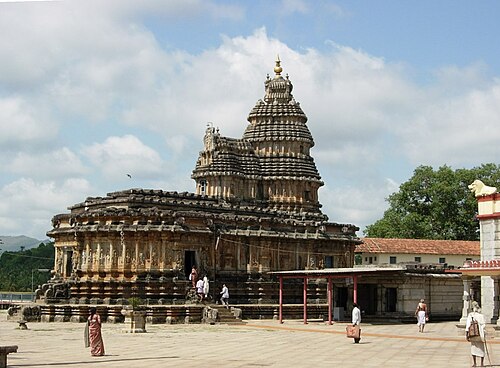
Tradition credits him with founding four monasteries (mathas) at Sringeri, Dwarka, Puri and Jyotirmath, headed to this day by teachers who take the title Shankaracharya, and with organising the Dashanami order of monks. Advaita Vedanta became, through teachers like Vivekananda, the best-known form of Hindu philosophy worldwide.
Adi Shankara on Wikipedia · Stanford Encyclopedia: Shankara · The Darshanas
