Tantra is one of the most widely misunderstood words to cross from South Asia into Western vocabulary. In popular usage it has been reduced almost entirely to sacred sexuality; in its home traditions, it names a broad current of ritual, philosophical, and yogic practice found across Hindu, Buddhist, and Jain esotericism from roughly the 5th century CE onward.
The Sanskrit root tan means "to weave" or "to extend" — Tantra is literally a "loom" or "framework," a systematic technology for working with the body and cosmos as a single fabric, rather than treating the material world as an obstacle to transcend.
Where much of earlier Indian philosophy treated the body as a hindrance to spiritual liberation, Tantra reversed the premise: the body itself is a sacred instrument, a microcosm of the universe, and a valid vehicle for realization. Its central metaphysics pairs Shiva, pure consciousness, with Shakti, the dynamic energy that animates and manifests that consciousness as the world. Liberation is understood as the reunion of these two principles.
That reunion is mapped onto the body through the subtle body — a network of channels (nadi) and energy centers (chakras) running from the base of the spine to the crown of the head. A dormant energy called kundalini, coiled at the base like a serpent, is awakened through disciplined practice and raised through each chakra in turn, culminating in union at the crown.
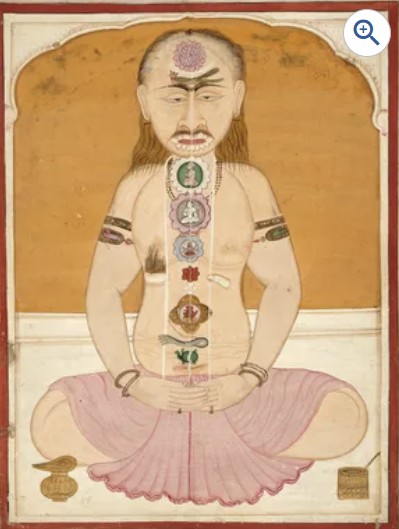
Traditional depiction of the seven chakras along the subtle body
Tantric practice draws on a distinctive toolkit: mantra (sacred sound repeated to focus and transform consciousness), yantra and mandala (geometric diagrams used as objects of visualization and ritual worship), mudra (symbolic hand gestures), and elaborate initiatory ritual under the guidance of a guru.
The Sri Yantra, nine interlocking triangles radiating from a central point, is among the most recognizable of these diagrams — a geometric map of the union between Shiva and Shakti used as a focus for meditation.
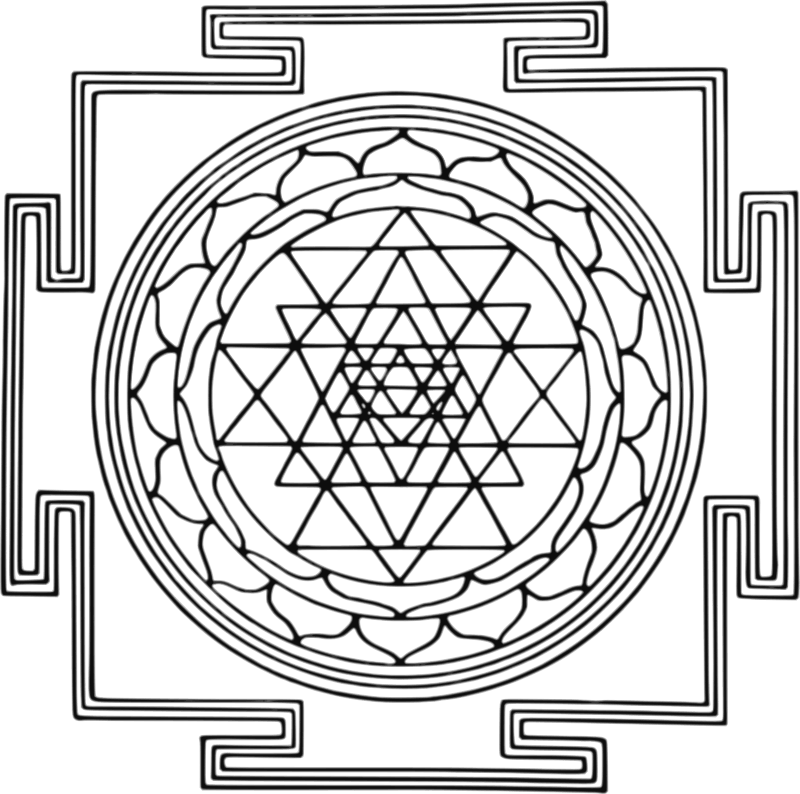
The Sri Yantra — nine interlocking triangles used as a focus for Tantric meditation
N.Manytchkine, CC BY-SA 3.0
Some Tantric lineages, particularly the "left-hand path" (vamachara) schools, historically incorporated transgressive ritual elements — including ritualized sexuality — as a deliberate confrontation with social taboo, intended to dissolve the practitioner's attachment to convention. These practices were always a minority current even within Tantra, and most Tantric lineages, including the "right-hand path" (dakshinachara) schools, are built around symbolic visualization and disciplined ritual rather than literal transgression.
Tantra is not confined to Hindu Shaivism and Shaktism. Vajrayana Buddhism, dominant in Tibet, Bhutan, and parts of the Himalayas, is itself a fully developed Tantric system, using deity visualization, mantra, and ritual to accelerate the path to enlightenment within a single lifetime. Jain Tantra developed its own parallel ritual traditions. Across all of these, the common thread is the use of embodied, ritual technique — rather than renunciation alone — to reach liberation.
Key Concepts: Kundalini, chakras, mantra, yantra, guru-initiation, Shiva-Shakti
Related Topics: Kabbalah's Tree of Life, alchemical transformation, Kundalini Yoga
