Yoga is older and wider than the postures most people know. Start wherever you like.
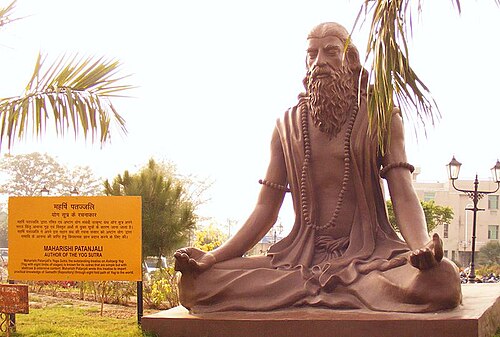
The Sanskrit word yoga comes from the root yuj, “to yoke” or “to join”. It can mean a discipline, a method, or the union that the discipline aims at. In Indian philosophy it is also the name of one of the six classical schools, the darshanas, whose founding text is the Yoga Sutras attributed to Patanjali.
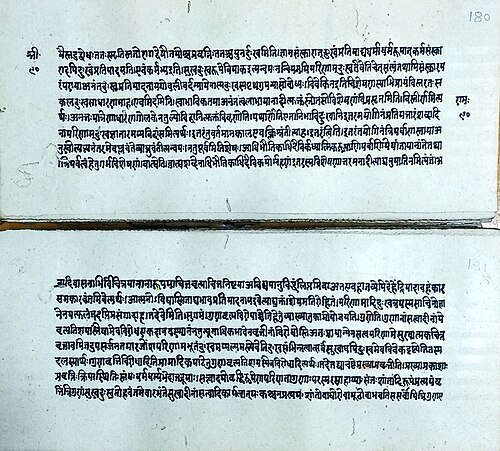
A manuscript page of Patanjali's Yoga-sutras, the foundational text of the Yoga darshan
The Yoga Sutras define the whole project in their second verse: yoga is the stilling of the movements of the mind (yogas citta-vritti-nirodhah, 1.2). The body matters, but as a support for that inner stillness.
Philosophically, Yoga borrows most of its picture of the world from Samkhya: pure consciousness (purusha) is entangled with matter (prakriti), and suffering comes from mistaking the movements of body and mind for the self. Its main difference from Samkhya is a place for Ishvara, the Lord: a special consciousness never touched by suffering, and a focus for devotion (Yoga Sutras 1.23–26). The goal is kaivalya, “aloneness”: consciousness resting in itself, free of that confusion.
Patanjali sets out the path in eight “limbs” (ashtanga, Yoga Sutras 2.29). They run from how you treat others, through body and breath, to deeper and deeper states of attention. Open any one to read more.
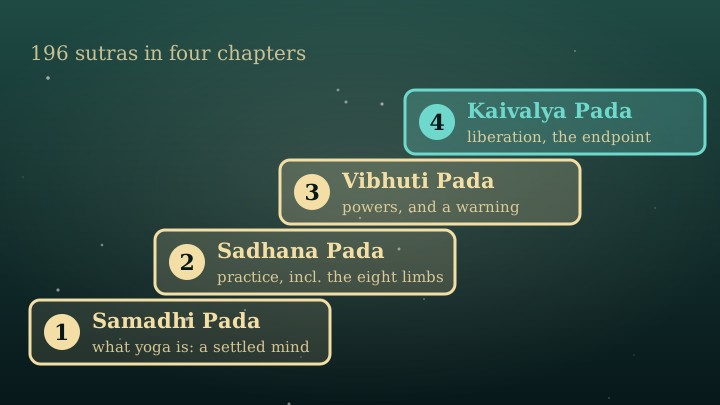 Illustration: the four chapters of Patanjali’s Yoga Sutras, where the eight limbs are set out
Five commitments toward others: not harming (ahimsa), truthfulness, not stealing, sexual restraint (brahmacharya) and not grasping. Patanjali calls them a “great vow” when kept everywhere and always (2.30–31).
Five disciplines toward oneself: cleanliness, contentment, austerity (tapas), self-study (svadhyaya) and devotion to Ishvara (2.32).
In the Sutras, asana means the seated posture for meditation, and Patanjali says only that it should be “steady and easy” (sthira-sukham, 2.46). The many standing and flowing poses of modern classes came much later.
Slowing and lengthening the in-breath, out-breath and pauses between them, so that the mind settles with the breath (2.49–52).
Drawing attention back from the objects of the senses, as a tortoise draws in its limbs. It is the hinge between the outer limbs and the inner ones (2.54).
Holding attention on one place or object, such as the breath, a point in the body or an image (3.1).
When that concentration becomes an unbroken flow toward its object, without constant effort to bring it back (3.2).
When only the object shines forth and the sense of a separate meditator falls away (3.3). The Sutras distinguish several levels of samadhi on the way to liberation.
The Yoga Sutras are 196 short aphorisms in four chapters (padas): on absorption (samadhi), on practice (sadhana), on the extraordinary powers that practice can bring (vibhuti), and on liberation (kaivalya). Sutras are deliberately terse, written to be memorised and explained by a teacher, and the oldest surviving commentary, the Yoga-bhashya attributed to Vyasa, has shaped how they have been read ever since.
Almost nothing is known about Patanjali himself. Indian tradition sometimes identifies him with the grammarian Patanjali, author of the Mahabhashya on Panini (2nd century BCE), but most scholars think these were different people. Estimates for the compilation of the Sutras range from the 2nd century BCE to the 5th century CE, with many modern scholars favouring the later end.
Hatha literally means “force”: it is the yoga of physical effort. Later tradition also read the two syllables symbolically, ha as the sun and tha as the moon, the two currents of energy that hatha practice is meant to balance.
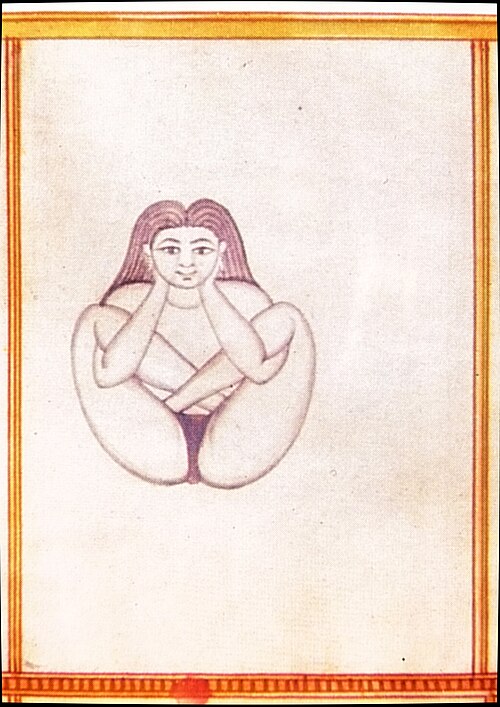
Uttana Kurmasana (the inverted tortoise pose), from the 19th-century Hatha Yoga manuscript Sritattvanidhi
Hatha yoga grew up in the medieval period, especially among the Nath yogis. Its best-known manual, the Hatha Yoga Pradipika by Svatmarama, dates from the 15th century. It opens by calling hatha yoga a stairway to raja yoga, the meditative yoga of Patanjali: the body is trained so that the mind can be stilled.
The Pradipika teaches four main kinds of practice:
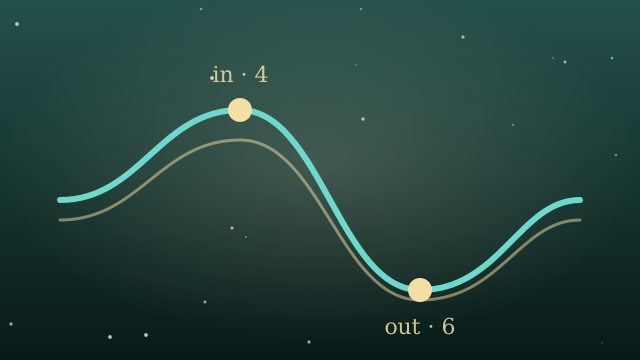 Illustration: pranayama begins with slowing the breath
Texts like the Pradipika promise that these practices cure disease and grant supernatural powers. Modern research is more modest: yoga can help with things like back pain, stress and sleep, but it is not a cure-all. Forceful breathing and long breath retention can be risky, so learn them from an experienced teacher, and check with a doctor if you have a heart, lung or blood-pressure condition.
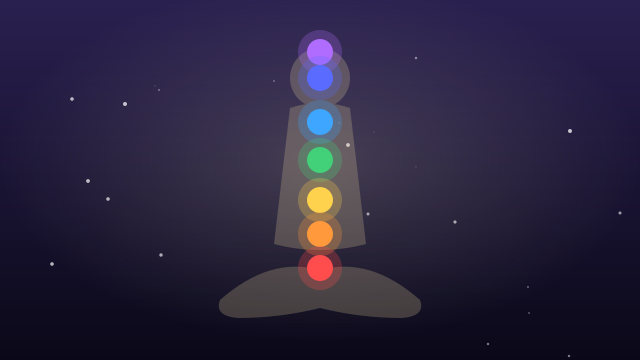 Illustration: the chakras as modern yoga usually maps them; older texts count them differently
Hindu tradition speaks of several yogas, each suited to a different temperament and all aimed at the same freedom. The scheme of four great paths below was made famous by Swami Vivekananda, who wrote a book on each.
The meditative path of Patanjali's eight limbs: ethical discipline, then body and breath, then ever deeper concentration, aimed at direct experience of the self.
Discriminating the real from the unreal through study and self-inquiry, most famously the question “Who am I?”, until the self (atman) is known as it is. It is closely tied to Vedanta.
Love and surrender toward a personal form of the divine, through prayer, song and worship, as in the poems of Mirabai and Kabir.
Doing one's work and duty without attachment to the results, as Krishna teaches Arjuna in the Bhagavad Gita.
Postures, breath, seals and locks, used to prepare the body for meditation and, in tantric forms, to awaken a dormant energy said to rest at the base of the spine (see Tantric Arts).
Yoga's journey to the West began in earnest with Swami Vivekananda's speeches at the 1893 Parliament of the World's Religions in Chicago. His book Raja Yoga (1896) presented yoga as meditation and mental discipline, and had little to say about postures. Paramahansa Yogananda followed in 1920, teaching Kriya Yoga to American audiences for three decades.
The posture-centred yoga of today owes most to the 20th century, and especially to T. Krishnamacharya, who taught at the Mysore palace from the 1930s. His students spread it worldwide: B. K. S. Iyengar, whose Light on Yoga (1966) became a global manual, and K. Pattabhi Jois, whose Ashtanga Vinyasa system, linking breath to flowing movement, is the ancestor of most “vinyasa flow” classes. In 2014 the United Nations declared 21 June the International Day of Yoga.
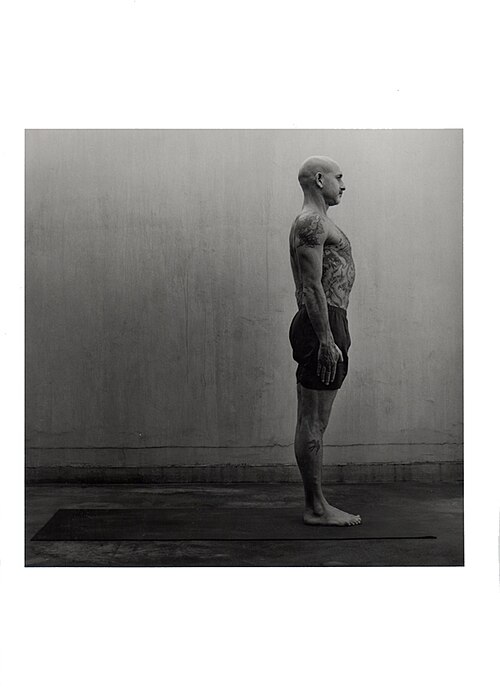
Tadasana (Mountain Pose), a starting posture in modern flowing styles of yoga
Barry Silver, CC BY 2.0
Along the way, posture and breath were often separated from the philosophy that once gave them their purpose. Many practitioners now go back to the older aim the Sutras set out in their second verse: not a more flexible body, but a quieter mind that can see clearly.
Yoga on Wikipedia · Britannica: Yoga philosophy · Yoga philosophy