The Upanishads are a body of philosophical texts — traditionally numbered at 108, though scholars recognize around 200 — that form the concluding portion of the Vedas, and are for that reason also called Vedanta, "the end of the Vedas." Composed roughly between 800 and 200 BCE, they mark a decisive shift in Indian religious thought: away from the elaborate sacrificial ritual of earlier Vedic religion, and toward direct philosophical inquiry into the nature of reality, the self, and liberation.
The Upanishads' central concern is the relationship between two concepts: Brahman, the single, formless, ultimate reality underlying the entire universe, and Atman, the innermost self or soul of the individual. Their recurring, radical claim is that these two are ultimately identical — a teaching distilled in the famous phrase from the Chandogya Upanishad, "Tat Tvam Asi", "Thou art That."
Realizing this identity directly, not merely believing it intellectually, is presented as the path to moksha — liberation from samsara, the otherwise endless cycle of death and rebirth driven by karma.
Rather than presenting doctrine as abstract argument, the Upanishads favor dialogue and vivid metaphor. In the Chandogya Upanishad, a father asks his son to dissolve salt in water and then find it again — illustrating how Brahman permeates all things invisibly, as the salt permeates the water without being visible within it. In the Katha Upanishad, the self is compared to a passenger in a chariot: the body is the chariot, the intellect the charioteer, the mind the reins, and the senses the horses — a discipline of self-mastery is needed for the "chariot" to reach its destination rather than run wild.
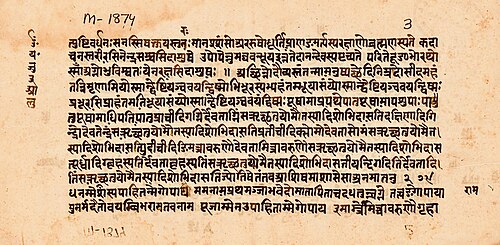
The Upanishads were transmitted for centuries as part of the larger Vedic oral and manuscript tradition
Of the many Upanishads, a set of ten to thirteen — including the Isha, Kena, Katha, Chandogya, Brihadaranyaka, and Mandukya Upanishads — are traditionally regarded as the "principal" Upanishads, commented on extensively by later philosophers. The Mandukya, though one of the shortest, is especially prized for its dense analysis of the sacred syllable Om as a symbol of the entire span of consciousness — waking, dreaming, deep sleep, and a "fourth" transcendent state beyond all three.
The Upanishads became the philosophical bedrock of Vedanta, later systematized into rival schools by commentators such as Adi Shankaracharya, whose non-dualist Advaita Vedanta reading of "Tat Tvam Asi" remains hugely influential within Hindu philosophy. Beyond India, translations of the Upanishads deeply affected Western thinkers including Arthur Schopenhauer, who called them "the solace of my life," as well as Ralph Waldo Emerson and Henry David Thoreau.
Key Concepts: Brahman, Atman, moksha, samsara, "Tat Tvam Asi"
Related Topics: The Vedas, Vedanta, Advaita philosophy, the Bhagavad Gita
