Some ancient inventions were so advanced that their methods were lost for centuries. Others are modern myths. Pick one below.
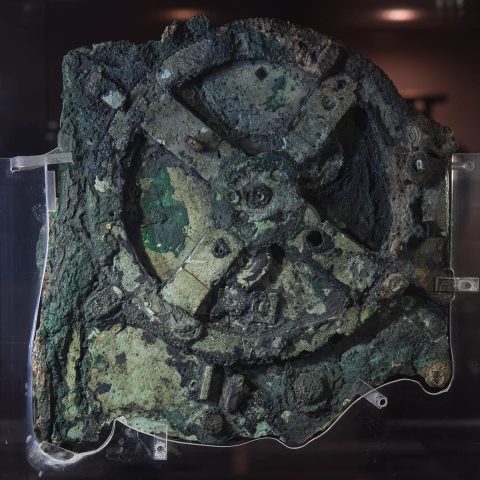
In 1901 sponge divers recovering statues from a Roman-era shipwreck off the Greek island of Antikythera brought up a lump of corroded bronze. Inside were gear wheels. Over the following century, X-ray studies, and from 2005 high-resolution CT scans, revealed what it was: a hand-cranked astronomical calculator from around the 2nd or 1st century BCE, with at least 30 surviving bronze gears.
Turning the handle showed the positions of the Sun and Moon, the phase of the Moon, predicted eclipses, and tracked the four-year cycle of the Panhellenic games, including the Olympics. Nothing of comparable mechanical complexity is known again until the astronomical clocks of medieval Europe more than a thousand years later. It is not evidence of lost aliens or Atlantis; it is evidence of how good Greek astronomers and craftsmen were, and of how much of their work has vanished.
Found: 1901, Antikythera shipwreck, Greece
Date: c. 2nd–1st century BCE
Now: National Archaeological Museum, Athens
Darshniks’ Take: The best antidote to the idea that ancient people were primitive. It also shows how much has been lost: if this survived by chance, how many similar devices did not?
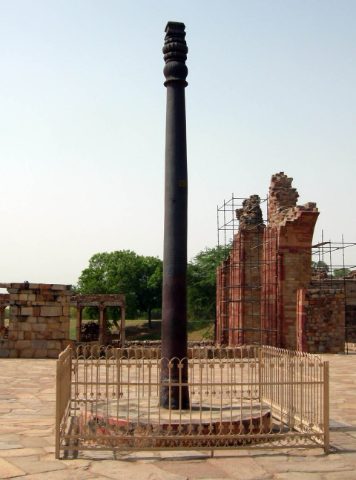
In the courtyard of the Qutb complex in Delhi stands an iron pillar about 7 metres tall and weighing around 6 tonnes. A Sanskrit inscription in Gupta-era script honours a king named Chandra, usually identified with Chandragupta II, dating it to around 400 CE. It was probably moved to Delhi from elsewhere centuries later. For some 1,600 years it has stood in the open air with remarkably little rust.
This is no mystery metal. Studies led by R. Balasubramaniam of IIT Kanpur showed that the iron is unusually rich in phosphorus, and that over time a thin, protective layer forms on its surface, including a compound called misawite, which slows further corrosion. Delhi’s fairly dry climate helps. The real marvel is the skill of the smiths who forge-welded such a huge mass of iron by hand.
Date: c. 400 CE (Gupta period)
Size: About 7 m tall, about 6 tonnes
Why little rust: High phosphorus iron and a protective surface film
Darshniks’ Take: A real wonder of Indian metallurgy with a scientific explanation, which makes it more impressive, not less. Admire it as craft, not as magic.
For centuries, swords made in the Middle East from “Damascus steel” were famous for their strength and for the flowing, watery patterns on their blades. The raw material was wootz, a high-carbon crucible steel made in southern India and Sri Lanka, where iron and carbon-rich plant matter were sealed in clay crucibles and melted. Wootz ingots were traded westwards for well over a thousand years.
The traditional method was lost by the 19th century, possibly as the particular ores, with tiny traces of elements such as vanadium, ran out. Modern metallurgists, notably J. D. Verhoeven and A. H. Pendray, have reproduced the patterned blades, and a 2006 study reported carbon nanotube-like structures in a 17th-century blade, though what they contribute is debated. A once-“lost” technique has been largely understood, and it began in India.
Made in: Southern India and Sri Lanka (crucible steel)
Famous as: “Damascus” blades with watery patterns
Status: Method lost by the 1800s; largely reconstructed today
Darshniks’ Take: One of India’s great contributions to world technology, prized for over a thousand years. Its story is better told as a triumph of skill than as a lost secret.
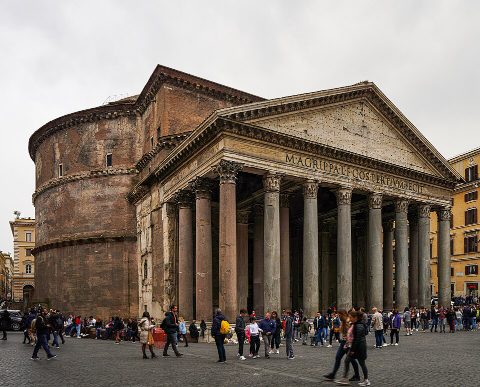
The Pantheon in Rome, finished around 125 CE, still has the largest unreinforced concrete dome in the world. Roman harbour walls built of concrete have stood in seawater for two thousand years, while modern concrete in the sea can crumble within decades. The Romans mixed lime with volcanic ash (pozzolana), and the ancient engineer Vitruvius described the materials.
Research has recently explained much of the durability. A 2017 study found that seawater seeping into Roman harbour concrete grows new interlocking minerals that strengthen it over time. A 2023 study led by MIT suggested the Romans used “hot mixing” with quicklime, leaving small white lime lumps that can later dissolve and re-harden inside cracks, so the concrete partly heals itself. Engineers are now studying these ideas for longer-lasting modern concrete.
Key ingredients: Lime and volcanic ash (pozzolana)
Showpiece: The Pantheon dome, c. 125 CE
Secret: Minerals that grow in seawater; self-healing lime clasts
Darshniks’ Take: Ancient engineering is now teaching modern engineers how to build longer-lasting structures. That is the most practical kind of lost knowledge recovered.

From the 670s CE the Byzantine Empire defended Constantinople with a terrifying weapon: a liquid fire pumped through siphons from the prows of warships, which kept burning on water. Byzantine writers credit its invention to Kallinikos, an architect from Syria, and it helped the city survive Arab sieges in the late 7th and early 8th centuries.
Its recipe was a state secret so closely guarded that it was eventually lost. Historians think it was based on petroleum, perhaps from natural seeps around the Black Sea, possibly mixed with resins, but no one knows for certain, and the pressurised siphon system mattered as much as the liquid. It is a real lost technology, lost not because it was impossible but because it was hidden too well.
First used: 670s CE, Byzantine navy
Inventor (by tradition): Kallinikos of Heliopolis
Recipe: Unknown; probably petroleum-based
Darshniks’ Take: A genuinely lost technology, lost because it was too secret rather than too advanced. Secrecy can protect knowledge for a while and then destroy it.
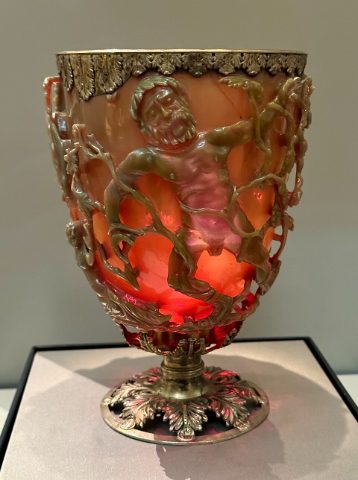
In the British Museum is a Roman glass cup from the 4th century CE, carved with the myth of King Lycurgus. Lit from the front it looks jade green; lit from inside it glows red. For centuries the effect was unexplained.
In the 1990s scientists found the glass contains tiny particles of gold and silver, tens of nanometres across, which scatter and absorb light differently depending on its direction. The Romans did not know about nanoparticles; they probably discovered the effect by accident, adding tiny amounts of metal to molten glass, and then used it deliberately. It is a beautiful early example of what we now call nanotechnology.
Date: 4th century CE, Roman
Effect: Green in reflected light, red when lit from within
Cause: Gold and silver nanoparticles in the glass
Darshniks’ Take: Roman craftsmen achieved a nanotechnology effect without any theory of it. Practical experiment can run centuries ahead of understanding.
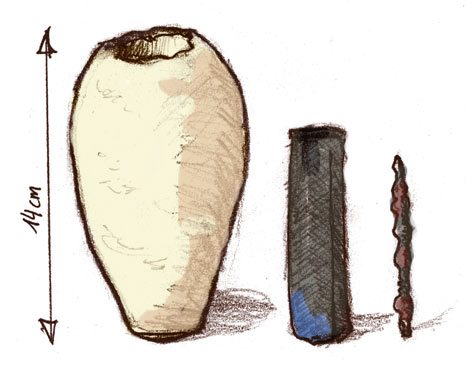
In the 1930s the German archaeologist Wilhelm König described a clay jar from near Baghdad containing a copper cylinder and an iron rod. He suggested it might have been a galvanic cell, an ancient battery, perhaps used for electroplating. The objects are usually dated to the Parthian or Sasanian period, roughly 2,000 years ago.
The idea became famous, but most archaeologists reject it. No wires or other electrical equipment were found, there is no ancient electroplated object that needs a battery to explain it, and similar jars were used to store sacred scrolls. Replicas filled with vinegar or grape juice can produce a feeble current, but that proves only that copper, iron and acid make a little electricity, not that anyone used it so.
Described: 1930s, Wilhelm König
Popular claim: An ancient electric battery
Likely use: Storage jar, perhaps for scrolls
Darshniks’ Take: An intriguing object, but there is no good evidence it was ever used as a battery. A reminder that a modern resemblance is not proof of a modern purpose.
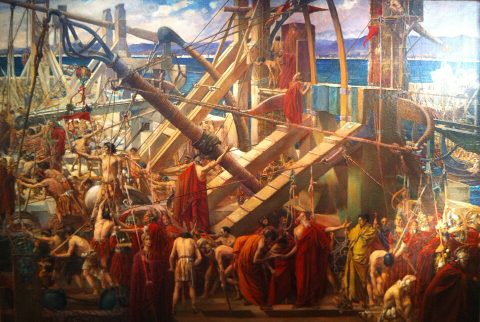
Archimedes really did defend Syracuse against a Roman siege in 214–212 BCE with ingenious machines, including cranes or “claws” that lifted ships out of the water, described by the historian Polybius. The story that he also set the Roman fleet on fire by focusing sunlight with mirrors appears only in writers many centuries later.
Modern tests have been mostly unconvincing. In 2005 MIT students did manage to ignite a wooden boat model using 127 mirrors, but only by holding it still for many minutes on a sunny day; moving ships at sea would be much harder. The burning mirrors are probably legend. The real Archimedes, with his mathematics and war machines, is impressive enough.
Siege of Syracuse: 214–212 BCE
Documented: Cranes and catapults (Polybius)
Mirrors: Reported only centuries later; probably legend
Darshniks’ Take: Archimedes was a genuine genius and a real military engineer. The burning mirrors are probably a later legend, and he does not need it.
Ancient engineers worked without modern science, but not without careful observation, trial and error, and craft passed down through generations. When an ancient object seems impossible, the usual answer is not lost aliens but lost skill: methods kept secret, forgotten when workshops closed, or never written down.
Antikythera mechanism on Wikipedia · Iron pillar of Delhi on Wikipedia · Roman concrete on Wikipedia