From a lake of skeletons in the Himalayas to a temple carved out of a single rock. Pick a place below.
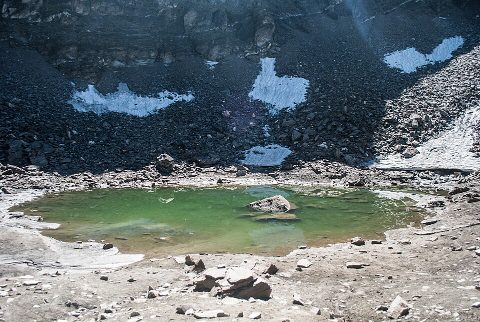
High in the Himalayas of Uttarakhand, at about 5,000 metres, lies a small glacial lake. In 1942 a British forest ranger reported hundreds of human skeletons around it, visible when the snow melts. For decades the favourite explanations were a lost army, an epidemic, or pilgrims killed together in a sudden storm; a local song tells of a goddess sending hail on a king’s party that offended her.
In 2019 a large international study of ancient DNA, published in Nature Communications, changed the picture. The remains belong to at least three distinct groups who died at different times: most were people with South Asian ancestry who died around the 7th to 10th centuries CE, while another group, with ancestry typical of the eastern Mediterranean, died around 1,000 years later. How a group from that region came to die at a remote Himalayan lake is still unexplained. The deaths were not one event, and the mystery is now more interesting than the legend.
Where: Uttarakhand, about 5,000 m above sea level
Reported: 1942
DNA study: 2019: several groups, dying centuries apart
Darshniks’ Take: DNA turned a ghost story into a real scientific puzzle: why did people from the eastern Mediterranean die at a remote Himalayan lake? That question is still open.
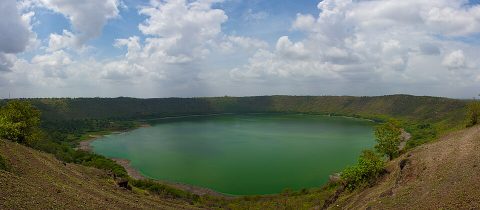
In Buldhana district of Maharashtra lies a nearly round lake, about 1.2 kilometres across, inside a crater. It was made by a meteorite striking the Deccan’s volcanic basalt, one of the very few well-preserved impact craters in basalt anywhere on Earth, which makes it valuable for comparison with craters on the Moon and Mars. Its age was long estimated at about 50,000 years; a 2019 study using argon dating suggested it is far older, around 570,000 years.
The lake is both salty and alkaline, unusual for this region, and in 2020 its water turned pink for a few weeks. Scientists traced the colour to a bloom of salt-loving microbes, helped by lower water levels and higher salinity, not to anything supernatural. The surrounding forest holds old temples, including the Daitya Sudan temple, linked to a legend of Vishnu slaying a demon there.
Formed by: A meteorite impact in basalt
Diameter: About 1.2 km
Age: Estimates range from c. 50,000 to c. 570,000 years
Darshniks’ Take: A rare, well-preserved impact crater in volcanic rock, valuable to planetary scientists. The pink water had a microbial explanation, which is still a small wonder.
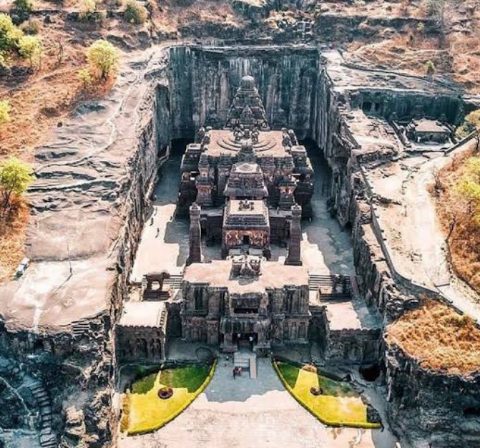
Cave 16 at Ellora in Maharashtra is not a cave at all but a full-size temple, with courtyards, a shrine, pillars and life-size elephants, carved downward and inward from a single mass of basalt rock. It is usually attributed to the Rashtrakuta king Krishna I in the 8th century CE and is dedicated to Shiva, imagined as his mountain home Kailasa.
Popular videos sometimes claim it is “impossible” for humans and must involve lost technology. The evidence says otherwise: chisel marks are visible everywhere, and the method, cutting trenches into the hillside and then carving from the top down, was used at other rock-cut sites in India. Estimates of how much rock was removed run to hundreds of thousands of tonnes. The real wonder is the planning, skill and labour of the workers, not any mystery machine.
Where: Ellora Caves (Cave 16), Maharashtra
Built: 8th century CE, usually credited to Krishna I
Method: Carved top-down from one rock mass
Darshniks’ Take: Carved by human hands, top-down, from a single rock. Calling it “impossible” takes the credit away from the skilled workers who actually made it.
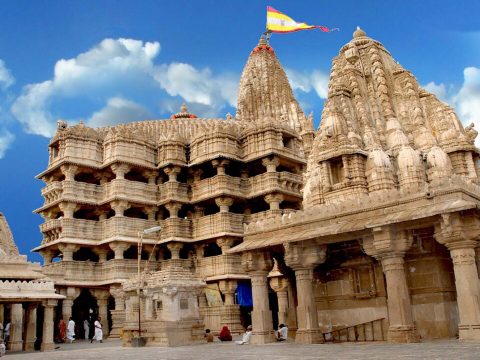
In the Mahabharata and the Puranas, Dwarka is Krishna’s golden city on the western sea, swallowed by the ocean after his death. Modern Dwarka in Gujarat is one of Hinduism’s holiest pilgrimage towns. From the 1980s the National Institute of Oceanography, led by the marine archaeologist S. R. Rao, explored the sea off Dwarka and Bet Dwarka and reported stone structures and anchors under water.
What the finds prove is debated. Rao proposed dates in the mid-second millennium BCE; other archaeologists argue that many of the stone anchors and blocks are from much later historical periods, and that a submerged structure is not automatically the city of the epic. The Archaeological Survey of India has carried out new underwater surveys in recent years. The honest summary: there are real ancient remains off this coast, but linking them to Krishna’s city remains a matter of faith and interpretation, not settled evidence.
Where: Off Dwarka and Bet Dwarka, Gujarat
Explored: From the 1980s, National Institute of Oceanography
Status: Real underwater remains; dates and meaning debated
Darshniks’ Take: There are real underwater remains off Dwarka; whether they are Krishna’s city is a matter of interpretation and faith. Keeping those two questions separate respects both.
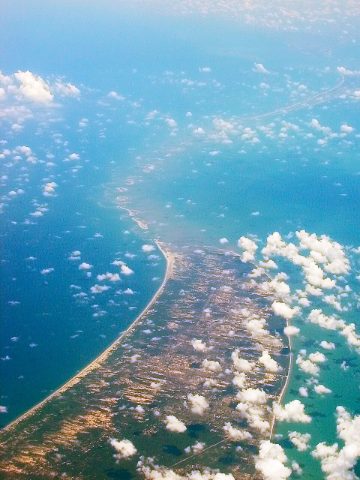
Between Rameswaram in Tamil Nadu and Mannar Island in Sri Lanka runs a chain of limestone shoals and sandbanks about 48 kilometres long. In the Ramayana, Rama’s army of vanaras builds a bridge of floating stones across the sea to Lanka; many devotees see the shoals as its remains. Arab and later European geographers called it Adam’s Bridge.
Geologists explain it as a natural formation of sand, coral and limestone built up as sea levels changed; parts of it may have been walkable in historical times, and storms are said to have broken the link in the 15th century. In 2007 the Government of India told the Supreme Court it saw no historical evidence that it was man-made, then withdrew that statement after protests. Faith and geology here answer different questions, and the site is also an important marine ecosystem worth protecting either way.
Length: About 48 km of shoals
Tradition: Rama’s bridge to Lanka (Ramayana)
Geology: Natural sand, coral and limestone formation
Darshniks’ Take: Geologists describe a natural formation; devotees see Rama’s bridge. Science and faith answer different questions here, and the site deserves protection either way.
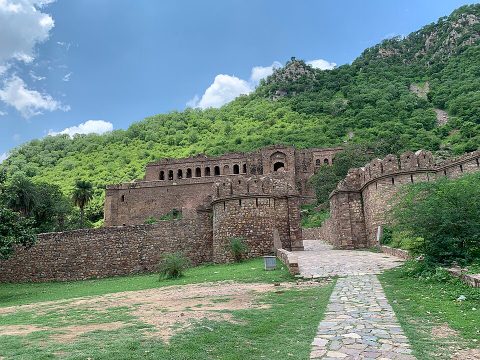
In Rajasthan’s Alwar district stand the ruins of Bhangarh, a town founded in the late 16th century with a fort, temples, markets and havelis, built by the Kachwaha rulers of Amber. It was gradually abandoned, and the ruins became the subject of ghost stories: a curse by an ascetic, or by a sorcerer who fell in love with a princess.
An Archaeological Survey of India board at the entrance famously forbids entry before sunrise and after sunset, which has made Bhangarh known as “India’s most haunted place”. Such timings are normal for protected monuments, for visitors’ safety. Historians point to more ordinary reasons for its decline, such as famine, war and shifting political power. It is a fine example of how a deserted ruin attracts legends.
Where: Alwar district, Rajasthan
Founded: Late 16th century
Legend: Cursed and haunted; decline more likely famine and war
Darshniks’ Take: A beautiful ruin with a famous ghost story. Its decline has ordinary historical explanations, and the visiting hours are a safety rule, not a warning about spirits.
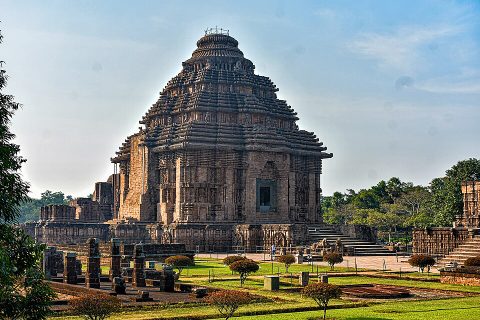
Built in the 13th century by King Narasimhadeva I of the Eastern Ganga dynasty, the Sun Temple at Konark in Odisha was designed as the chariot of the Sun god Surya, with 24 great carved stone wheels and seven horses. Some of the wheels can work as sundials: the shadow of a spoke shows the time of day.
A persistent legend says a giant lodestone at the top held the iron-framed idol floating in the air and pulled passing ships’ compasses off course, until sailors removed it. There is no evidence for this. The main sanctuary has long since collapsed, and in 1903 the British filled the surviving assembly hall with sand to stop it falling; the Archaeological Survey began a project to remove the sand safely only in recent years. A UNESCO World Heritage Site since 1984.
Built: 13th century, Narasimhadeva I
Design: Surya’s chariot: 24 wheels, 7 horses
Legend: Floating idol held by a magnet (no evidence)
Darshniks’ Take: The temple and its sundial wheels are real masterpieces; the floating idol and its magnet are legend. The truth is impressive enough.
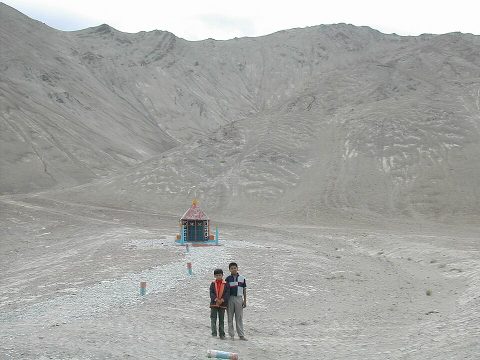
On the Leh–Kargil road in Ladakh a signboard announces a “Magnetic Hill” where cars left in neutral appear to roll uphill, supposedly pulled by magnetic force. It is a popular stop for travellers, and some say aircraft change altitude to avoid it.
It is an optical illusion, known as a gravity hill, found in many countries. Because the horizon is hidden or sloping and there are few reliable reference points, a slight downhill stretch looks like an uphill one. Magnetism strong enough to pull a car would also wreck every phone and watch nearby. The best mysteries are the ones you can test, and this one has a satisfying answer.
Where: Leh–Kargil highway, Ladakh
Claim: Cars roll uphill by magnetism
Explanation: Optical illusion (a “gravity hill”)
Darshniks’ Take: An optical illusion, not magnetism. It is a fun one to test yourself: the slope is downhill even though your eyes say otherwise.
Many of India’s mysterious places are also sacred places, and the two kinds of truth need not fight. Archaeology and science ask what happened and when; tradition asks what a place means. The best way to honour these sites is to protect them, read the evidence honestly, and enjoy the stories as stories.
Roopkund on Wikipedia · Lonar Lake on Wikipedia · Kailasa temple, Ellora on Wikipedia