Diogenes was born around 412–404 BCE in Sinope, a Greek city on the Black Sea. According to the ancient stories, he and his father, who ran the mint, were exiled for defacing the currency. Diogenes later turned “deface the currency” into his life’s mission: to strike out false values wherever he found them.
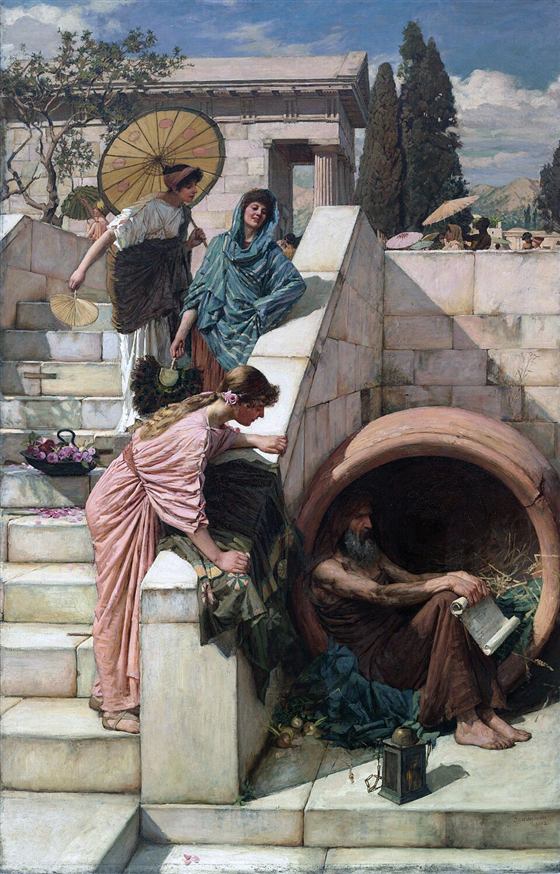 John William Waterhouse, Diogenes, 1882, public domain
In Athens he lived in a large storage jar in the marketplace, owned almost nothing and did in public what others hid. People called him kyon, “dog”, which gave his followers their name: the Cynics. His point was that most of what society calls necessary is not. Seeing a child drink from cupped hands, it is said, he threw away his cup: a child had beaten him in plain living.
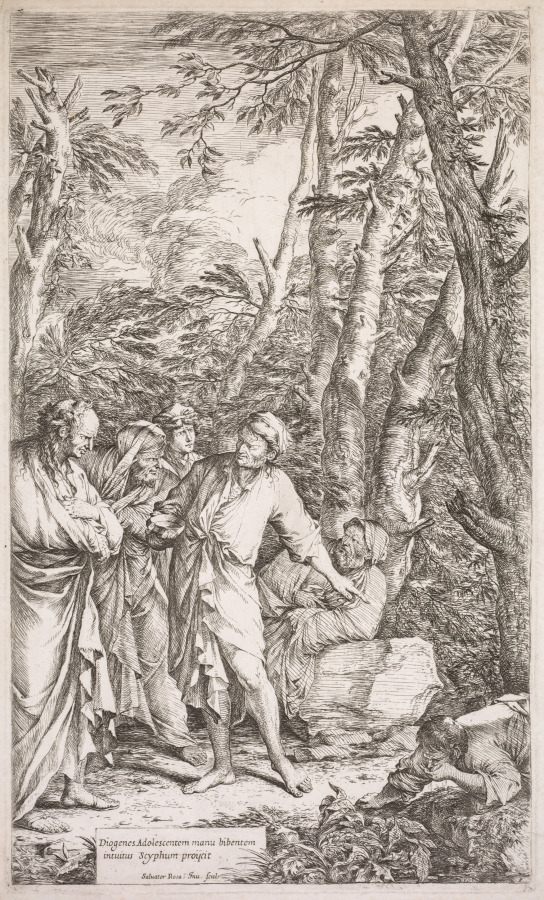 Salvator Rosa, Diogenes Casting Away His Cup, etching, 1662 — Cleveland Museum of Art, CC0
Almost everything we know comes from anecdotes collected centuries later by Diogenes Laertius, so treat them as legend with a core of truth.
“He lit a lamp in broad daylight and said, as he went about, “I am looking for a man.””Diogenes Laertius, Lives VI.41 (tr. R. D. Hicks)
“When he was sunning himself in the Craneum, Alexander came and stood over him and said, “Ask of me any boon you like.” To which he replied, “Stand out of my light.””Diogenes Laertius, Lives VI.38 (tr. R. D. Hicks)
When Plato defined a human being as a featherless biped and was applauded, Diogenes plucked a chicken, brought it to Plato’s school and announced, “Here is Plato’s man.” Plato added “with broad nails” to the definition (VI.40).
“Asked where he came from, he said, “I am a citizen of the world.””Diogenes Laertius, Lives VI.63 (tr. R. D. Hicks)
The Greek word he used, kosmopolitēs, is the origin of “cosmopolitan”.
By tradition Diogenes died in Corinth in 323 BCE, the same year as Alexander. His pupil Crates taught Zeno of Citium, who founded Stoicism, so Marcus Aurelius and Epictetus are his philosophical grandchildren. His shamelessness was a method: if you can live without approval, possessions and comfort, no one can take your freedom away.
Cynicism was not just provocation; it was training, askesis. Diogenes Laertius says Diogenes rolled in hot sand in summer and embraced snow-covered statues in winter, to harden himself against discomfort (Lives VI.23). The aim was autarkeia, self-sufficiency: needing so little that nothing could be taken from you. Shamelessness was part of the same discipline. If you no longer fear looking foolish, you are free to say and do what is right.
Try it: choose one comfort and go without it for a week. Notice how much of your unease was habit, not need.
Three quick questions on Diogenes. The wrong answers describe other thinkers on Darshniks.
Who was Diogenes?
Which of these is Diogenes's big idea?
What is Diogenes best known for?
Diogenes on Wikipedia · Diogenes Laertius, Book VI (Wikisource) · Internet Encyclopedia of Philosophy: Cynics · Epicurus
