Epicurus was born on the island of Samos in 341 BCE. Around 306 BCE he bought a house with a garden outside Athens and founded a school there, simply called the Garden. Unusually for the time, it welcomed women and slaves. Its members lived simply, on bread, water and a little cheese for a feast, and valued friendship above almost everything.
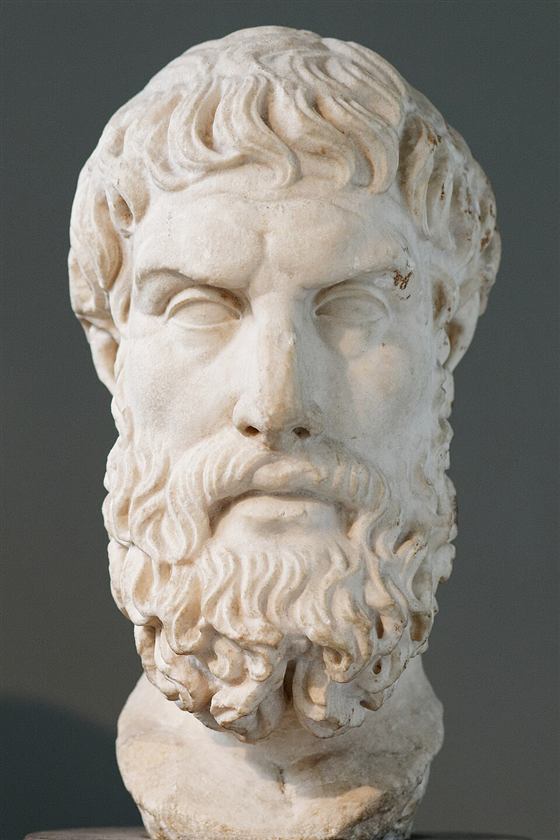 Roman bust of Epicurus, British Museum, public domain
“Of all the means which are procured by wisdom to ensure happiness throughout the whole of life, by far the most important is the acquisition of friends.”Principal Doctrines 27, in Diogenes Laertius X (tr. R. D. Hicks)
Epicurus said pleasure is the goal of life, and was misunderstood for two thousand years. His pleasure is not feasting but calm: no pain in the body, no turmoil in the mind. You can read his own words on our Happiness page. Many desires, he taught, are neither natural nor necessary, like the craving for fame or luxury, and chasing them only brings anxiety.
Following Democritus, Epicurus held that everything is made of atoms moving in the void, and that the gods, if they exist, take no interest in us. This was meant to comfort, not to shock: there is no divine punishment to dread, and no afterlife to fear. The Roman poet Lucretius later set the whole system to verse in On the Nature of Things, whose rediscovery in 1417 helped shape the Renaissance and modern science.
“Death, therefore, the most awful of evils, is nothing to us, seeing that, when we are, death is not come, and, when death is come, we are not.”Letter to Menoeceus 125, in Diogenes Laertius X (tr. R. D. Hicks)
Later Epicureans, such as Philodemus, summed up the teaching as a tetrapharmakos, a four-part medicine:
Do not fear the gods. Do not worry about death. What is good is easy to get. What is terrible is easy to endure.
“Is God willing to prevent evil, but not able? Then he is not omnipotent. Is he able, but not willing? Then he is malevolent…” The famous “Epicurean paradox” is not found in any surviving writing of Epicurus. The Christian writer Lactantius credited a version of the argument to him, and David Hume made it famous in his Dialogues Concerning Natural Religion (1779).
More famous misquotes: Quotes They Never Said
Read Epicurus in his own words: Epicurus quotes with sources.
The core of Epicurus’s practical teaching is a sorting of desires (Letter to Menoeceus 127). Some are natural and necessary: food, shelter, friendship. Some are natural but not necessary: luxurious food, sex. Some are neither: fame, power, wealth beyond need. Satisfy the first, enjoy the second when they come easily, and let go of the third, which have no limit and so can never be satisfied.
The Letter to Menoeceus, preserved by Diogenes Laërtius, is only a few pages long and contains nearly his whole ethics. Read it once quickly, then once slowly, with the four-part cure beside you.
Three quick questions on Epicurus. The wrong answers describe other thinkers on Darshniks.
Who was Epicurus?
Which of these is Epicurus's big idea?
What is Epicurus best known for?
Epicurus on Wikipedia · Stanford Encyclopedia: Epicurus · Diogenes Laertius, Book X (Wikisource) · Happiness
