The Book of the Dead was not a single book but a collection of around two hundred spells, written on papyrus rolls and buried with the dead in ancient Egypt from about 1550 BCE. The Egyptians called it the Book of Coming Forth by Day. Its spells were a guide and protection for the soul on its dangerous journey through the underworld, the Duat, towards eternal life in the Field of Reeds.
Wealthy Egyptians commissioned beautifully illustrated copies; one of the finest, the Papyrus of Ani (about 1250 BCE), is in the British Museum.
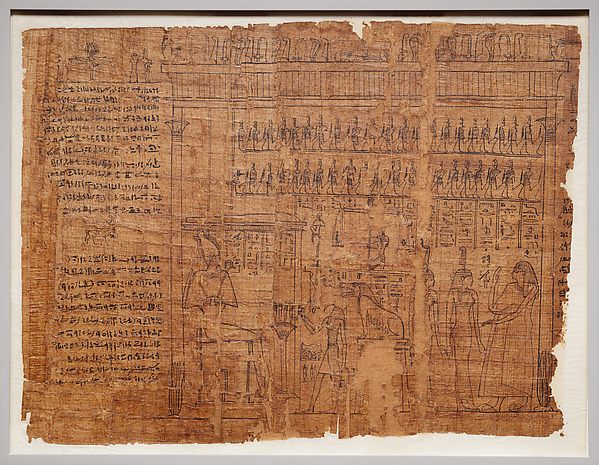 The judgment before Osiris, from a funerary papyrus, c. 230–150 BCE — The Metropolitan Museum of Art, public domain
The most famous scene, from chapter 125, is the judgment of the dead. The jackal-headed god Anubis weighs the dead person’s heart on a scale against a single feather, the feather of Maat, goddess of truth, justice and cosmic order. Thoth, the ibis-headed god of writing, records the result. A heart heavy with wrongdoing is devoured by Ammit, a monster part crocodile, part lion, part hippopotamus. A heart in balance with the feather passes on to Osiris and eternal life.
Before the weighing, the dead person declares their innocence before the gods, in a list sometimes called the “negative confession”:
“I have not caused pain. I have not let any man hunger. I have made no one to weep. I have not committed murder.”Book of the Dead, chapter 125 (tr. E. A. Wallis Budge)
The declarations are one of humanity’s oldest written statements of a moral code: not harming others, not stealing, not lying, not oppressing the weak, not letting anyone go hungry. Over three thousand years ago, the Egyptians imagined that how you treated others would be weighed when your life was over. The image of judgment by scales passed into later traditions, and the feather of Maat remains one of the most striking symbols of conscience ever drawn.
Period: New Kingdom onward, from about 1550 BCE to the 1st century BCE
Contents: around 200 spells, never one fixed text; each copy was a personal selection
Related: Ancient Egypt, Ancient Symbols (the ankh), The Epic of Gilgamesh
The Egyptians called these texts the Spells for Coming Forth by Day: guidance for the dead to leave the tomb by day, travel safely and join the gods. The name “Book of the Dead” comes from the German Egyptologist Karl Richard Lepsius, who published a long version in 1842.
The finest surviving copy, the Papyrus of Ani, is over 23 metres long and is in the British Museum.
Book of the Dead on Wikipedia · Budge’s translation (Project Gutenberg) · British Museum: the Papyrus of Ani · Ancient Egypt
