The Epic of Gilgamesh is the oldest great work of literature to survive, written in cuneiform on clay tablets in ancient Mesopotamia, in what is now Iraq. Its questions are the oldest ones too: what is friendship worth, why must we die, and how should a mortal live? Gilgamesh himself was probably a real king of the city of Uruk, ruling around 2700 BCE, who became a legend.
Sumerian poems about Gilgamesh were written down by around 2100 BCE. These were woven into a single Akkadian epic, and the best-known “standard” version, in twelve tablets, is credited to a scribe called Sîn-lēqi-unninni, late in the second millennium BCE. Copies were kept in the library of the Assyrian king Ashurbanipal at Nineveh, which was sacked in 612 BCE; buried in the ruins, thousands of tablets survived.
The epic was forgotten for some two thousand years. In 1872 George Smith, a self-taught Assyriologist at the British Museum, read Tablet XI and found a flood story strikingly like Noah’s, and the discovery made headlines. New pieces still turn up: in 2015 scholars published a tablet from the Sulaymaniyah Museum in Iraq that adds new lines to the cedar forest episode.
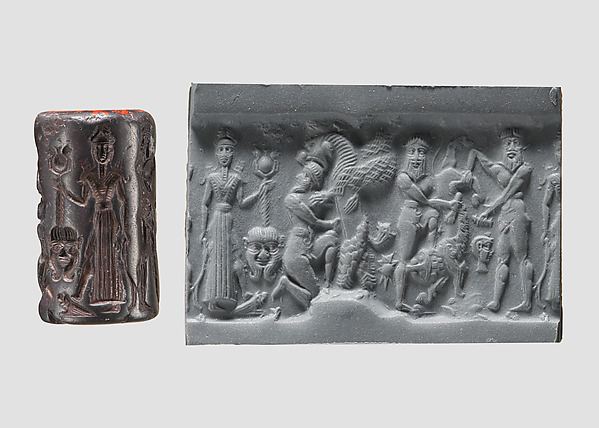 Cylinder seal and its impression: heroes in combat and the head of Humbaba, the forest guardian Gilgamesh kills, Babylonian, c. 2000–1600 BCE — The Metropolitan Museum of Art, public domain
The tyrant king — Gilgamesh, two-thirds god and one-third man, oppresses Uruk. The gods create a wild man, Enkidu, as his equal.
Friendship — after wrestling to a standstill, they become inseparable, kill the forest guardian Humbaba and the Bull of Heaven.
Death — the gods decree that Enkidu must die. Gilgamesh, shattered, refuses to bury him until a worm falls from his friend’s nose.
The search — terrified of his own death, he crosses the waters of death to find Utnapishtim, the one man granted immortality after surviving the great flood.
The plant and the snake — he wins a plant that restores youth, but while he bathes a snake steals it and sheds its skin.
Return — he comes home to Uruk empty-handed and shows the boatman the city’s great walls: the work of human hands is what lasts.
In an Old Babylonian version of the epic, the tavern-keeper Siduri tells the grieving king that the life he seeks he will not find; the gods kept life for themselves and gave death to humanity. So, she says, fill your belly, make merry day and night, wear clean clothes, wash your head, delight in the child who holds your hand and the wife in your embrace, for this is what is given to human beings.
It is a startlingly modern answer, close to Ecclesiastes and to Epicurus centuries later: not eternity, but ordinary life, fully lived.
Standard version: 12 tablets in Akkadian, credited to Sîn-lēqi-unninni
Oldest material: Sumerian poems from around 2100 BCE
Related: Rise and Fall of Ancient Empires, Lost Texts, Grief and Loss
Where to start: Andrew George’s translation is the scholarly standard; Stephen Mitchell’s popular book is a free poetic version, not a translation.
Epic of Gilgamesh on Wikipedia · Britannica: Epic of Gilgamesh · The British Museum flood tablet · Lost Texts