Rabindranath Tagore was born on 7 May 1861 into a wealthy, brilliant family in Calcutta (Kolkata), the youngest of thirteen surviving children. He hated school and largely taught himself. Over a long life he wrote poems, songs, plays, novels, short stories and essays, composed more than two thousand songs, still sung as Rabindra Sangeet, and in his sixties began to paint.
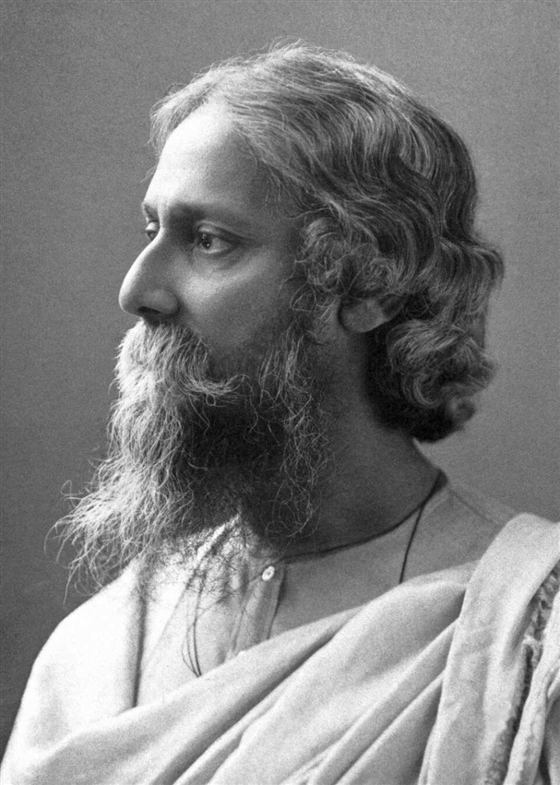 Photograph, 1909, public domain
Gitanjali (“Song Offerings”) is a book of devotional poems he translated into English himself in 1912, with an introduction by W. B. Yeats. In 1913 it made him the first non-European to win the Nobel Prize in Literature. Its most famous poem is a prayer for his country:
“Where the mind is without fear and the head is held high; Where knowledge is free; Where the world has not been broken up into fragments by narrow domestic walls … Into that heaven of freedom, my Father, let my country awake.”Gitanjali, 35 (1912)
Tagore’s religion was closer to the Upanishads and the Baul singers of Bengal than to temple ritual: the infinite is met in nature, in love and in the life of ordinary people. He distrusted anything that divided humans, including nationalism, which he attacked in lectures in Japan and America in 1916–17 as an organised selfishness. In 1921 he founded Visva-Bharati at Santiniketan, a university meant to bring East and West together “where the world makes a home in a single nest”, its motto.
The two greatest Indians of their age admired each other and argued in public. In 1921 Tagore criticised Gandhi’s non-cooperation movement and its burning of foreign cloth as narrow and anti-intellectual; Gandhi replied in Young India that the spinning wheel was a discipline of service, not a creed against reason. When Gandhi called a 1934 earthquake in Bihar a punishment for untouchability, Tagore objected that this was superstition. Their friendship survived it all.
After the Jallianwala Bagh massacre in 1919 he gave up the knighthood the British had awarded him. He wrote the national anthems of both India (Jana Gana Mana) and Bangladesh (Amar Shonar Bangla). In 1930 he met Albert Einstein at Caputh, near Berlin, and their conversation on whether truth exists independently of human minds is still read. He died in Calcutta on 7 August 1941.
Read Tagore in his own words: Tagore quotes with sources.
In April 1919 British troops fired on an unarmed crowd at Jallianwala Bagh in Amritsar, killing hundreds. Weeks later Tagore wrote to the Viceroy renouncing the knighthood he had received in 1915, saying the time had come when badges of honour made the shame all the more glaring. It was one of the most powerful protests of the period, made by one man with a pen.
Three quick questions on Rabindranath Tagore. The wrong answers describe other thinkers on Darshniks.
Who was Rabindranath Tagore?
Which of these is Rabindranath Tagore's big idea?
What is Rabindranath Tagore best known for?
Tagore on Wikipedia · Gitanjali (Project Gutenberg) · Nobel Prize: Tagore · Mahatma Gandhi
