Guru Nanak was born in 1469 in Talwandi, now Nankana Sahib in Pakistan, to a Hindu family of the Khatri caste. The stories of his life, the Janamsakhis, were written down after his death and mix memory with legend; they show a boy more interested in questions than in ceremonies, who refused the sacred thread at his coming-of-age because a thread that can break and burn cannot bind the soul.
Janamsakhi painting, 18th–19th century, public domain: Guru Nanak at Mecca, with his companion Mardana
The River
While working as a storekeeper at Sultanpur Lodhi, about thirty years old, he went to bathe in the river and disappeared for three days. When he returned, the tradition says, his first words were: “There is no Hindu, there is no Muslim.” He meant that the labels people fight over matter less than the one God they share and how they live.
The Travels
For more than twenty years Nanak travelled, by tradition as far as Sri Lanka, Tibet, Baghdad and Mecca, with the Muslim musician Mardana, who played the rebab while Nanak sang his hymns. In one famous story he falls asleep at Mecca with his feet pointing toward the Kaaba; when rebuked, he asks to have his feet turned toward a direction where God is not.
Teachings
Ik Onkar — there is one Creator, beyond form, beyond fear and hate, known by grace (the opening of his Mool Mantar)
Naam japna — remembering the divine Name in daily life
Kirat karni — earning an honest living by your own work
Vand chhakna — sharing what you have
Equality — rejecting caste and the idea that women are lesser; everyone eats together in the langar
His hymns, above all the morning prayer Japji Sahib, open the Guru Granth Sahib.
Kartarpur
In his last years Nanak settled at Kartarpur, on the Ravi river, as a farmer, leading a community that worked, sang and ate together. He chose his disciple Lehna, renamed Angad, as the next Guru, and died there in 1539. Kartarpur now lies just inside Pakistan; since 2019 a visa-free corridor lets pilgrims from India visit.
Key Ideas
Hukam, the divine order. Everything happens within God’s will; wisdom is learning to live in tune with it rather than against it (Japji Sahib).
Haumai, ego. The root of suffering is the self-centred “I, I” that separates us from God and from each other; remembering the Name dissolves it.
Truthful living. Truth is higher than everything, Nanak taught, but higher still is truthful living (Guru Granth Sahib, p. 62, in substance). Belief that does not change behaviour counts for little.
Seva and sangat. Selfless service and the company of others on the path, made concrete in the community kitchen, where everyone sits on the floor at the same level.
Women and Equality
In a famous verse of Asa di Var, Nanak asks why women should be called inferior when kings themselves are born of them (Guru Granth Sahib, p. 473, in substance). Sikh congregations do not exclude anyone from worship on grounds of caste or sex, a principle the later Gurus built into the institutions of the community.
Things People Often Get Wrong
“Sikhism is a blend of Hinduism and Islam.” Nanak drew on the devotional language of his time, but Sikhs understand his teaching as a distinct revelation, and it rejects key practices of both traditions, from caste to ritual pilgrimage.
“The stories are history.” The Janamsakhis were written generations later and differ from each other; historians read them as devotional portraits rather than biography.
Living it: the three pillars fit any life. Remember what matters most each day, earn honestly, and share something you have, however small.
Check Yourself
Three quick questions on Guru Nanak. The wrong answers describe other thinkers on Darshniks.
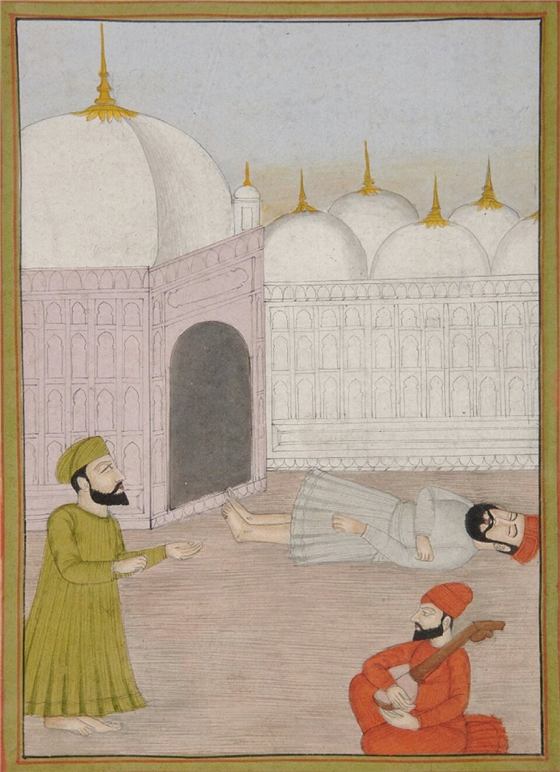 Janamsakhi painting, 18th–19th century, public domain: Guru Nanak at Mecca, with his companion Mardana