Bhakti means loving devotion to God. As a movement, it swept across India over a thousand years, from about the 6th century to the 17th, carried not by priests and Sanskrit texts but by poet-saints singing in the languages ordinary people spoke. It taught that love, not ritual, birth or learning, is the way to the divine, and that anyone, of any caste or gender, can walk it.
Its seed is in the Bhagavad Gita, where Krishna says that a simple offering made with love is enough:
“Whoever offers me with devotion a leaf, a flower, a fruit or water, that offering of love I accept.”Bhagavad Gita 9.26
Tamil Nadu (6th–9th centuries) — the Alvars, devotees of Vishnu, and the Nayanars, devotees of Shiva, sang hymns still used in temples; the philosopher Ramanuja later gave bhakti a philosophical foundation
Karnataka (12th century) — Basava and the Lingayats rejected caste and temple ritual in short poems called vachanas; Akka Mahadevi wandered naked, devoted to Shiva alone
Maharashtra (13th–17th centuries) — Jnaneshwar, Namdev and Tukaram, and the Varkari pilgrimage to Pandharpur that still draws vast crowds each year
North India (15th–17th centuries) — Kabir, Ravidas, Mirabai, Surdas, and Tulsidas, whose Ramcharitmanas made the Ramayana the people’s book
Bengal (16th century) — Chaitanya, who led crowds in ecstatic singing of Krishna’s names, kirtan
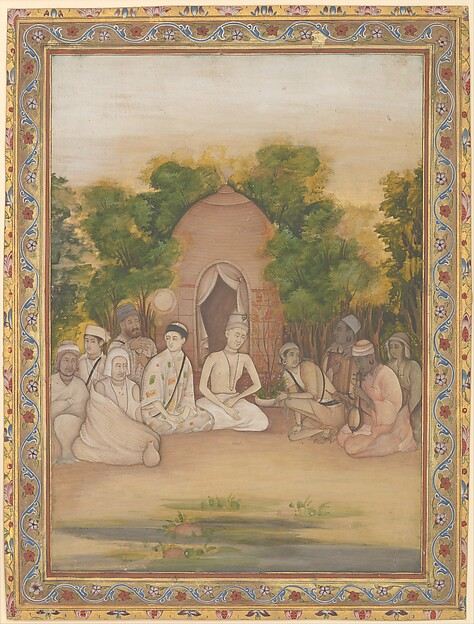 Mir Kalan Khan, A Gathering of Holy Men of Different Faiths, Lucknow, c. 1770–75 — The Metropolitan Museum of Art, public domain
Bhakti saints divided into two streams. Saguna bhaktas, like Mirabai and Tulsidas, loved God with a form and a story: Krishna the flute-player, Rama the just king. Nirguna bhaktas, like Kabir, loved a God beyond all form, found within:
“O servant, where dost thou seek Me? Lo! I am beside thee. I am neither in temple nor in mosque: I am neither in Kaaba nor in Kailash …”Kabir, Songs of Kabir I (tr. Rabindranath Tagore, 1915)
The movement crossed religious lines. It flowed together with Sufism, and its poets, Kabir, Ravidas and Namdev among them, are included in the Guru Granth Sahib beside Guru Nanak. Its legacy lives in India’s devotional music, its pilgrimages, and its long argument that God does not care about caste.
Related: Sufism, the paths of yoga, Ramakrishna, Mystics
The Bhagavata Purana (7.5.23) lists nine forms of bhakti: hearing about God, singing God’s praise, remembering, serving God’s feet, worship, bowing, servitude, friendship and complete self-offering. The list shows how wide devotion was meant to be: from listening to a story to giving your whole life.
Bhakti is the most practical of the Indian paths: you do not need learning, rank or solitude. Sing, listen, serve, or simply bring your attention back, with love, to what you hold sacred, several times a day.
Bhakti movement on Wikipedia · Songs of Kabir (Project Gutenberg) · Kabir · Mirabai
