Hypatia was born in Alexandria, Egypt, sometime between about 350 and 370 CE, the daughter of the mathematician Theon. She became the city’s leading teacher of philosophy, in the tradition of Plato and Plotinus, and of mathematics and astronomy. Students came from far away; one of them, Synesius, later a bishop, wrote her admiring letters asking for help building an astrolabe and a hydrometer.
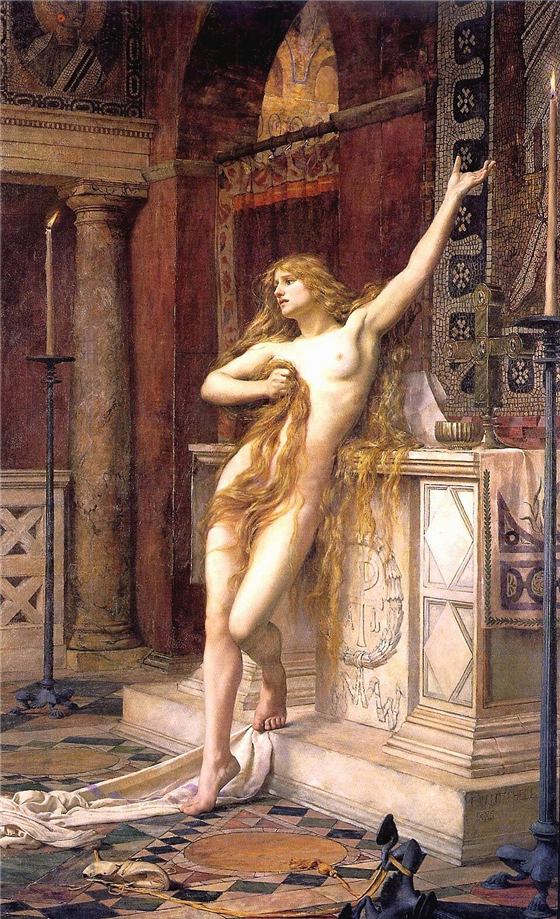 Charles William Mitchell, Hypatia, 1885, public domain. No likeness from her lifetime survives.
The church historian Socrates Scholasticus, writing a generation later, described her:
“There was a woman at Alexandria named Hypatia, daughter of the philosopher Theon, who made such attainments in literature and science, as to far surpass all the philosophers of her own time.”Socrates Scholasticus, Ecclesiastical History VII.15 (tr. A. C. Zenos)
None of her writings survives under her own name. She is reported to have written commentaries on Diophantus’s Arithmetica and Apollonius’s Conics, and to have helped her father edit Ptolemy’s astronomy. She is the first woman mathematician about whom we know a reasonable amount.
In March 415, in a bitter power struggle between Alexandria’s bishop Cyril and its Roman governor Orestes, who was her friend and pupil, rumours spread that Hypatia was turning Orestes against the bishop. A Christian mob seized her in the street and killed her brutally. Socrates Scholasticus, himself a Christian, called the murder a disgrace to the church of Alexandria.
Hypatia has become a symbol of reason destroyed by fanaticism, in books, paintings and the film Agora (2009). Some of the legend is not history: she was not killed in, or because of, the burning of the Library of Alexandria, which had long since declined, and her death was as much about city politics as about religion or science.
“Reserve your right to think, for even to think wrongly is better than not to think at all.” Not from any ancient source. It first appears in Elbert Hubbard’s Little Journeys to the Homes of Great Teachers (1908), a popular, partly imagined portrait, where Hubbard puts it in the mouth of her father, Theon.
More famous misquotes: Quotes They Never Said
The works she is reported to have commented on were among the hardest of antiquity. Diophantus’s Arithmetica deals with equations and their whole-number solutions, the ancestor of algebra and number theory. Apollonius’s Conics describes the curves made by slicing a cone: the ellipse, parabola and hyperbola. Over a thousand years later, Kepler would discover that the planets move in ellipses, and those curves became the shape of modern astronomy.
Later sources describe her lecturing in public in the philosopher’s cloak, on Plato and Aristotle, to anyone who wanted to listen, and being consulted by the city’s magistrates. Her students included pagans and Christians alike; Synesius remained devoted to her after becoming a bishop. That openness, and her closeness to the governor, made her a political target.
Her modern legend began with Charles Kingsley’s 1853 novel Hypatia; for the historical woman, read Edward Watts’s biography.
Three quick questions on Hypatia. The wrong answers describe other thinkers on Darshniks.
Who was Hypatia?
Which of these is Hypatia's big idea?
What is Hypatia best known for?
Hypatia on Wikipedia · Socrates Scholasticus, Ecclesiastical History VII.15 · Women in philosophy (Wikipedia) · Plato
