You know what you should be doing. You are doing something else. Procrastination feels like a modern disease of phones and deadlines, but philosophers two thousand years ago were already puzzled by it: why would anyone knowingly choose the worse option? Their answers are surprisingly practical.
Seneca’s essay On the Shortness of Life opens with a reversal: life is not short, we make it short by wasting it. His first letter to his friend Lucilius turns that into an instruction.
“… hold every hour in your grasp. Lay hold of to-day’s task, and you will not need to depend so much upon to-morrow’s. While we are postponing, life speeds by.”Seneca, Letters to Lucilius 1.2 (tr. R. M. Gummere)
Even the ruler of Rome argued with his own bed. His answer was to remind himself what he was for.
“In the morning when thou risest unwillingly, let this thought be present — I am rising to the work of a human being.”Marcus Aurelius, Meditations 5.1 (tr. George Long)
Socrates had argued that no one knowingly chooses what is worse; if we do wrong, we simply didn’t know better (Plato, Protagoras 358c). Aristotle thought that couldn’t be the whole story. He called the failure akrasia, weakness of will: you hold the right judgment in general, but in the moment a nearer pleasure crowds it out, like someone asleep or drunk who “has” knowledge without using it. The cure is not more information but better habits, so the right choice is already the easy one.
Aristotle, Nicomachean Ethics VII.1–3
Arjuna wants to put down his bow and do nothing. Krishna’s reply is blunt: action is better than inaction, and not even the body can be kept alive without acting. Do the work that is yours, and let go of your anxious grip on how it turns out; that grip is often exactly what keeps us from starting.
Bhagavad Gita 3.8 and 2.47
“The tree which fills the arms grew from the tiniest sprout; the tower of nine storeys rose from a small heap of earth; the journey of a thousand li commenced with a single step.”Tao Te Ching 64 (tr. James Legge)
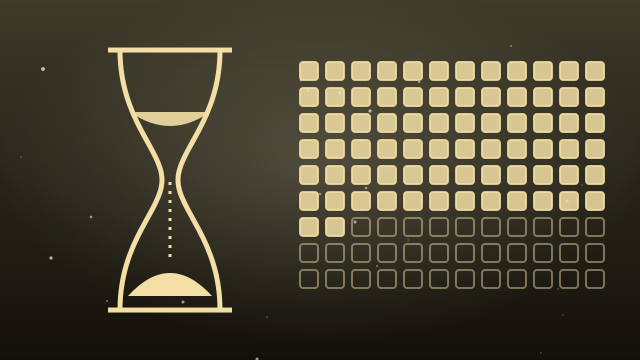
 Illustration: the pause before the first step
“Procrastination is the thief of time.” Often treated as an anonymous proverb, it comes from the English poet Edward Young’s Night Thoughts (1742).
More famous lines and their real authors: Quotes They Never Said
Go deeper: 7 Days with the Stoics, a short daily journey, or Seneca’s life and ideas.
Seneca, On the Shortness of Life · Seneca, Letter 1 (full text) · Stanford Encyclopedia: Weakness of Will · Work–Life Balance