Arthur Schopenhauer was born in Danzig (now Gdańsk) in 1788, the son of a merchant who wanted him to go into business. After his father’s probable suicide he turned to philosophy. At thirty he published his masterpiece, The World as Will and Idea (1818), and it sold almost nothing. Lecturing in Berlin, he defiantly scheduled his classes at the same hour as the famous Hegel’s, and hardly any students came.
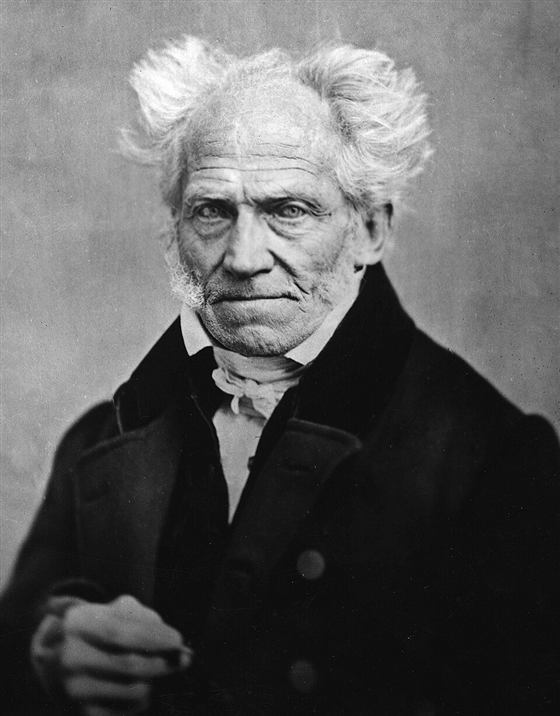 Photograph by Johann Schäfer, 1859, public domain
Schopenhauer began from Kant: we never see things as they are in themselves, only as they appear to us.
“The world is my idea: this is a truth which holds good for everything that lives and knows.”The World as Will and Idea, Book I, §1 (tr. R. B. Haldane and J. Kemp)
But behind appearances, he argued, lies one blind, restless striving he called will, felt directly in our own desires and at work in everything from gravity to sexuality. Because will is endless wanting, life swings between pain when we lack something and boredom when we have it. That makes him philosophy’s great pessimist.
Art — in contemplating beauty we briefly stop wanting; music above all expresses the will itself.
Compassion — seeing that the same will suffers in every creature is the foundation of morality. He was an early defender of animals.
Renunciation — the saint and the ascetic quiet the will altogether, as the Buddhist and Hindu traditions taught.
Schopenhauer was among the first major European philosophers to take Indian thought seriously. He read the Upanishads in a Latin translation every day, kept a statue of the Buddha, and named his poodles Atma. In the preface to his masterpiece he wrote that access to the Vedas,
“opened to us through the Upanishads, is in my eyes the greatest advantage which this still young century enjoys over previous ones.”The World as Will and Idea, preface to the first edition (tr. Haldane and Kemp)
Recognition came only with a book of essays, Parerga and Paralipomena, in 1851. He died in Frankfurt in 1860, by then famous. His influence was enormous: Wagner, Nietzsche, Tolstoy, Thomas Mann and Freud all drew on him, and Einstein liked to quote his line that a man can do what he wants, but cannot want what he wants.
“All truth passes through three stages. First, it is ridiculed. Second, it is violently opposed. Third, it is accepted as being self-evident.” Not found in his writings. It seems to have grown from a real remark in the same preface: truth is allowed “only a brief triumph … between the two long periods in which it is condemned as paradoxical or disparaged as trivial”.
More famous misquotes: Quotes They Never Said
In his late essays Schopenhauer tells a parable. On a cold winter day, porcupines huddle together for warmth, but their quills prick them and they move apart; the cold drives them back together, and so on, until they find a moderate distance at which they can bear each other. Society, he says, is like that. Psychologists still call it the hedgehog’s dilemma.
In Aphorisms on the Wisdom of Life he divides what we can have into three: what a person is (health, character, intelligence), what a person has (property), and what a person represents in others’ eyes (reputation, rank). We chase the last two, he argues, but happiness depends far more on the first. A cheerful temperament and an inner life to fall back on are worth more than any fortune.
Where to start: his essays in T. Bailey Saunders’s translation, free on Project Gutenberg, beginning with The Wisdom of Life.
Three quick questions on Arthur Schopenhauer. The wrong answers describe other thinkers on Darshniks.
Who was Arthur Schopenhauer?
Which of these is Arthur Schopenhauer's big idea?
What is Arthur Schopenhauer best known for?
Schopenhauer on Wikipedia · The World as Will and Idea, Vol. 1 (Project Gutenberg) · Stanford Encyclopedia: Schopenhauer · The Upanishads
