Social justice spans philosophy, law, and history — from what fairness even means, to the movements that fought for it, to the frameworks used to think about it today. Pick a topic to explore.
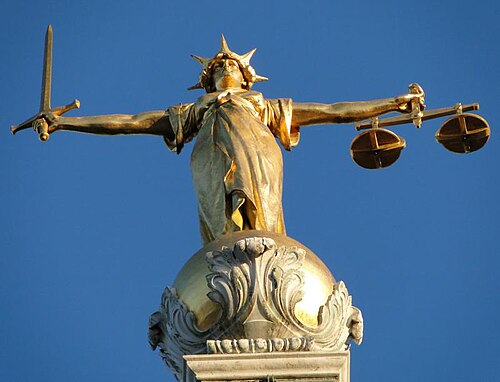
Social justice concerns the fair distribution of rights, opportunities, and resources within a society — going beyond the narrower, more traditional legal idea of justice as simply punishing wrongdoing, to ask whether a society's underlying structures, its laws, institutions, and economic systems, treat people equitably in the first place. The term has roots in 19th-century social teaching and later became central to labor, civil rights, and human rights movements across the 20th century.
A key distinction runs through most modern social justice thinking: equality means giving everyone identical treatment or resources, while equity means giving people what they specifically need to reach the same outcome or starting line, which may mean different treatment for people starting from different circumstances. The distinction sounds abstract until applied concretely — identical funding for two schools, one already well-resourced and one badly under-resourced, produces equality of input but not equity of outcome.
Core question: Do a society's institutions and structures treat people fairly, not just its laws
Key distinction: Equality (same treatment) vs. equity (what's needed for the same outcome)
Roots: 19th-century social teaching, later central to labor and civil rights movements
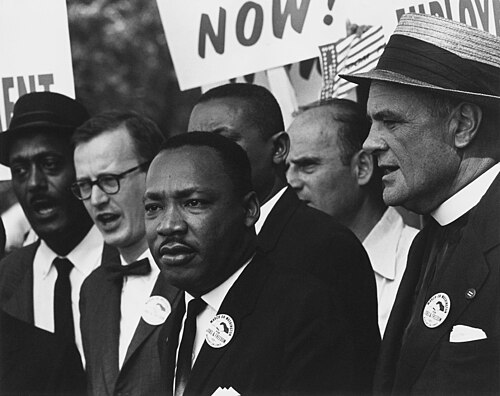
On August 28, 1963, roughly 250,000 people gathered at the March on Washington for Jobs and Freedom, where Martin Luther King Jr. delivered his "I Have a Dream" speech — a pivotal moment in the American civil rights movement's campaign against legal racial segregation and disenfranchisement, which culminated the following year in the Civil Rights Act of 1964 and, in 1965, the Voting Rights Act.
The American civil rights movement is one of many such movements across the 20th century with parallel aims and often direct mutual influence — Mahatma Gandhi's nonviolent resistance campaigns against British colonial rule in India directly shaped King's own philosophy of nonviolent civil disobedience, which in turn influenced later movements against apartheid in South Africa and beyond. None of these movements achieved their aims through a single event; each was the product of sustained organizing, often over decades, by far more people than the individual leaders history tends to remember by name.
Key event: The March on Washington, August 28, 1963 (~250,000 attendees)
Legislative result: Civil Rights Act (1964) and Voting Rights Act (1965)
Global thread: Direct influence chain from Gandhi to King to later global movements
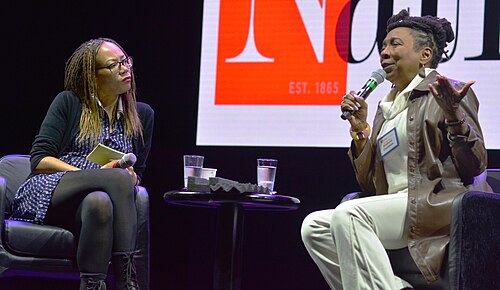
The term "intersectionality" was coined by legal scholar Kimberlé Crenshaw in a 1989 paper, describing how overlapping forms of discrimination — for instance, race and gender together — can compound in ways that neither factor alone fully captures. Crenshaw's original case study examined a lawsuit where Black women couldn't get legal standing for discrimination, because the company could show it hired women (mostly white) and hired Black employees (mostly men), leaving the specific discrimination faced by Black women legally invisible between the two categories.
The concept has since expanded well beyond its original legal context into a widely used framework across sociology, public health, and policy, examining how race, gender, class, disability, sexuality, and other categories combine to shape a person's specific experience of advantage or disadvantage, rather than treating each category as independent and separable.
Coined by: Kimberlé Crenshaw, 1989
Original context: A discrimination lawsuit where overlapping categories left a gap in legal protection
Now used in: Sociology, public health, and policy, well beyond its original legal setting
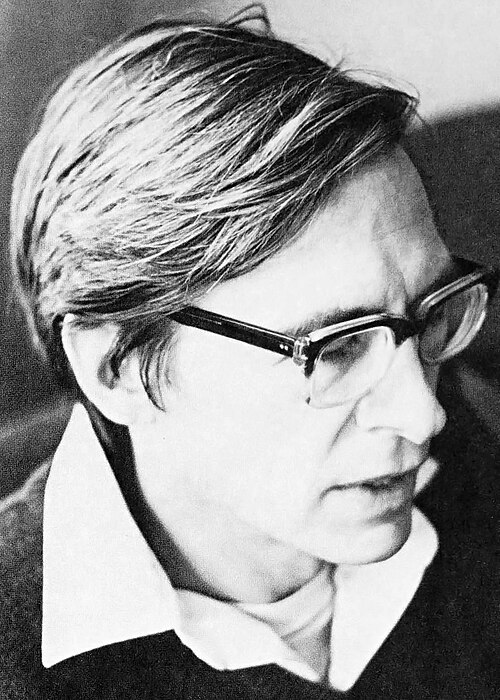
In his landmark 1971 book "A Theory of Justice," philosopher John Rawls proposed a thought experiment for designing a genuinely fair society: imagine you had to choose the rules of a society from behind a "veil of ignorance," not knowing in advance whether you'd be born rich or poor, into a majority or a minority, healthy or disabled. Rawls argued that a rational person in that position, unable to game the system in their own favor, would choose rules that protect the worst-off position in society, precisely because they might end up there themselves.
This "original position" thought experiment became one of the most influential ideas in 20th-century political philosophy, offering a secular, systematic argument for why a just society should be structured to benefit its least advantaged members — not out of charity, but out of the basic logic of fairness applied consistently, echoing questions this site has traced back through Confucian social ethics, Stoic conceptions of the common good, and Buddhist teachings on compassion for the suffering of others.
Key work: "A Theory of Justice" (1971)
Central idea: The "veil of ignorance" thought experiment
Influence: One of the most cited works in 20th-century political philosophy
Every philosophy explored on this site eventually confronts the same question in its own vocabulary: how should people treat one another, and what do we owe to those with less power than ourselves? Social justice is that question asked at the scale of entire societies, not just individual conduct — and like the rest of this site's material, it's less a settled answer than a discipline of ongoing inquiry.
Social justice on Wikipedia · Stanford Encyclopedia: John Rawls · Intersectionality on Wikipedia