Baruch (later Benedict) de Spinoza was born in Amsterdam in 1632 to a family of Portuguese Jews who had fled the Inquisition. In 1656, at twenty-three, his synagogue issued a herem, a writ of expulsion of extraordinary harshness, for his “abominable heresies”. He never returned. He supported himself grinding lenses for microscopes and telescopes, turned down a professorship at Heidelberg in 1673 to keep his freedom of thought, and died at The Hague in 1677, aged 44, probably of a lung disease that the glass dust did not help.
Anonymous portrait, c. 1665, public domain
God or Nature
Spinoza’s Ethics, published just after his death and laid out like a geometry book with definitions, axioms and proofs, argues that there is only one substance, infinite and eternal, which can be called God or Nature. God is not a person outside the world who plans and judges; God is the world’s own necessary order.
“The eternal and infinite Being, which we call God or Nature, acts by the same necessity as that whereby it exists.”Ethics, Part IV, Preface (tr. R. H. M. Elwes)
His contemporaries called this atheism. Later readers, from the German Romantics to Einstein, who said he believed in “Spinoza’s God”, found it deeply religious.
Freedom Through Understanding
Everything, including every human action, follows from causes. Freedom, then, is not escaping necessity but understanding it. A passion that pushes us around loses its grip once we see clearly where it comes from, and a mind that understands is not afraid.
“A free man thinks of death least of all things; and his wisdom is a meditation not of death but of life.”Ethics, Part IV, Proposition 67 (tr. R. H. M. Elwes)
“But all things excellent are as difficult as they are rare.”Ethics, Part V, Proposition 42, note: the last words of the book
Freedom of Thought
In the Theological-Political Treatise (1670), published anonymously, he read the Bible as a historical book written by many human authors, and argued that a state is strongest when it lets people think and speak freely. It was banned almost everywhere. Today it is seen as one of the founding texts of liberal democracy and modern biblical scholarship. Read more on Rationalism.
Key Ideas
Conatus. Every thing strives to persevere in its being (Ethics III, Proposition 6). For us this striving, when we are aware of it, is desire.
Joy and sadness. All our emotions, he argued, are forms of desire, joy (an increase in our power to act) or sadness (a decrease). Love is joy joined to the idea of its cause; hatred is sadness joined to the idea of its cause.
No purposes in nature. In the Appendix to Part I he argues that we imagine nature acts for our benefit because we act for ends ourselves, and that this illusion breeds superstition.
Three kinds of knowledge: imagination (hearsay and vague experience), reason (understanding general laws) and intuition (seeing things in the light of the whole). The last brings the deepest peace, which he calls the intellectual love of God.
Things People Often Get Wrong
“A gloomy determinist.” The Ethics is a philosophy of joy: understanding why things happen frees us from bitterness, regret and fear.
“An atheist.” He wrote constantly about God; what he rejected was a God who rewards, punishes and plans. Whether that is atheism or a deeper religion is still argued.
Where to Start
Begin with the opening pages of his early Treatise on the Improvement of the Understanding, where he describes realising that wealth, fame and pleasure could never satisfy him, and resolving to look for a lasting good. Then read Parts IV and V of the Ethics, on human bondage and freedom.
Check Yourself
Three quick questions on Baruch Spinoza. The wrong answers describe other thinkers on Darshniks.
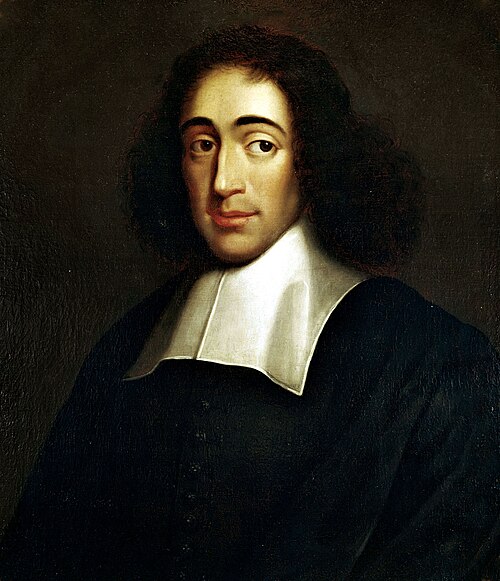 Anonymous portrait, c. 1665, public domain