The carbon in your cells, the oxygen you breathe, the iron in your blood: none of it was there at the beginning of the universe. It was made later, inside stars, and scattered when they died. It is one of the most remarkable discoveries of modern science, and it echoes something the mystics said all along.
The Big Bang made almost only the two lightest elements, hydrogen and helium, with a trace of lithium. Every heavier element had to be built later. That the stars themselves are mostly hydrogen was first shown in 1925 by Cecilia Payne, then a student at Harvard (see Overlooked Scientists).
Stars are furnaces. Their cores fuse hydrogen into helium, then, in bigger stars, helium into carbon and oxygen, and on up to iron. In 1957 four astronomers, Margaret and Geoffrey Burbidge, William Fowler and Fred Hoyle, set out in one famous paper how almost every element is made this way.
Elements heavier than iron need even more violent events. Exploding stars, supernovae, blast them into space, and in 2017 astronomers watched two neutron stars collide and saw signs of gold and platinum being made. That debris drifts, mixes into clouds of gas, and forms new stars and planets: our Sun and Earth formed from such a cloud about 4.6 billion years ago.
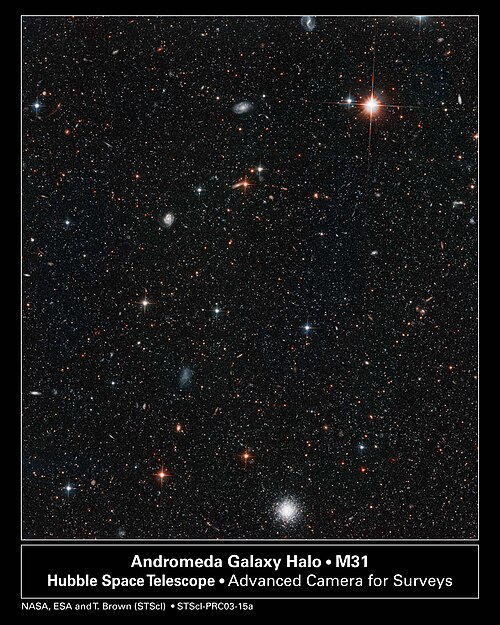 Andromeda: a hundred billion stars, all making new elements
So the calcium in your teeth and the iron in your blood were made in stars that died before the Sun was born. Carl Sagan put it in four words in his television series Cosmos (1980): we are made of star-stuff.
A father teaches his son Svetaketu that the same subtle essence runs through everything, the seed, the river, the salt dissolved in water, and the boy himself:
“That which is that subtile essence, in it all that exists has its self. It is the True. It is the Self, and thou, O Svetaketu, art it.”Chandogya Upanishad 6.8.7 (tr. F. Max Müller)
“… in a manner all things are implicated with one another, and all in this way are friendly to one another.”Marcus Aurelius, Meditations 6.38 (tr. George Long)
The sages did not know about supernovae. But the scientific picture gives their intuition a literal form: you are not a visitor to the universe. You are a part of it that has become able to look at itself.
Continue: Our Place in the Cosmos, The Origin of Life, or The Upanishads.
In 1925 a young astronomer at Harvard, Cecilia Payne, showed in her doctoral thesis that stars are made overwhelmingly of hydrogen and helium, not, as almost everyone assumed, of roughly the same mix as the Earth. A senior astronomer persuaded her to call her result probably “not real”; within a few years it was accepted as correct. Her work is the starting point of the whole story on this page.
Carl Sagan made the phrase “star-stuff” famous in his 1980 television series Cosmos. It is not poetry stretched over a fact; it is simply the fact.
The widths are a sketch, not exact proportions.
Our Sun and its planets formed about 4.6 billion years ago from a cloud already enriched by earlier generations of stars. In about five billion years the Sun will swell into a red giant, then shed its outer layers into space and shrink to a white dwarf. The atoms of the Earth, and of everyone who ever lived on it, may one day drift into new clouds and new stars. Marcus Aurelius pictured the elements endlessly changing into one another; astronomy suggests he was closer to the truth than he could know.
Nucleosynthesis on Wikipedia · The B2FH paper (1957) · NASA: Where do elements come from? · Our Place in the Cosmos
