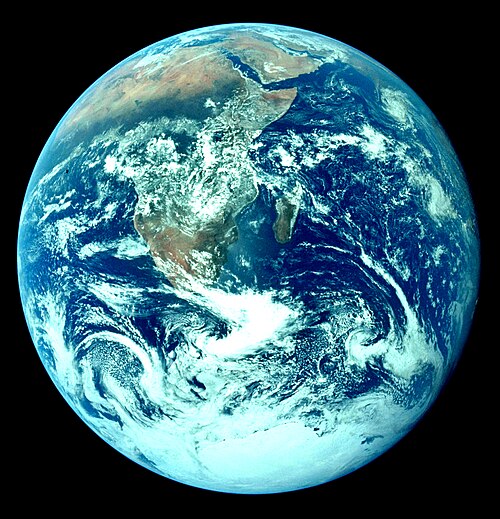
Earth formed about 4.5 billion years ago. Within perhaps a billion years, it was alive. How did lifeless chemistry become the first living cell? It is one of the biggest open questions in science, and every culture has told its own story about it.
The oldest widely accepted signs of life are fossil microbial mats, stromatolites, about 3.5 billion years old, from Western Australia; some scientists argue for traces older still. Life appeared early in Earth’s history, almost as soon as the planet was cool enough.
Darwin’s Origin of Species (1859) explained how life diversified, but not how it began. In a private letter he speculated:
“But if (& oh what a big if) we could conceive in some warm little pond with all sorts of ammonia & phosphoric salts, …”Charles Darwin, letter to Joseph Hooker, 1 February 1871
He went on to imagine light, heat and electricity forming a protein compound that could undergo more complex changes, adding that today such matter would be eaten at once, which could not have happened before living things existed.
In 1952 the chemist Stanley Miller, working with Harold Urey, filled a flask with water and gases thought to resemble the early atmosphere and passed sparks through it, like lightning. Within days it contained amino acids, the building blocks of proteins. It showed that life’s ingredients can form on their own.
RNA world — before DNA and proteins, RNA molecules may have both carried information and done chemical work, copying themselves
Hydrothermal vents — hot, mineral-rich springs on the sea floor provide energy and natural compartments
Panspermia — life’s ingredients, or even microbes, may have arrived on meteorites; organic molecules have been found in some
No one has yet made life from scratch in a laboratory, and how the first self-copying cell arose is still unknown.
“… from so simple a beginning endless forms most beautiful and most wonderful have been, and are being, evolved.”Charles Darwin, On the Origin of Species (1859), final sentence
The Rig Veda’s Hymn of Creation asks where everything came from and admits that perhaps even the highest does not know (see Where Did It All Come From?). Genesis describes life created by God’s word, day by day. Aristotle thought simple creatures arose spontaneously from mud and decay, an idea that survived until Louis Pasteur disproved it with his swan-necked flasks in the 1860s. Many traditions picture life emerging from water, from an egg or from the union of earth and sky.
Science and the stories ask different questions. Science asks how; the stories ask why there is anything, and what we owe to the living world. Both are still open.
Continue: We Are Made of Stardust, Are We Alone?, or Big Questions.
For two thousand years people believed that simple life arose on its own from mud, meat or grain: maggots from rotting meat, mice from old rags. In the early 1860s Louis Pasteur boiled broth in flasks with long, curved, swan-like necks that let air in but trapped dust. The broth stayed lifeless; when he broke the neck, microbes soon grew. Life, at least today, comes only from life. That made the question of the first life sharper, not easier.
Defining life turns out to be surprisingly hard. In 1944 the physicist Erwin Schrödinger’s small book What Is Life? argued that living things keep their order by drawing it from their surroundings, and that heredity must be stored in an “aperiodic crystal”, an idea that inspired the young scientists who later found the structure of DNA. A working definition used by NASA describes life as a self-sustaining chemical system capable of Darwinian evolution. Viruses sit awkwardly on the border.
Abiogenesis on Wikipedia · Darwin’s letter to Hooker (Darwin Correspondence Project) · Miller–Urey experiment · On the Origin of Species (Project Gutenberg)