How did people without machines raise stones weighing hundreds of tonnes, and why? Pick one below.
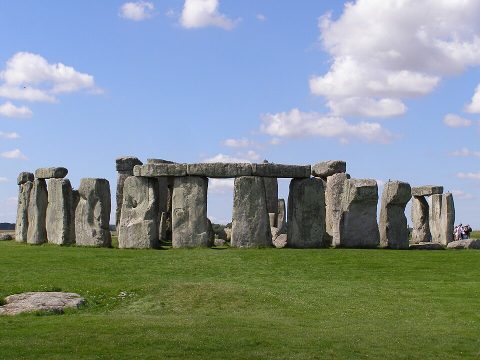
Stonehenge in southern England was built in stages over more than a thousand years, from around 3000 BCE, with the great stone circle raised around 2500 BCE. Its axis lines up with sunrise at midsummer and sunset at midwinter, and it was likely a place of ceremony and burial for the dead.
Its large sarsen stones came from about 25 kilometres away, but the smaller “bluestones” were brought around 240 kilometres from the Preseli Hills in Wales. In 2024 a study in Nature showed that the six-tonne Altar Stone came from north-east Scotland, over 700 kilometres away, an astonishing journey, probably by land or by sea along the coast. How exactly they moved the stones is still studied, but sledges, rollers, ropes and many people are enough to explain it.
Built: From c. 3000 BCE; stone circle c. 2500 BCE
Bluestones from: Preseli Hills, Wales (about 240 km)
Altar Stone from: North-east Scotland (shown 2024)
Darshniks’ Take: We now know where its stones came from, some from hundreds of kilometres away. That people moved them without machines is the real marvel.
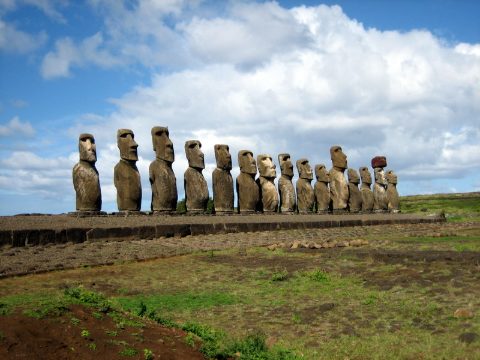
On Rapa Nui (Easter Island), people of Polynesian descent carved nearly 1,000 giant stone statues, called moai, mostly between about 1250 and 1500 CE. Almost all were cut from a single volcanic crater, Rano Raraku, and many stand on stone platforms, facing inland as if watching over the villages. They are thought to represent honoured ancestors.
Island oral tradition said the moai “walked” to their places. In 2012 archaeologists Terry Hunt and Carl Lipo, with a team, showed that a replica moai could be moved upright by a few dozen people with ropes, rocking it from side to side so that it waddled forward. The idea that the islanders destroyed their society by cutting trees to move moai has also been challenged; European diseases and slave raids did far more harm.
Number: Nearly 1,000 statues
Carved: Mostly c. 1250–1500 CE
Moved: Probably “walked” upright with ropes
Darshniks’ Take: The islanders carved and “walked” their statues, and modern experiments support their own oral tradition. The old story of self-destruction is being rewritten.
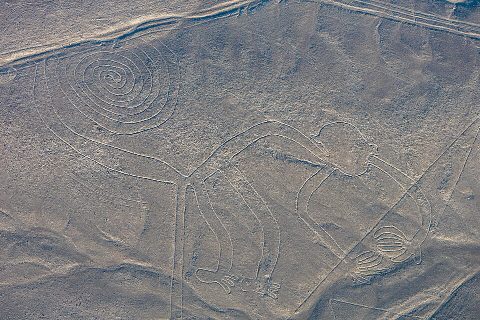
In the desert of southern Peru, the Nazca people, around 500 BCE to 500 CE, made hundreds of lines, geometric shapes and giant figures, including a monkey, a hummingbird and a spider, by removing the dark surface stones to expose the lighter ground beneath. The dry, windless climate has preserved them for two thousand years.
Because many figures are best seen from the air, they inspired claims about ancient astronauts. But experiments have shown that the figures can be laid out with simple tools: stakes, cords and careful measurement from a small drawing. Many archaeologists think they were walked as ritual paths, linked to water and fertility. In 2024 researchers using AI to analyse aerial images reported more than 300 previously unknown figures.
Made by: The Nazca culture, c. 500 BCE–500 CE
Where: Southern Peru
New finds: 2024: hundreds more figures found with AI help
Darshniks’ Take: Made by the Nazca people with simple tools, as experiments show. What they meant to their makers is the genuinely interesting open question.

At Baalbek in Lebanon stand the ruins of one of the largest temple complexes of the Roman Empire, dedicated to Jupiter, built mainly in the 1st century BCE and 1st century CE. Its podium includes the “Trilithon”, three limestone blocks each weighing around 800 tonnes, lifted several metres off the ground.
In the nearby quarry lie even bigger blocks that were never moved, including the “Stone of the Pregnant Woman” and another found in 2014, weighing perhaps 1,650 tonnes, among the largest stones ever cut by humans. Their size feeds claims of lost technology, but the quarry shows exactly how they were cut, and Roman engineers had cranes, levers and huge labour forces. That some blocks were abandoned suggests that even they reached their limits.
Built: Mainly 1st century BCE–1st century CE (Roman)
Trilithon blocks: About 800 tonnes each
Largest quarried block: About 1,650 tonnes (found 2014)
Darshniks’ Take: Gigantic, but Roman, with the quarry showing how it was done. Unfinished blocks suggest even Roman engineers found their limits.
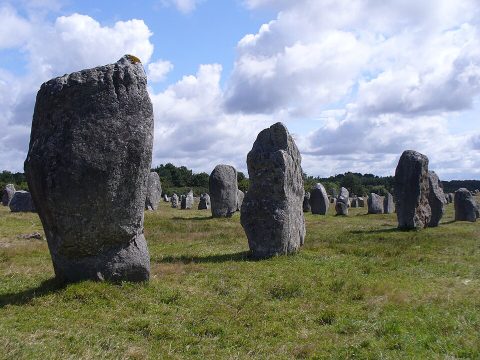
Near the village of Carnac in Brittany, France, stand more than 3,000 standing stones, arranged in long parallel rows that stretch for kilometres, along with burial mounds and dolmens. Most were raised in the Neolithic period, roughly between 4500 and 3300 BCE, making some older than Stonehenge.
A local legend says they are Roman soldiers turned to stone by Saint Cornelius. Archaeologists do not know for certain what the rows were for: suggestions include processional routes, territorial markers and astronomical alignments. In 2023 the removal of some stones for a shop project caused an outcry, a reminder of how easily such sites can be lost.
Where: Brittany, France
Number: More than 3,000 standing stones
Date: Roughly 4500–3300 BCE
Darshniks’ Take: Clearly human-made and very old; what the long rows were for is still unknown. Its partial destruction in 2023 shows how fragile even stone heritage is.
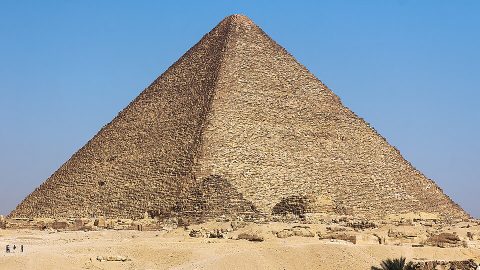
Built for the pharaoh Khufu around 2560 BCE, the Great Pyramid was the tallest human-made structure on Earth for nearly four thousand years. It contains around 2.3 million blocks. Claims that it was built by aliens or a lost civilisation ignore a great deal of evidence.
We know where the workers lived: archaeologists have excavated their town, bakeries and cemeteries near the plateau, and they were organised labourers, not slaves. In 2013 a team led by Pierre Tallet found the oldest inscribed papyri ever discovered, at Wadi al-Jarf on the Red Sea: the logbook of an official named Merer, recording how his crew shipped limestone blocks along the Nile to Giza for Khufu’s pyramid. Exactly how the blocks were raised, by straight, zigzag or internal ramps, is still debated.
Built: c. 2560 BCE, for Khufu
Blocks: About 2.3 million
Key evidence: Diary of Merer (papyri found 2013)
Darshniks’ Take: We know the workers’ town and even have a logbook of stone deliveries. Exactly how the blocks were raised is debated, but who built it is not.
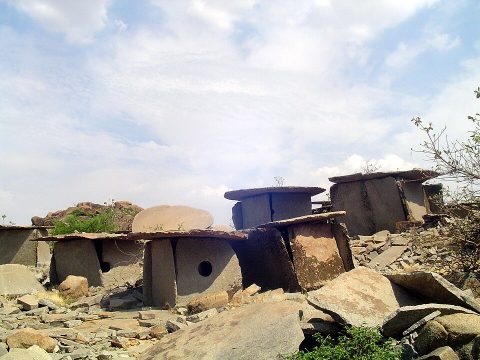
On a rocky hillside in Koppal district, Karnataka, lies one of the largest megalithic sites in India: hundreds of stone burial structures, mostly dolmens built of large slabs, from the Iron Age, roughly 800 to 200 BCE. Some have round “port-holes” cut in a side slab, perhaps for offerings or for the spirits of the dead.
Megaliths like these are found across peninsular India, linked to burial customs of the Iron Age. Hire Benakal is less famous than Stonehenge, but in many ways just as remarkable. Local people call the site “Moryar Mane”, houses of the Moryas, a legendary short people. It has been proposed for UNESCO World Heritage status, and parts of it are damaged by quarrying and neglect.
Where: Koppal district, Karnataka
Date: Iron Age, roughly 800–200 BCE
Type: Hundreds of dolmens and stone burials
Darshniks’ Take: One of India’s great prehistoric sites, under-visited and under-protected. It deserves the same care and pride as Stonehenge.
Every monument here was built by people with simple tools, deep knowledge of their materials and the ability to organise large groups over years or generations. That is the real “lost technology”: not machines, but cooperation. Calling these achievements impossible takes credit away from the people who actually made them.
Stonehenge on Wikipedia · Moai on Wikipedia · Hire Benakal on Wikipedia
