Swami Vivekananda was born Narendranath Datta in Calcutta on 12 January 1863, into a well-to-do family. A brilliant, restless student of Western philosophy and science, he joined the reformist Brahmo Samaj and asked everyone he met the same question: had they seen God? In 1881 he met Ramakrishna, who answered that he had — and Narendranath became his most important disciple.
After Ramakrishna’s death in 1886, Narendranath took monastic vows with his fellow disciples. From 1888 to 1893 he wandered the length of India on foot, living on alms. The poverty he saw convinced him that spirituality had to go together with practical service to the poor.
“Sisters and Brothers of America —”Opening words of Vivekananda’s address to the Parliament of the World’s Religions, Chicago, 11 September 1893
At the Parliament of the World’s Religions in Chicago, the young monk’s greeting brought the audience to its feet. His message of religious harmony and Vedanta made him famous overnight, and he spent the next years lecturing in the United States and Britain, founding the Vedanta Society of New York in 1894 and publishing Raja Yoga in 1896.
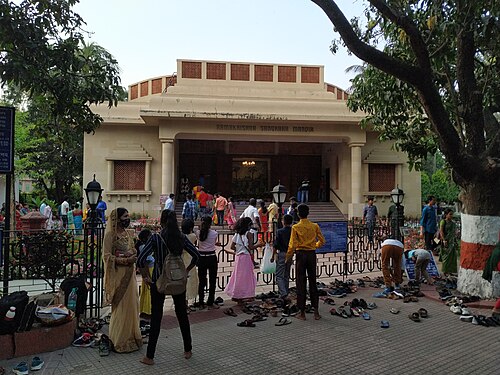 Libreravi, CC BY-SA 4.0
“Each soul is potentially divine. The goal is to manifest this Divinity within by controlling nature, external and internal.”Vivekananda, Raja Yoga (1896), preface
Back in India in 1897, he founded the Ramakrishna Mission, which combines monastic life with schools, hospitals and disaster relief; its headquarters at Belur Math followed in 1898. Worn out by work and illness, he died on 4 July 1902, aged just 39.
Vivekananda took a teaching of Ramakrishna's — to serve living beings as God, not merely pity them — and turned it into a programme. He popularised the phrase Daridra Narayana, “God in the form of the poor”, and told his monks that hungry people need bread before they need religion. Worship, for him, included running famine relief, schools and hospitals.
 Illustration: service as worship: seeing the divine in those you serve
“Religion is not in doctrines, in dogmas, nor in intellectual argumentation; it is being and becoming.”Vivekananda, Complete Works
Vivekananda believed India's deepest problem was not poverty alone but a loss of confidence. He called for “man-making” education that would build character, self-reliance and fearlessness as well as skills, and he wanted the best of Western science joined to India's spiritual heritage. Physical vigour mattered too: young men, he joked, would come closer to the Gita through football than through study.
“The world is the great gymnasium where we come to make ourselves strong.”Vivekananda, Complete Works
He was equally firm about women's education, arguing that no nation could rise while half its people were kept back. His Irish disciple Margaret Noble, known as Sister Nivedita, opened a school for girls in Calcutta in 1898 with his encouragement.
At the Parliament of the World's Religions near the end of his first speech he quoted a Hindu hymn picturing the faiths as rivers flowing to one sea, and he argued that religions should accept one another, not merely tolerate. In the West he taught small groups as well as huge audiences, and his talks became the books Karma Yoga, Bhakti Yoga, Raja Yoga and Jnana Yoga.
 Illustration: many streams, one sea: his image of the religions at Chicago
“As the different streams having their sources in different places all mingle their water in the sea, so, O Lord, the different paths which men take... all lead to Thee.”Vivekananda at Chicago, 11 September 1893, quoting a Hindu hymn
His influence reached far beyond religion. Leaders of the Indian freedom movement, from Bal Gangadhar Tilak to Subhas Chandra Bose, drew on his call to fearlessness, and the French writer Romain Rolland wrote a biography of him (1930) that introduced him to a new generation of European readers.
Vivekananda shaped modern Hinduism and the Western understanding of Indian thought more than almost anyone of his time. India celebrates his birthday, 12 January, as National Youth Day.
Swami Vivekananda on Wikipedia · Vivekananda: quotes and lessons · Vedanta
