Science can explain how the brain processes light, sound and memory. What it cannot yet explain is why any of it feels like something: why there is an inner life at all. That puzzle is called the hard problem of consciousness, and it may be the deepest question there is.
In 1974 the philosopher Thomas Nagel asked, “What is it like to be a bat?” A bat finds its way by echoes; we could learn every fact about its brain and still not know what that experience is like from the inside. In 1995 David Chalmers named this the hard problem: explaining how the brain does things is hard enough, but explaining why those processes are accompanied by experience at all seems to be a different kind of problem.
The puzzle is old. In 1714 Leibniz imagined a thinking machine enlarged to the size of a mill, so that you could walk inside it. You would see only parts pushing on one another, he argued, and nothing that would explain a perception (Monadology §17). Three centuries later, this is close to how the debate about artificial intelligence still runs.
For Descartes, consciousness was the first certainty, the one thing that survives all doubt: I think, therefore I am. But it left him with a mind and a body that seemed to be two different kinds of thing.
“It is nothing jointed; it flows. A ‘river’ or a ‘stream’ are the metaphors by which it is most naturally described.”William James, The Principles of Psychology (1890), ch. IX
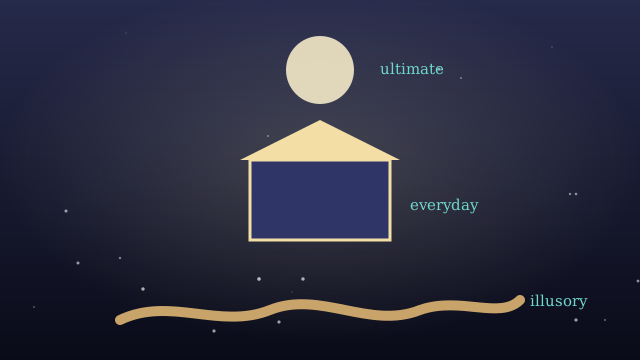 Illustration: waking, dreaming, deep sleep
Indian philosophy put consciousness at the centre. The Mandukya Upanishad describes four states: waking, dreaming, dreamless sleep, and a fourth, turiya, pure awareness underlying the other three. For Advaita Vedanta, consciousness is not something the brain produces but the fundamental reality itself, the Self that is Brahman.
Buddhism took the opposite route: look closely and you find no permanent self behind experience, only a stream of momentary events of awareness, a view strikingly close to Hume’s “bundle of perceptions”.
Researchers now study the “neural correlates of consciousness”: what changes in the brain when we become aware of something. Leading theories include the global workspace theory, in which consciousness is information broadcast across the brain, and integrated information theory, which tries to measure how unified a system is. None yet explains why experience feels like anything, and whether animals, newborns or future machines are conscious remains unsettled.
Continue: Big Questions, Can a Machine Think?, or The Upanishads.
Buddhist teachers described consciousness not as a fixed self but as a stream of moments, each arising with its object and passing away, a view surprisingly close to William James’s stream. Advaita Vedanta went the other way: the passing contents change, but the awareness that knows them never does, and that awareness is what you truly are. Both traditions agree on one practical point: you can study consciousness directly, from the inside, by paying careful attention to it.
Hard problem of consciousness · Stanford Encyclopedia: Consciousness · What Is It Like to Be a Bat? · William James, Principles of Psychology (Project Gutenberg)